
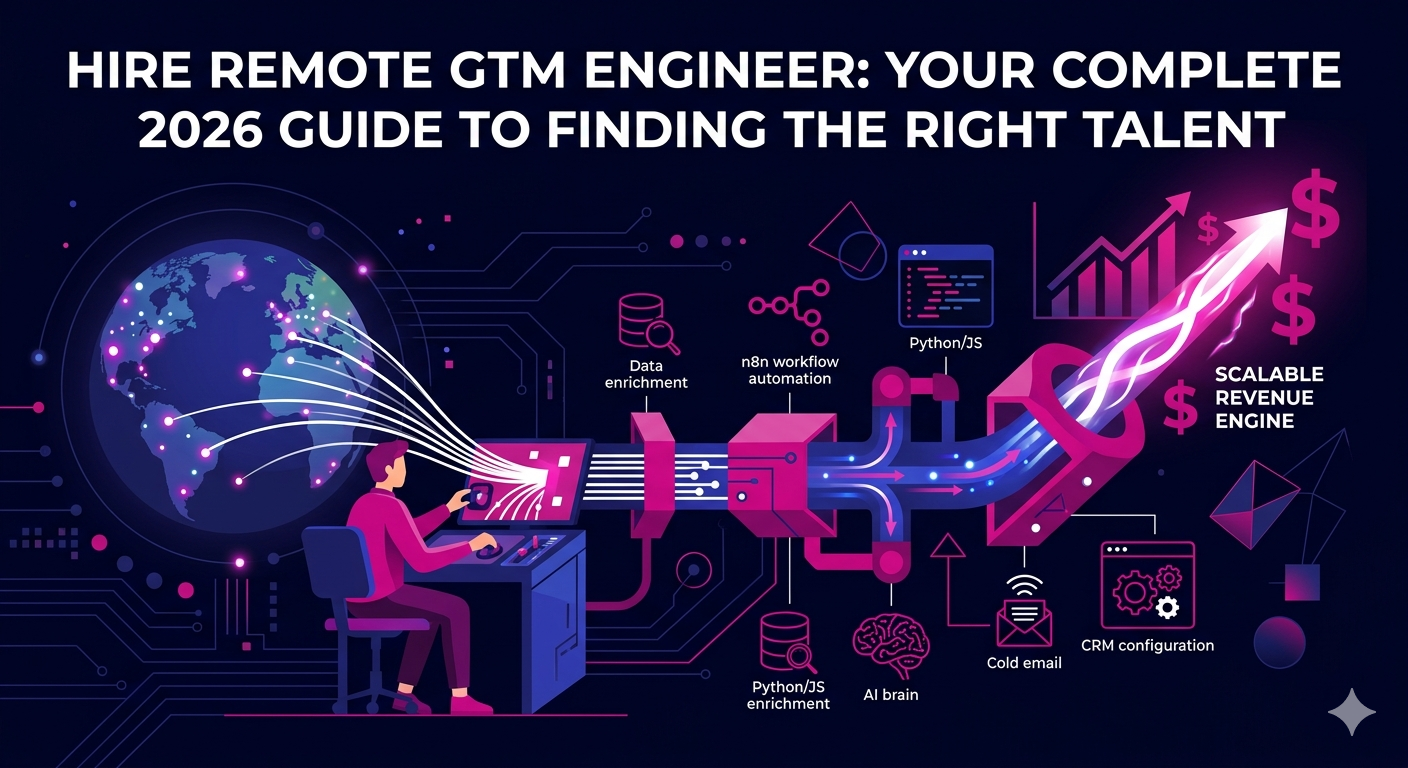
The decision to hire a remote GTM engineer is one of the highest-leverage moves a B2B company can make in 2026. As go-to-market motions become increasingly technical and automation-dependent, having a skilled GTM engineer on your team, regardless of where they sit in the world, can be the difference between a stagnant pipeline and a scalable revenue engine.
But finding, evaluating, and onboarding the right person is not straightforward. This guide covers everything you need to know: what to look for, where to search, how to assess candidates, and how to set your new hire up for success from day one.
Why More Companies Are Choosing to Hire Remote GTM Engineers
The shift toward remote hiring in technical go-to-market roles has accelerated significantly over the past two years. Here is what is driving it:
Access to a Global Talent Pool
When you limit your search to local candidates, you dramatically shrink the number of qualified people you can consider. GTM engineering is a niche discipline. The best practitioners are scattered across time zones. Hiring remotely means you are competing for the top 1% globally, not just in your city.
Cost Efficiency Without Quality Trade-Offs
Hiring a remote GTM engineer, particularly from talent-dense markets outside the United States and Western Europe, can reduce salary costs by 30 to 60 percent compared to local hires. Critically, this is not about cutting corners. The remote talent market has matured, and you can find world-class engineers at highly competitive rates.
Faster Time to Productivity
Experienced remote professionals are typically self-directed and comfortable working asynchronously. A skilled remote GTM engineer can often start delivering value within the first two weeks because they are used to ramping quickly in distributed environments.
What to Look for When You Hire a Remote GTM Engineer
Not every technical hire is right for the GTM engineering role. Here are the specific attributes you should prioritize during your search:
Technical Proficiency Across the GTM Stack
Your ideal candidate should have hands-on experience with the tools that power modern go-to-market operations. Look for demonstrated expertise with:
- Data enrichment platforms such as Clay, Apollo, and Clearbit
- Workflow automation tools including n8n, Make, and Zapier
- CRM platforms like HubSpot and Salesforce, including custom configuration
- Cold email infrastructure and deliverability management
- Scripting languages, particularly Python and JavaScript
- AI and LLM integrations for personalization at scale
Commercial Mindset
A GTM engineer who only thinks like a developer will struggle in this role. The best candidates understand pipeline metrics, conversion rates, and buyer psychology. They ask questions like “What outcome are we trying to drive?” rather than just “What should I build?”
Proven Remote Work Experience
When you hire a remote GTM engineer, their remote work track record matters as much as their technical skills. Look for candidates who can demonstrate asynchronous communication habits, a structured daily workflow, and a history of delivering results without direct supervision.
Portfolio of Past Systems and Automations
Strong candidates will be able to show you examples of outbound systems they have built, workflows they have automated, or revenue improvements they have contributed to. Ask for case studies, Loom walkthroughs, or documentation of past projects during the interview process.
Where to Find Remote GTM Engineers in 2026
Knowing what you are looking for is one thing. Knowing where to find it is another. Here are the most effective sourcing channels in 2026:
Specialized Remote Staffing Partners
The most efficient path to a qualified hire is often through a staffing partner that specializes in remote go-to-market talent. These firms pre-vet candidates, understand the role deeply, and can significantly shorten your time to hire. If you are serious about making the right hire quickly, this is where to start.
Hire a remote GTM engineer through The Remote Reps, a staffing partner that specializes exclusively in remote go-to-market talent and provides pre-vetted candidates matched to your specific needs.
Community-Based Sourcing
The GTM engineering community has grown rapidly in 2025 and 2026. Active communities on Slack, Discord, and LinkedIn are where top practitioners share their work, exchange ideas, and look for new opportunities. Posting in these spaces, or having your staffing partner do so, can surface strong candidates quickly.
LinkedIn Outreach
Boolean search on LinkedIn remains a reliable method for finding remote GTM engineers. Search for combinations of terms like “GTM engineer,” “sales automation,” “Clay expert,” and “outbound infrastructure.” Candidates who are actively posting content about their work are often the most engaged and skilled practitioners.
Referrals From Your Network
If you already have a strong revenue team, your existing sales engineers, RevOps managers, or SDR leads likely know people in the GTM engineering space. A personal referral often leads to a higher-quality hire than any job board.
How to Evaluate Remote GTM Engineer Candidates
The interview process for a remote GTM engineer should be different from a standard technical or sales hire. Here is a process that works:
Step 1: Screen for Foundational Knowledge
Start with a 30-minute screening call focused on their experience with the GTM stack. Ask them to walk you through a system they have built from scratch. Listen for specificity. Vague answers are a red flag.
Step 2: Assign a Paid Technical Assessment
Give candidates a real-world problem to solve. For example, ask them to map out an outbound automation workflow for a specific ICP, or to diagnose a cold email deliverability issue based on a scenario you provide. Pay for their time. The quality of their solution will tell you everything you need to know.
Step 3: Evaluate Communication and Async Skills
Since you are hiring remotely, how they communicate is just as important as what they know. Ask them to submit their technical assessment as a written document or Loom video. This gives you a direct window into how they will communicate as a remote team member.
Step 4: Check References Rigorously
Ask references specifically about the candidate’s ability to work independently, manage competing priorities, and deliver on commitments without close supervision. Remote work amplifies both strengths and weaknesses, so reference checks are critical.
Onboarding Your Remote GTM Engineer for Success
A strong hire can still underperform if the onboarding process is poorly designed. Here is how to set your remote GTM engineer up for a fast and effective start:
Provide Clear Documentation of Existing Systems
Before their first day, document your current tech stack, existing workflows, and any known issues or gaps. The faster they can understand the current state, the faster they can start improving it.
Define a 30-60-90 Day Plan
Give your new hire a structured plan with clear milestones. In the first 30 days, focus on learning the systems and identifying quick wins. In days 31 to 60, have them build or improve one key workflow. By day 90, they should be driving measurable improvements in pipeline or efficiency.
Establish Communication Rhythms Early
Set up regular check-ins, a shared project management space, and clear norms around response times and async communication. Good remote work infrastructure removes friction and lets your GTM engineer focus on what they do best.
According to LinkedIn’s research on remote hiring trends for technical roles, companies with structured onboarding programs for remote technical hires see significantly higher retention and faster time to full productivity compared to those with informal processes.
The Cost of Waiting to Hire a Remote GTM Engineer
Every month you delay is a month your competitors are building systems you do not have. In 2026, the compounding advantage of a well-built GTM infrastructure is enormous. AI-powered personalization, automated enrichment pipelines, and optimized outbound sequences do not happen by themselves. A skilled remote GTM engineer makes them happen.
The question is not whether you can afford to hire one. It is whether you can afford not to.
FAQ: How to Hire a Remote GTM Engineer
How long does it typically take to hire a remote GTM engineer?
The timeline to hire a remote GTM engineer depends heavily on your sourcing strategy. Using a specialized staffing partner can reduce the process to two to four weeks. Going through job boards or LinkedIn outreach alone can take two to three months, especially given the high demand for skilled GTM engineers in 2026.
What is a fair salary range when you hire a remote GTM engineer?
Compensation varies based on experience level and location. Remote GTM engineers based in the United States typically command between $90,000 and $150,000 per year for full-time roles. Remote hires from other regions can be significantly more affordable while still delivering excellent results, often ranging from $30,000 to $70,000 annually depending on the market.
Should I hire a remote GTM engineer full-time or on a contract basis?
For most companies, starting with a contract or fractional engagement makes sense if you are still validating your go-to-market systems. Once you have a clear picture of the scope and ongoing needs, transitioning to a full-time remote GTM engineer gives you more continuity and deeper institutional knowledge.
What are the biggest mistakes companies make when they hire a remote GTM engineer?
The most common mistakes include hiring based on general technical skills rather than GTM-specific experience, skipping a technical assessment, and failing to provide structured onboarding. Another frequent issue is not defining clear success metrics upfront, which makes it hard to evaluate performance and course-correct quickly.
How do I know if a remote GTM engineer candidate is truly qualified?
Ask them to walk you through a specific system they have built, from initial strategy through execution and results. A genuinely qualified remote GTM engineer will be able to give you a detailed, outcome-focused walkthrough with specific metrics. If their answers are vague or generic, that is a strong signal to keep looking.
Can a remote GTM engineer work across multiple time zones effectively?
Yes, and many of the best remote GTM engineers already do. The key is establishing clear async communication norms and ensuring there is a reasonable overlap window for real-time collaboration. Most GTM engineering work is project-based and does not require constant synchronous availability.
Final Thoughts
The decision to hire a remote GTM engineer is not just a staffing decision. It is a strategic investment in the infrastructure that powers your entire revenue motion. Done right, it pays dividends for years in the form of better data, smarter outbound, and a sales team that consistently outperforms the competition.
Start with a clear picture of what you need, use the right sourcing channels, evaluate rigorously, and onboard with intention. The right remote GTM engineer is out there, and with the right process, you can find them faster than you think.