
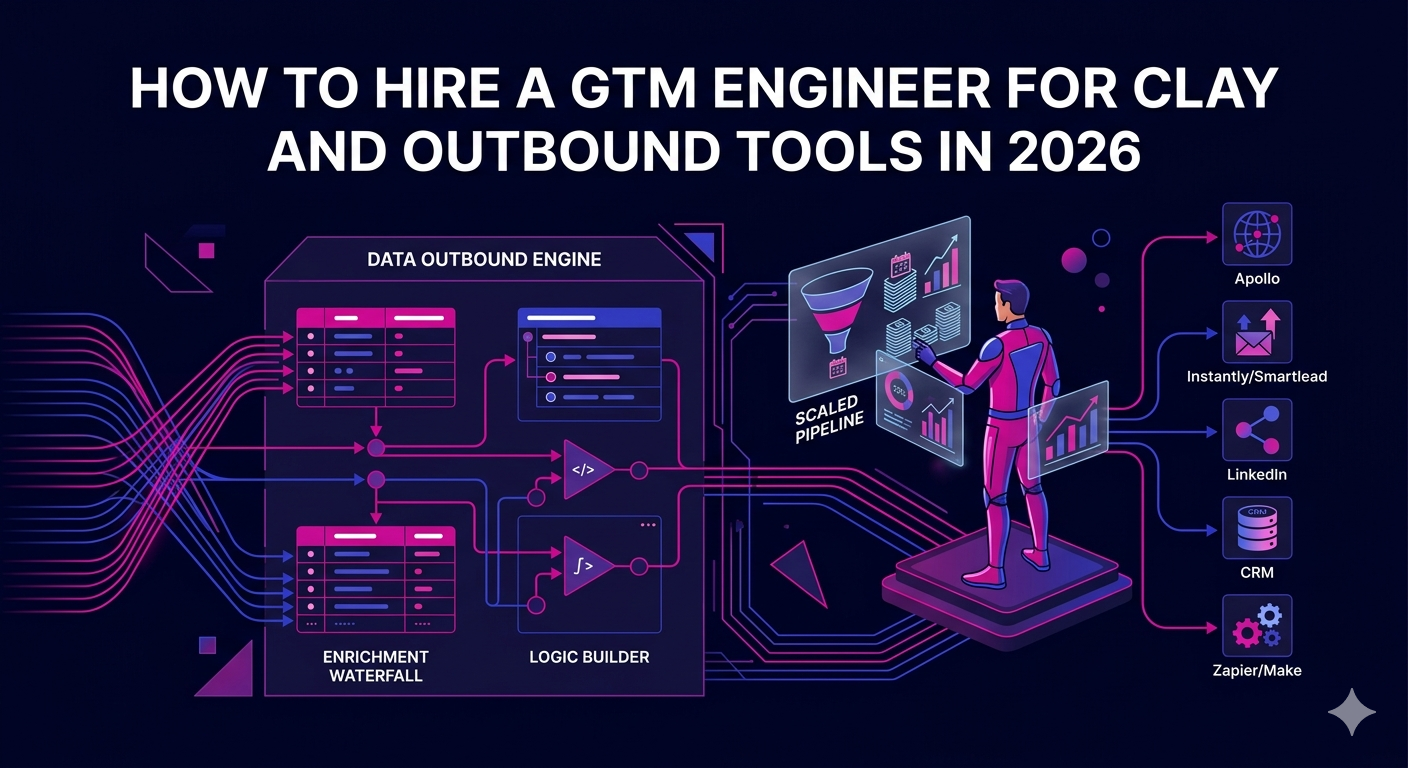
If your outbound sales motion is falling flat, the problem might not be your offer or your team. It might be the infrastructure powering it. In 2026, the most competitive B2B companies are investing in a specialized role that sits at the crossroads of sales strategy and technical execution: the GTM engineer. Specifically, businesses that want to scale outbound are rushing to hire a GTM engineer for Clay and outbound tools who can turn complex data workflows into booked meetings.
This guide breaks down exactly what a GTM engineer does, why Clay expertise matters, what to look for when hiring, and how to get the best talent fast.
What Is a GTM Engineer and Why Does the Role Matter in 2026?
A go-to-market (GTM) engineer is a hybrid professional who combines technical skills with a deep understanding of sales and marketing systems. Unlike a traditional developer or a typical SDR, a GTM engineer builds and optimizes the technology stack that powers outbound campaigns, lead enrichment pipelines, and automated prospecting workflows.
In 2026, the B2B outbound landscape is more sophisticated than ever. Buyers tune out generic cold emails. Personalization at scale is now table stakes. That is why companies are looking to hire GTM engineers who know how to use tools like Clay, Apollo, Instantly, Smartlead, and LinkedIn Sales Navigator in combination to create hyper-targeted outreach.
The Rise of Clay in Outbound Workflows
Clay has emerged as one of the most powerful data enrichment and workflow automation platforms for outbound teams. It allows GTM engineers to pull data from dozens of sources, run enrichment waterfalls, trigger conditional logic, and push personalized records directly into your outreach sequences.
A skilled GTM engineer who knows Clay can build workflows that would otherwise require a full data engineering team. That is a significant competitive advantage, which is exactly why demand to hire GTM engineers for Clay and outbound tools has surged throughout 2025 and into 2026.
Key Responsibilities of a GTM Engineer for Outbound
When you hire a GTM engineer for Clay and outbound tools, here is what you can expect them to own:
- Building and managing Clay tables, enrichment waterfalls, and data pipelines
- Integrating outbound tools such as Instantly, Smartlead, Apollo, and LinkedIn automation platforms
- Setting up and optimizing cold email infrastructure including domain warm-up and deliverability monitoring
- Writing and testing personalization variables and dynamic snippets for sequences
- Connecting CRMs such as HubSpot or Salesforce to outbound workflows via APIs or Zapier
- Analyzing campaign data and iterating on sequence performance
- Collaborating with SDRs and account executives to align technical workflows with pipeline goals
This is not a role you can hand off to a generalist. The tools are evolving rapidly, and expertise in Clay specifically requires hands-on experience with its no-code logic builder, HTTP integrations, and enrichment provider ecosystem.
What Skills to Look for When Hiring a GTM Engineer
Technical Skills That Signal Real Expertise
When evaluating candidates for a GTM engineering role focused on Clay and outbound tools, prioritize these technical competencies:
- Clay proficiency: Can they build multi-step enrichment workflows, use conditional branching, and connect Clay to external APIs?
- Cold email infrastructure: Do they understand SPF, DKIM, DMARC, and sending domain management?
- Sequencer platforms: Have they worked with Instantly, Smartlead, Lemlist, or comparable tools?
- Data sourcing: Can they identify and pull high-quality lead data from Apollo, LinkedIn, ZoomInfo, or custom scrapers?
- API and automation: Are they comfortable with Zapier, Make, or basic API calls to connect platforms?
- CRM integration: Do they have experience syncing outbound activity with HubSpot, Salesforce, or Pipedrive?
Soft Skills That Separate Good from Great
Beyond the tools, the best GTM engineers bring a strategic mindset. Look for candidates who ask about your ICP before building anything, who think in terms of pipeline outcomes rather than just task completion, and who can communicate clearly with non-technical stakeholders. The ability to iterate quickly based on data is essential in a role where sequence performance can shift week to week.
Where to Find Top GTM Engineers with Clay Expertise
Finding a GTM engineer who genuinely knows Clay and modern outbound tooling is not as simple as posting on LinkedIn. The talent pool is specialized, and the best candidates are usually already working somewhere or are selective about new opportunities.
Your best options in 2026 include:
- Specialized remote staffing agencies that pre-vet sales tech talent
- Niche communities like Clay’s official Slack group, Outbound Squad, and GTM-focused Discord servers
- Referrals from other operators running high-performance outbound teams
- Freelance platforms with filtering by tool-specific expertise
Working with a specialized agency is often the fastest route because the vetting is already done. If you want to explore pre-vetted options, you can browse available GTM engineers for Clay and outbound tools at The Remote Reps, a platform that connects companies with qualified remote sales and GTM talent.
Full-Time vs. Fractional: Which Hiring Model Makes Sense?
Not every company needs a full-time GTM engineer on day one. Fractional or contract GTM engineers are a smart option if you are still validating your outbound motion, operating with a lean team, or need to move quickly without a lengthy hiring process.
A fractional GTM engineer can typically be onboarded within days and start building Clay workflows within the first week. Once you have proven ROI, transitioning to a full-time hire becomes a much easier internal sell.
On the other hand, if outbound is central to your growth strategy and you are running multiple sequences across different segments simultaneously, a dedicated full-time hire will deliver significantly more output and institutional knowledge over time.
How to Structure Compensation for a GTM Engineer in 2026
Compensation for GTM engineers varies based on experience level, tool depth, and whether the role is remote or hybrid. In 2026, typical ranges for professionals with strong Clay and outbound tool expertise look like this:
- Junior or entry-level GTM engineer: $55,000 to $75,000 per year
- Mid-level GTM engineer with 2 to 4 years of experience: $80,000 to $110,000 per year
- Senior GTM engineer with deep Clay and multi-tool expertise: $120,000 to $160,000 per year
- Fractional or contract rate: $75 to $150 per hour depending on scope
Remote-first companies hiring from global talent pools can often access strong candidates at more competitive rates without sacrificing quality. This is a key advantage of working with a remote staffing partner.
According to Clay’s official resources for GTM teams using Clay and outbound tools, companies that invest in dedicated Clay operators see significantly higher personalization output and pipeline velocity compared to teams without a dedicated technical operator.
Common Mistakes to Avoid When Hiring for This Role
Here are the pitfalls that cost companies time and money when trying to hire a GTM engineer for Clay and outbound tools:
- Hiring a generalist marketer and expecting them to learn Clay quickly without support
- Posting a job description that conflates GTM engineering with sales operations or marketing automation
- Skipping a skills test or paid trial project before making an offer
- Underestimating the onboarding time needed to align the engineer with your ICP, messaging, and tech stack
- Failing to give the engineer access to the tools and data they need to do their job effectively
The best hiring processes for this role include a short paid project where candidates demonstrate their Clay workflow-building ability on a realistic task. This filters out resume inflation fast.
FAQ Section
What does it mean to hire a GTM engineer for Clay and outbound tools?
To hire a GTM engineer for Clay and outbound tools means bringing on a specialist who can build and manage technical workflows that power outbound sales. This includes setting up data enrichment pipelines in Clay, configuring outreach sequencers, and integrating your CRM with your outbound stack to create a seamless and personalized prospecting engine.
How long does it take to hire a GTM engineer for Clay and outbound tools?
The timeline varies depending on your hiring channel. Through a specialized remote staffing platform, you can typically hire a GTM engineer for Clay and outbound tools within one to two weeks. Going through general job boards or LinkedIn may take four to eight weeks given how competitive and specialized the talent pool is in 2026.
Is it better to hire a GTM engineer for Clay and outbound tools on a contract or full-time basis?
It depends on your current stage and outbound volume. If you are testing your outbound motion or have a limited budget, hiring a GTM engineer for Clay and outbound tools on a fractional or contract basis is a smart way to start. Once outbound proves ROI, transitioning to a full-time hire gives you better continuity and deeper tool mastery over time.
What tools should a GTM engineer for Clay and outbound tools know?
A well-rounded GTM engineer for Clay and outbound tools should have hands-on experience with Clay for data enrichment and workflow automation, at least one major sequencing platform such as Instantly or Smartlead, a CRM like HubSpot or Salesforce, a data sourcing tool like Apollo or ZoomInfo, and automation connectors like Zapier or Make. Strong candidates will also understand cold email deliverability best practices.
How do I evaluate a candidate when I hire a GTM engineer for Clay and outbound tools?
The most reliable evaluation method when you hire a GTM engineer for Clay and outbound tools is a paid skills test. Ask the candidate to build a sample Clay workflow, enrich a small lead list, and explain their logic and data sourcing approach. Review their ability to troubleshoot, document their work, and explain technical concepts clearly. References from past outbound teams they have supported are also valuable.
Start Building Your Outbound Engine Today
The companies winning in B2B outbound in 2026 are not the ones with the biggest teams. They are the ones with the smartest infrastructure. Hiring a GTM engineer for Clay and outbound tools is one of the highest-leverage moves you can make to scale your pipeline without scaling headcount across the board.
Whether you need a full-time operator or a contract specialist to get your Clay workflows off the ground, working with the right hiring partner makes all the difference. Browse pre-vetted talent and take the first step toward a more automated, personalized, and profitable outbound motion today.