
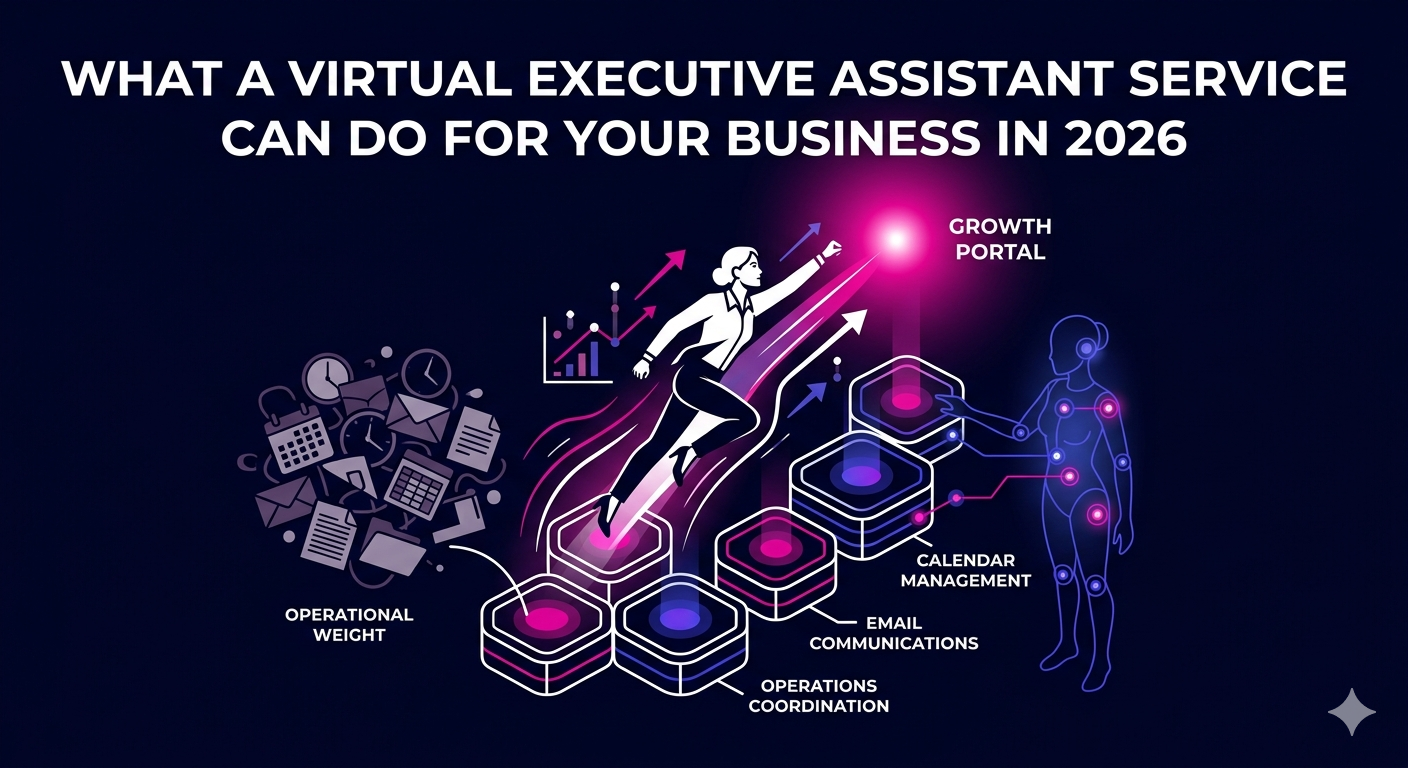
The way business leaders manage their time has changed dramatically. In 2026, the most productive executives and founders are not working longer hours. They are working with a virtual executive assistant service that handles the operational weight so they can focus entirely on growth.
Whether you are running a scaling startup, a busy agency, or a mid-sized company, the right virtual executive assistant service can be the difference between a founder who is constantly reactive and one who operates with intention. This guide explains what a quality service looks like, what you should expect to delegate, how to choose the right provider, and how to set the relationship up for long-term success.
What Is a Virtual Executive Assistant Service?
A virtual executive assistant service provides businesses with skilled, remote executive-level support. Rather than hiring a full-time, in-office assistant, companies access a vetted professional who works remotely, manages high-priority responsibilities, and integrates into existing workflows and tools.
This model offers significant advantages over traditional hiring in 2026. There is no need for office space, equipment provisioning, or lengthy recruitment cycles. A quality service handles vetting, matching, and often ongoing performance management, so you get results faster with less overhead.
How a Virtual EA Service Differs from a Standard VA Service
Many business owners confuse virtual executive assistants with general virtual assistants. The distinction matters when making a hiring decision.
- Complexity of work: A virtual EA handles nuanced, judgment-driven tasks. A VA handles documented, repeatable processes.
- Communication level: A virtual EA engages with investors, executives, partners, and key clients on your behalf. A VA typically communicates internally.
- Strategic input: A skilled virtual EA anticipates needs, flags risks, and offers process improvements. A VA executes assigned work.
- Accountability: A virtual EA takes ownership of outcomes. A VA takes ownership of tasks.
If your business needs someone who can think alongside you, not just work for you, a virtual executive assistant service is the right choice.
What to Delegate to a Virtual Executive Assistant Service
Choosing what to delegate is the first major decision after selecting a service. The goal is to offload anything that consumes your time without requiring your unique expertise or final decision-making authority.
Calendar and Schedule Management
- Full ownership of your calendar, including scheduling, blocking focus time, and resolving conflicts
- Coordinating meetings across time zones with internal teams and external stakeholders
- Preparing daily and weekly schedule briefs aligned to your priorities
- Managing recurring events and reminders so nothing falls through the cracks
Email and Communications Management
- Filtering and prioritizing inbound email and messages
- Drafting responses for routine and semi-routine communications
- Managing follow-up sequences and ensuring no conversation goes stale
- Flagging urgent items and archiving low-priority noise
Research, Briefings, and Decision Support
- Preparing meeting briefs with background on attendees, agenda context, and key questions
- Researching vendors, tools, competitive intelligence, or market data
- Summarizing long reports, contracts, or documents into executive-level takeaways
- Tracking action items from meetings and following up on outstanding deliverables
Operations and Project Coordination
- Monitoring cross-functional projects and surfacing blockers before they escalate
- Coordinating travel, events, and offsites end to end
- Managing relationships with vendors, contractors, and service providers
- Maintaining documentation, contact databases, and internal wikis
For businesses that need executive support alongside broader remote team capabilities, The Remote Reps virtual executive assistant service offers pre-vetted professionals who integrate quickly into high-demand business environments.
How to Choose the Right Virtual Executive Assistant Service in 2026
Not all services are created equal. In 2026, the market for remote executive support has grown considerably, and the quality gap between providers is wide. Here is how to evaluate your options with confidence.
Look for Rigorous Vetting Processes
A reputable virtual executive assistant service should be able to explain exactly how candidates are screened. Look for multi-stage interviews, skills assessments, reference checks, and experience requirements specific to executive-level support. A service that places anyone without a structured process is not worth the risk.
Assess Matching Quality
The best services do not just send you a list of candidates. They actively match you to an EA based on your industry, working style, tools, and specific needs. Ask how the matching process works and what happens if the first placement is not the right fit.
Evaluate Onboarding and Ongoing Support
The first 30 days of a new EA relationship are the most important. A good service provides structured onboarding support, helps set expectations on both sides, and checks in regularly to ensure the relationship is tracking well. Avoid services that disappear after placement.
Consider Time Zone and Availability Alignment
Remote executive support in 2026 is global. Depending on your business, you may need a virtual EA who works fully in your time zone or one who provides extended coverage across multiple zones. Clarify this requirement upfront and confirm the service can accommodate it.
Check References and Testimonials
Ask for client case studies or testimonials specifically from businesses similar to yours in size, stage, or industry. A service that consistently delivers for e-commerce companies may not be the best fit for a B2B SaaS founder with a heavy investor relations workload.
According to McKinsey’s research on the value of executive assistant services for business leaders, executives who delegate effectively through skilled assistant relationships consistently outperform peers who try to manage high volumes of operational detail themselves.
Setting Up Your Virtual Executive Assistant Service for Success
Even the best virtual EA service will underperform if the setup is poor. The following steps are what separates businesses that see transformational results from those that feel the hire was not worth it.
Create a Priorities and Preferences Document
Before your EA starts, write down your top three business priorities for the quarter, how you prefer to communicate, which relationships matter most and how to handle them, what decisions they can make independently, and what must always come to you. This single document cuts onboarding time in half and gives your EA the confidence to act without constant check-ins.
Build SOPs for Recurring Workflows
Standard operating procedures do not need to be complex. A short Loom video or a bulleted Notion page explaining how you want something handled is enough. SOPs reduce errors, speed up execution, and make your EA far more autonomous over time.
Establish a Weekly Sync Rhythm
A 20 to 30 minute weekly video call is essential for any virtual executive assistant service relationship. Use it to review the prior week, align on the upcoming week’s priorities, surface any blockers, and give direct feedback. Consistency in this rhythm is the single biggest driver of long-term EA performance.
Give Feedback Early and Often
Remote EAs do not receive ambient signals the way in-office staff do. They rely on explicit feedback to calibrate their work. Make it a habit to acknowledge strong work and redirect anything that missed the mark. Specific, prompt feedback accelerates performance faster than any other single input.
The Financial Case for a Virtual Executive Assistant Service
Many business leaders hesitate at the cost of a quality virtual executive assistant service. The math, however, strongly favors investment. If your time as a founder or executive is conservatively valued at $300 per hour and a virtual EA saves you just 12 hours per week, that is $3,600 in weekly value created. A skilled remote EA at full-time equivalent typically costs a fraction of that.
Beyond time savings, the downstream impact of a well-supported executive includes fewer missed opportunities, stronger investor and partner relationships, faster decision cycles, and a healthier team dynamic overall. The businesses that win in 2026 are the ones led by executives who protect their highest-leverage time relentlessly.
If you are also building your sales and marketing team alongside executive support, The Remote Reps provides remote professionals across every core business function, from executive assistants to lead generation, SDRs, and digital marketing specialists.
Frequently Asked Questions: Virtual Executive Assistant Service
What is included in a virtual executive assistant service?
A virtual executive assistant service typically includes calendar management, email and communications handling, meeting preparation, research and briefings, project coordination, and vendor or stakeholder management. The exact scope depends on the provider and the specific needs of the business, but a quality service covers all high-priority executive support functions remotely.
How much does a virtual executive assistant service cost in 2026?
In 2026, the cost of a virtual executive assistant service ranges from approximately $1,500 to $5,000 per month depending on experience level, hours of support, and the provider’s model. Specialist services that vet and match talent for executive-level roles sit at the higher end, but the return on investment for a well-matched EA typically far exceeds the monthly fee within the first 60 days.
How is a virtual executive assistant service different from hiring a freelance EA?
A virtual executive assistant service handles vetting, matching, onboarding support, and often performance monitoring on your behalf. Hiring a freelance EA independently requires you to source, screen, interview, and manage the relationship entirely on your own. For time-constrained executives, using a managed service is significantly faster and reduces the risk of a poor hire.
How quickly can I get started with a virtual executive assistant service?
Most reputable virtual executive assistant services can place a matched EA within one to two weeks of an initial consultation. Some platforms offer placements within 48 to 72 hours for urgent needs. The speed of onboarding after placement depends largely on how much preparation the business owner does in advance, including creating a priorities document and SOPs.
Can a virtual executive assistant service support specialized industries?
Yes. The best virtual executive assistant services place EAs with experience in specific industries such as technology, legal, finance, healthcare, and e-commerce. When evaluating a service, ask whether they have placed EAs in your industry before and whether their candidates understand the specific tools, terminology, and norms relevant to your business.
What makes a virtual executive assistant service worth the investment?
A virtual executive assistant service is worth the investment when it consistently frees up 10 to 20 hours of executive time per week, reduces dropped balls in key business relationships, and enables the leader to operate more strategically. The best way to evaluate this is by tracking time savings, response rate improvements, and executive capacity in the first 90 days after placement.