
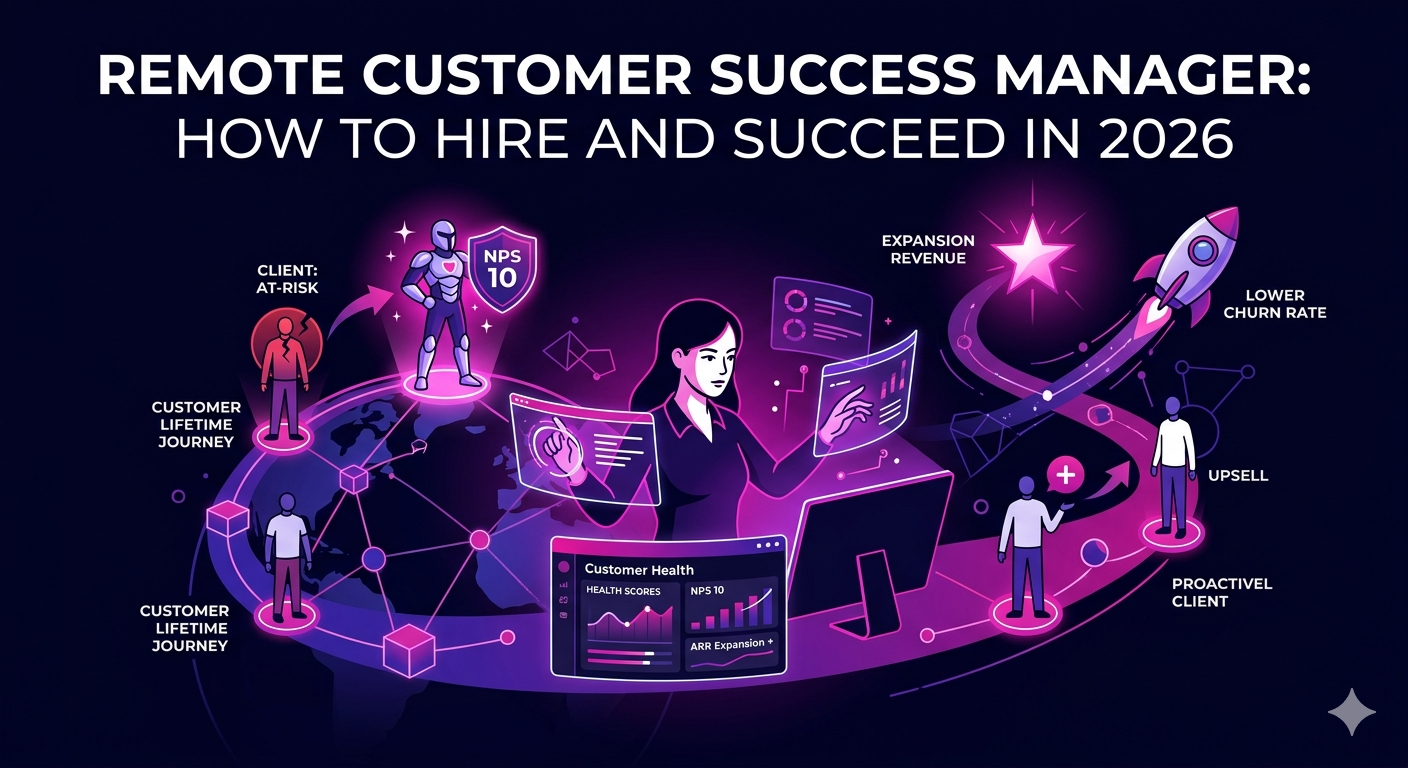
Customer retention is the lifeblood of any subscription or service-based business, and in 2026, the demand for a skilled remote customer success manager has never been higher. Companies across every industry are discovering that hiring remote talent unlocks access to world-class professionals while keeping overhead costs low. Whether you are scaling a SaaS startup or managing enterprise accounts, a dedicated remote customer success manager can transform your churn rate, boost lifetime value, and turn your customers into loyal advocates.
This guide covers everything you need to know: what the role entails, which skills to look for, how to structure the position remotely, and where to find the best candidates in 2026.
What Does a Remote Customer Success Manager Do?
A remote customer success manager is responsible for ensuring customers achieve their desired outcomes while using your product or service. Unlike a support agent who reacts to problems, a customer success manager takes a proactive approach, building relationships and driving long-term value.
Core Responsibilities
- Onboarding new customers and guiding them through product adoption
- Conducting regular check-in calls and business reviews via video conferencing
- Identifying upsell and cross-sell opportunities within existing accounts
- Monitoring account health scores and flagging at-risk customers early
- Acting as the voice of the customer internally to influence product development
- Tracking key metrics such as Net Promoter Score (NPS), churn rate, and expansion revenue
- Coordinating with sales, support, and product teams asynchronously across time zones
When working remotely, this role relies heavily on digital tools such as CRM platforms, customer health dashboards, video conferencing software, and project management systems. A top-performing remote customer success manager knows how to build genuine relationships through a screen and keep customers engaged without in-person interaction.
Why Hire a Remote Customer Success Manager in 2026?
The remote work model has matured significantly since its early adoption days. In 2026, businesses that hire remote customer success managers benefit from a wider talent pool, reduced overhead, and the ability to cover customers in multiple time zones without operating multiple offices.
Key Business Benefits
- Cost savings: Remote professionals often cost 30 to 50 percent less than equivalent in-house hires when you factor in office space, equipment, and benefits.
- Global coverage: A remote team can provide follow-the-sun support, ensuring customers receive timely responses regardless of their location.
- Access to specialized talent: You are not limited to candidates within commuting distance. You can hire the best person for the role, period.
- Faster scaling: Bringing on remote talent is typically faster than going through traditional hiring pipelines, especially when using a specialized staffing platform.
- Higher employee satisfaction: Remote professionals report greater job satisfaction on average, which often translates to lower turnover and more consistent customer relationships.
According to research from Gainsight, the leading platform for customer success professionals, companies with dedicated customer success functions see significantly higher net revenue retention compared to those relying solely on reactive support. Pairing that function with remote talent amplifies the advantage further.
Essential Skills to Look for in a Remote Customer Success Manager
Not every customer success professional thrives in a remote environment. When evaluating candidates, prioritize a combination of technical knowledge, interpersonal ability, and remote-specific competencies.
Must-Have Hard Skills
- Proficiency with CRM tools such as Salesforce, HubSpot, or Gainsight
- Experience with customer health scoring and retention analytics
- Ability to conduct effective video calls and remote business reviews
- Understanding of SaaS metrics including MRR, ARR, churn, and LTV
- Comfort working with project management platforms like Asana, Monday, or Notion
Critical Soft Skills
- Strong written and verbal communication for async collaboration
- Empathy and emotional intelligence to understand customer frustrations
- Proactive mindset to identify risks before they escalate
- Self-discipline and time management without direct supervision
- Problem-solving ability to navigate complex customer challenges independently
Remote-Specific Competencies
- Experience working across multiple time zones
- Comfort with asynchronous communication via Slack, email, and Loom
- A reliable home office setup with stable internet and professional video presence
- Ability to collaborate with distributed teams across sales, product, and support
How to Structure a Remote Customer Success Manager Role
Setting your remote customer success manager up for success requires intentional structure. Without a physical office, the systems and processes you build become the foundation of their performance.
Onboarding and Training
Create a thorough digital onboarding process. Use recorded walkthroughs, written playbooks, and live video sessions to introduce the new hire to your product, customers, and internal workflows. Set clear 30, 60, and 90-day milestones so both parties know what success looks like early on.
Communication Rhythms
Establish a predictable cadence of team meetings and one-on-ones. Weekly syncs via video call keep everyone aligned, while daily async updates in a project management tool or Slack channel maintain visibility without micromanaging. Avoid over-scheduling; trust your remote hire to manage their calendar while being available during core business hours.
Performance Metrics
Define clear KPIs from day one. A remote customer success manager should be measured on metrics such as customer retention rate, time to first value, expansion revenue, and customer satisfaction scores. Transparent dashboards accessible to both manager and employee make performance conversations objective and productive.
Where to Find Top Remote Customer Success Managers in 2026
Finding pre-vetted, high-performing remote talent is the biggest challenge most businesses face. Generic job boards flood you with applications from unqualified candidates, and the screening process eats up valuable time.
A smarter approach is to use a specialized remote staffing platform that already vets candidates for your specific needs. TheRemoteReps connects businesses with expert remote customer success and customer support professionals who are ready to hit the ground running. Their network includes specialists with proven track records in SaaS, e-commerce, and B2B environments, so you skip the guesswork and get to results faster.
Hiring Options to Consider
- Dedicated full-time remote hire: Best for companies with a large customer base that needs consistent, daily relationship management.
- Part-time or fractional CSM: A cost-effective option for early-stage startups that need expertise without the full-time commitment.
- Outsourced CSM team: Ideal for scaling businesses that need multiple managers across different customer segments or time zones simultaneously.
Common Mistakes to Avoid When Hiring Remotely
Even companies with strong hiring processes make avoidable mistakes when recruiting for remote roles. Here are the most common pitfalls and how to sidestep them.
- Hiring for in-office traits: Presence in meetings and hallway conversations do not exist remotely. Prioritize written communication and async output instead.
- Skipping a trial project: A short paid test project or simulation call reveals more about a candidate’s remote capability than any interview question.
- Neglecting cultural fit: A remote customer success manager represents your brand in every customer interaction. Values alignment matters as much as technical skill.
- Undefined expectations: Ambiguity leads to underperformance. Document expectations in writing before the first day begins.
- Under-investing in tools: Equip your remote hire with the right software stack from day one. Cutting corners on tools creates friction that slows down customer outcomes.
The ROI of a Remote Customer Success Manager
Hiring a remote customer success manager is not a cost, it is an investment with measurable returns. Businesses that implement a structured customer success function typically see improvements in annual recurring revenue within six months of hiring their first dedicated CSM.
Consider the math: if your average contract value is $12,000 per year and your remote customer success manager prevents even five churned accounts per quarter, that is $60,000 in retained revenue every three months from a single hire. Add expansion revenue from upsells and the ROI becomes even more compelling.
In 2026, retaining existing customers costs far less than acquiring new ones. A skilled remote customer success manager pays for themselves quickly and continues compounding value over time.
FAQ: Remote Customer Success Manager
What is a remote customer success manager?
A remote customer success manager is a professional who manages customer relationships and drives product adoption, retention, and growth entirely from a remote location. They use digital tools to communicate with customers, track account health, and collaborate with internal teams without being physically present in an office.
How much does a remote customer success manager cost in 2026?
Salaries for a remote customer success manager in 2026 typically range from $50,000 to $95,000 per year in the United States, depending on experience, industry, and the complexity of accounts managed. Companies hiring internationally or through staffing platforms can often access equivalent talent at 30 to 50 percent lower cost.
What tools does a remote customer success manager need?
A remote customer success manager typically works with a CRM platform such as HubSpot or Salesforce, a customer health tool like Gainsight or ChurnZero, video conferencing software, a team communication platform like Slack, and a project management tool such as Asana or Notion. A stable internet connection and professional video setup are also essential.
How do I measure the performance of a remote customer success manager?
Key performance indicators for a remote customer success manager include customer retention rate, net revenue retention, time to first value, expansion revenue from upsells, NPS scores, and the number of at-risk accounts rescued each quarter. Setting these metrics at the time of hire ensures aligned expectations and objective performance reviews.
Is a remote customer success manager the same as a remote customer support agent?
No. A remote customer success manager takes a proactive, strategic approach to long-term account health and revenue growth, while a customer support agent primarily handles reactive, ticket-based issues. Customer success managers focus on outcomes, business reviews, and retention strategy, whereas support agents resolve immediate technical or product problems. Many businesses benefit from having both roles covered by specialized remote professionals.
Where can I hire a vetted remote customer success manager?
You can hire a vetted remote customer success manager through specialized staffing platforms that pre-screen candidates for remote readiness and industry experience. Platforms like TheRemoteReps match businesses with qualified professionals across customer success, support, and other go-to-market functions, saving time and reducing hiring risk significantly.