
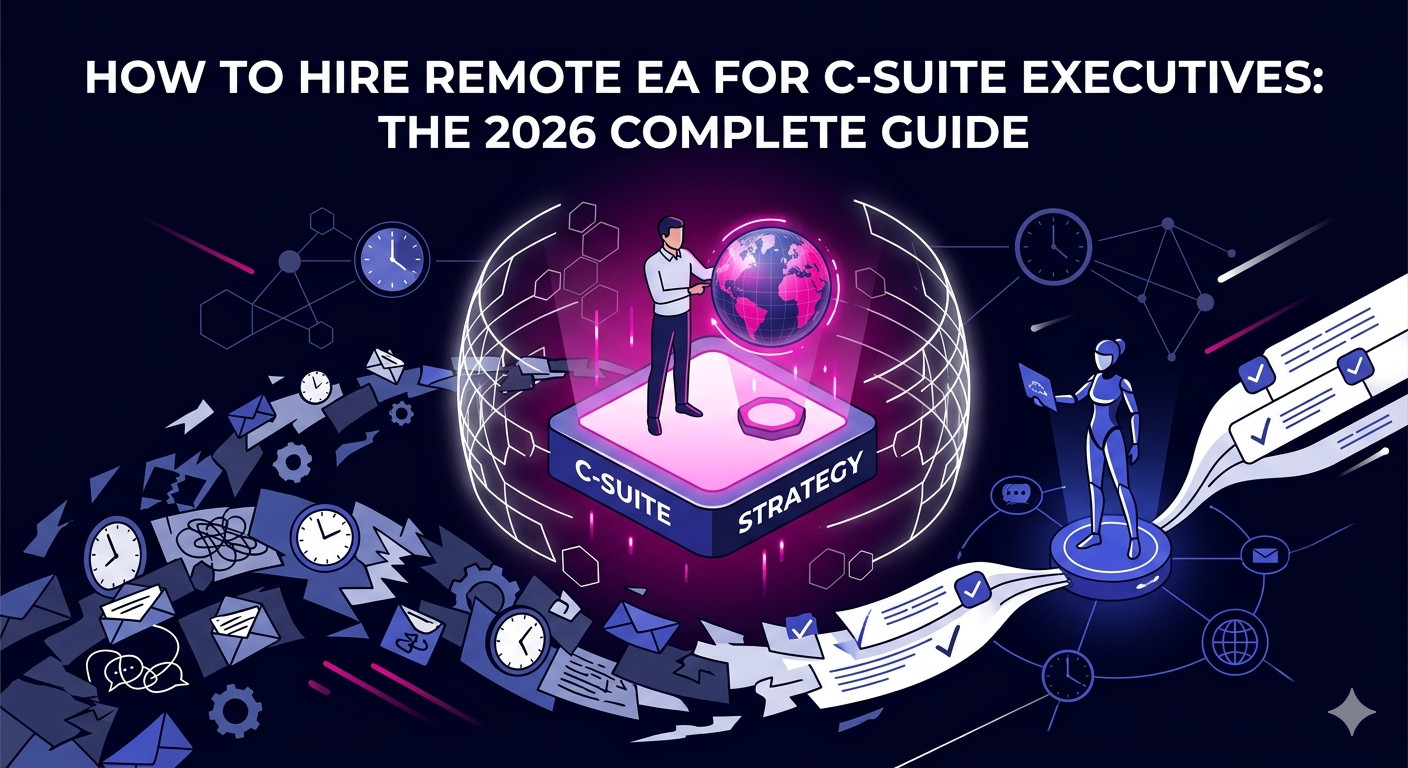
The decision to hire a remote EA for C-suite leadership is one of the highest-ROI investments a company can make. In 2026, top executives are not just managing larger organizations remotely. They are navigating faster decision cycles, distributed teams, global stakeholders, and relentless communication volume. Without dedicated executive support, even the most capable C-suite leader loses hours every day to work that should never reach their desk.
This guide walks through exactly why and how to hire a remote EA for C-suite roles, from defining the right profile to structuring the working relationship for long-term impact.
Why C-Suite Leaders Need to Hire a Remote EA in 2026
The modern C-suite operates under a level of complexity that has no precedent. A CEO, COO, or CFO in 2026 is simultaneously managing investor relationships, board obligations, cross-functional leadership, external partnerships, and the day-to-day demands of a scaling organization. All of this happens across time zones, tools, and communication channels that did not exist a decade ago.
The result is a significant time tax. Research from leadership consultancies consistently shows that senior executives spend 30 to 40 percent of their working week on activities that a skilled EA could handle entirely. When C-suite leaders hire a remote EA, that time flows back into the work only they can do.
The Business Case for Remote EA Support at the C-Suite Level
- A C-suite leader reclaiming 15 hours per week at an effective hourly rate of $500 creates $7,500 in weekly value returned to the business
- Investor and board communication quality improves when managed through a prepared, briefed EA
- Strategic initiatives move faster when the executive is not bottlenecked by scheduling, inbox management, and logistics
- Leadership presence improves when executives arrive at meetings prepared, rested, and focused on outcomes
What a Remote EA for C-Suite Roles Actually Does
The scope of a C-suite EA is materially different from that of a general virtual assistant. When you hire a remote EA for C-suite support, you are bringing on a professional who operates at the intersection of strategy and execution.
Executive Calendar and Time Architecture
- Full ownership of the executive’s calendar, including priority blocking, conflict resolution, and time zone coordination
- Structuring the week around strategic priorities rather than reactive scheduling
- Managing recurring commitments such as board meetings, investor check-ins, and all-hands sessions
- Protecting focus time and ensuring the executive has space for deep work every week
Board, Investor, and Stakeholder Communications
- Managing inbound and outbound communication with board members and investors
- Drafting correspondence, briefing documents, and follow-up summaries
- Tracking action items from board meetings and ensuring accountability across the leadership team
- Handling sensitive external relationships with discretion and professionalism
Strategic Research and Executive Briefings
- Preparing detailed briefings before critical meetings, including background on attendees and key discussion points
- Synthesizing market intelligence, competitive research, and industry news into actionable summaries
- Reviewing and summarizing legal documents, contracts, or reports before they reach the executive
Cross-Functional Coordination and Internal Leadership Support
- Acting as a communication bridge between the C-suite executive and department heads
- Tracking priority initiatives and surfacing blockers before they escalate
- Managing leadership team logistics, including planning sessions, offsites, and executive travel
To explore vetted professionals ready to provide this level of support, visit The Remote Reps executive assistant placement service, where C-suite leaders are matched with remote EAs who understand high-stakes business environments.
The Profile to Look for When You Hire Remote EA for C-Suite
Not every experienced EA is ready for C-suite support. When you hire a remote EA for C-suite roles, the bar for judgment, discretion, and proactivity is significantly higher than for a standard support hire.
Non-Negotiable Qualities for a C-Suite Remote EA
- Discretion and confidentiality: A C-suite EA is exposed to board deliberations, financial data, personnel decisions, and strategic plans. Absolute confidentiality is the baseline expectation, not a bonus.
- Executive presence: This person represents the most senior leaders in the organization. Their written and verbal communication must reflect that standard across every interaction.
- Proactive problem-solving: A strong remote EA for C-suite roles anticipates problems, surfaces them early, and often resolves them without needing to escalate.
- Async-first communication skills: In a remote environment, the ability to communicate clearly and manage complex work without real-time supervision is essential.
- High tolerance for ambiguity: C-suite priorities shift based on market conditions, board feedback, and business performance. The right EA adapts without friction.
- Organizational mastery: The ability to manage multiple high-stakes workstreams simultaneously, with zero dropped balls, is what separates a good EA from a great one.
Preferred Background and Experience
When evaluating candidates to hire as a remote EA for C-suite roles, prioritize professionals who have previously supported VP-level or above executives, have experience in your industry or a similarly complex business environment, are proficient in the tools your organization uses (Google Workspace, Notion, Slack, CRM platforms), and have worked in a remote-first capacity for at least two years.
According to Harvard Business Review’s research on delegating effectively for C-suite executives, senior leaders who invest in building strong assistant relationships consistently make faster decisions, maintain better stakeholder relationships, and sustain higher performance over time than those who manage without dedicated support.
How to Hire Remote EA for C-Suite: Step-by-Step Process
A structured hiring process reduces the risk of a poor fit and shortens the time to productivity significantly.
Step 1: Define the Role Before Recruiting
Write a scope document that covers the specific responsibilities you need covered, the tools the EA will use, the communication channels they will manage, the working hours and time zone requirements, and the level of autonomy expected in the first 30, 60, and 90 days. Clarity at this stage prevents misalignment after placement.
Step 2: Use a Specialist Placement Service
Sourcing a C-suite EA through general job boards is slow and surfaces candidates who are rarely pre-screened for the judgment and discretion the role demands. Specialist remote staffing platforms that focus on executive-level support vet candidates against a higher standard and can match you with a qualified professional in days rather than weeks.
Step 3: Assess for Judgment and Discretion, Not Just Skills
In interviews, go beyond task-based questions. Ask how they have handled confidential information in previous roles, describe a time they proactively caught a problem before it reached the executive, and how they manage competing priorities when all tasks feel urgent. These questions reveal the judgment and character that technical skill assessments cannot capture.
Step 4: Onboard With Intentional Structure
Prepare a C-suite context document before your new EA starts. Include your top three priorities for the next quarter, the five most important relationships they will manage and how to engage each one, your decision-making preferences for common scenarios, your communication style, and a clear escalation protocol. Share access to tools with appropriate permission levels from day one.
Step 5: Establish a Performance Rhythm
Schedule a weekly 30-minute check-in for the first 90 days. Use it to review the prior week, align on the upcoming week’s priorities, give direct feedback, and identify any gaps in process or documentation. After the first quarter, most strong remote EAs need less frequent formal check-ins as the relationship matures.
Common Mistakes When You Hire Remote EA for C-Suite
- Hiring too late: Most executives wait until they are overwhelmed to hire a remote EA for C-suite support. By then, the onboarding load adds to an already maxed-out calendar. Hire before you hit capacity.
- Delegating too little: An EA who only manages scheduling is not operating at their potential. Trust the hire and delegate at the level the role was designed for.
- Skipping the context document: Without this document, your EA is operating blind. Every hour spent on this upfront saves multiple hours of back-and-forth later.
- Inconsistent feedback: Remote EAs depend on explicit, regular feedback to improve. Without it, performance plateaus and the hire underdelivers relative to its potential.
If your organization is also building out revenue and marketing functions alongside C-suite support, The Remote Reps offers remote professionals across sales, growth, and operations to complement your leadership team.
Frequently Asked Questions: Hire Remote EA for C-Suite
Why should a C-suite executive hire a remote EA rather than an in-office assistant?
When you hire a remote EA for C-suite roles, you access a broader talent pool, eliminate geographic limitations, reduce overhead costs, and often find candidates with more specialized executive support experience than the local market provides. In 2026, remote-first EAs are also more experienced with async communication and distributed team tools, which are essential in most modern C-suite environments.
How much does it cost to hire a remote EA for C-suite support in 2026?
The cost to hire a remote EA for C-suite support in 2026 typically ranges from $2,500 to $6,000 per month for a full-time engagement, depending on experience, industry background, and the complexity of the role. Specialist placement services add a one-time matching fee but significantly reduce the time and risk associated with sourcing independently.
How long does it take to hire a remote EA for C-suite roles?
Using a specialist placement service, most C-suite leaders can hire a remote EA and have them starting within two to three weeks. The onboarding period to full productivity typically spans 30 to 60 days, with strong performance visible by the end of the first quarter when onboarding is handled well.
What tools should a remote EA for C-suite be proficient in?
When you hire a remote EA for C-suite support, look for proficiency in Google Workspace or Microsoft 365 for calendar and email, a project management tool such as Asana, Notion, or Monday, a communication platform like Slack or Teams, and any CRM or investor management platform your organization uses. Proficiency in video conferencing tools and document collaboration platforms is also essential.
How do I ensure confidentiality when I hire a remote EA for C-suite?
Confidentiality protocols should be established from the first day. Have your remote EA sign a comprehensive NDA before accessing any sensitive systems or communications. Use a secure password manager for credential sharing, limit tool access to what is strictly necessary for the role, and discuss confidentiality expectations explicitly during onboarding. Choosing a candidate with a strong prior track record of handling sensitive executive information is the most important safeguard.
Can I hire a remote EA for C-suite on a part-time basis?
Yes. Many C-suite leaders start with part-time remote EA support, typically 20 hours per week, before expanding to full-time as the working relationship matures and trust develops. Part-time engagements are best suited for executives whose support needs are concentrated in specific areas like communications and calendar management, rather than broad operational oversight.