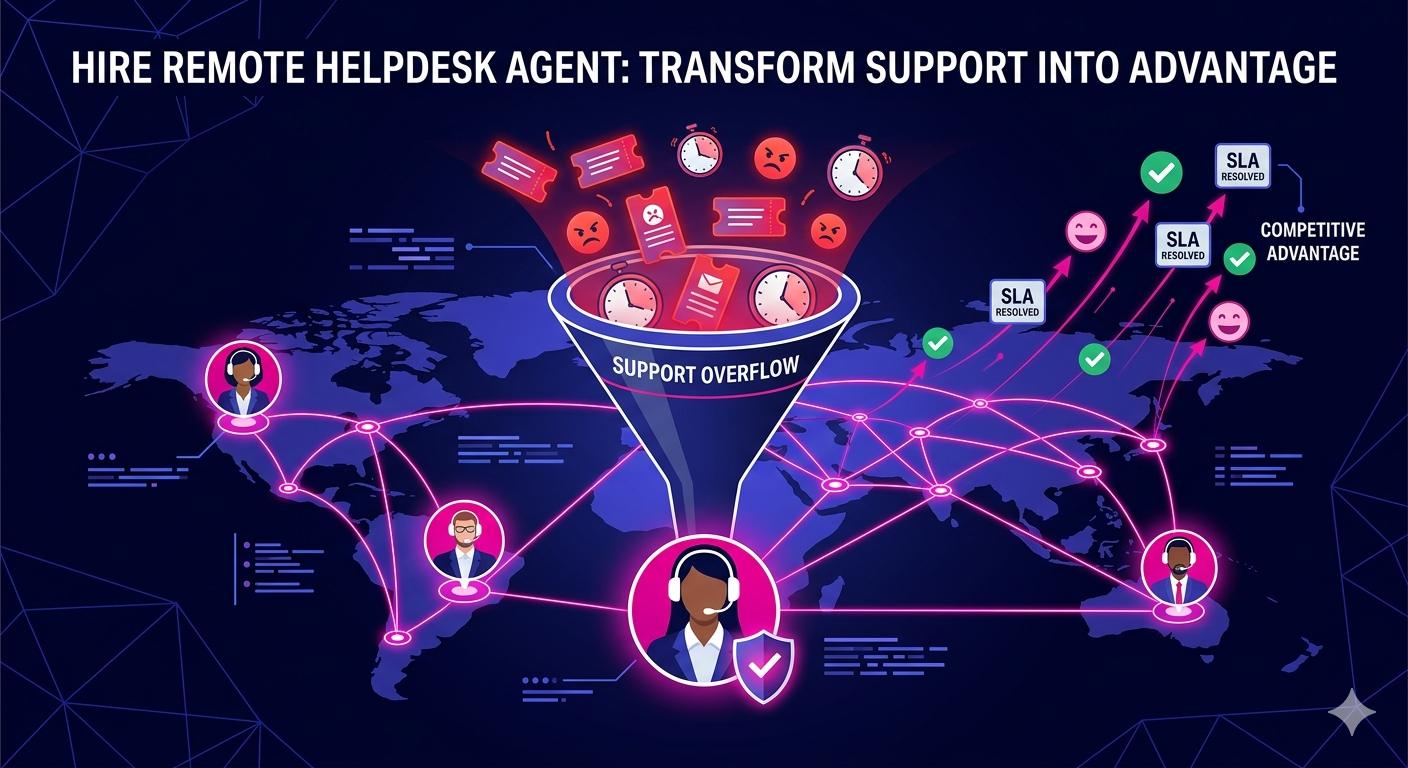
If your support inbox is overflowing, your response times are slipping, or your in-house team is stretched thin, it is time to seriously consider making the decision to hire a remote helpdesk agent. In 2026, remote helpdesk talent is more accessible, more skilled, and more cost-effective than ever before. Whether you run a SaaS company, an e-commerce brand, or a growing service business, the right remote agent can transform your customer support operation from a bottleneck into a competitive advantage.
This guide breaks down what a remote helpdesk agent actually does, why businesses are increasingly choosing remote over in-house, and the exact steps to find and retain the right person for your team.
What Does a Remote Helpdesk Agent Do?
A remote helpdesk agent is a support professional who handles technical and general customer service inquiries from a location outside your office. They operate through ticketing systems, live chat, email, or phone platforms and are responsible for resolving issues, answering questions, and ensuring customers leave each interaction satisfied.
Unlike a generalist customer service rep, a helpdesk agent typically has a stronger technical orientation. They are trained to troubleshoot product or software issues, document recurring problems, escalate complex cases, and help reduce the volume of repeat inquiries by improving documentation and self-service resources.
Typical Responsibilities of a Remote Helpdesk Agent
- Responding to inbound tickets, emails, and live chat inquiries within defined SLA windows
- Diagnosing and resolving tier-one technical issues across software, hardware, or platform-related problems
- Escalating unresolved or complex issues to tier-two support or specialist teams
- Updating and maintaining help center documentation and internal knowledge bases
- Logging all interactions accurately in a CRM or helpdesk platform
- Identifying patterns in support volume to help improve product or process quality
- Following up with customers on open cases to ensure full resolution
Why Businesses Choose to Hire a Remote Helpdesk Agent in 2026
The remote work model has matured significantly. Tools, processes, and talent pipelines are all well-established. Hiring a remote helpdesk agent is no longer a workaround or compromise. For many businesses, it is the preferred approach.
Cost Efficiency Without Sacrificing Quality
Hiring a local, in-office helpdesk agent in a major US or UK city carries costs that go well beyond salary. Office space, equipment, payroll taxes, benefits, and management overhead add up quickly. A remote helpdesk agent sourced from a skilled talent market in Latin America, Eastern Europe, or Southeast Asia can deliver the same level of professionalism and technical knowledge at a substantially lower total cost. Many businesses report reducing their per-agent support costs by 40 to 60 percent after transitioning to a remote model.
Access to a Wider Talent Pool
When you hire a remote helpdesk agent, you are no longer limited to candidates within commuting distance of your office. This dramatically expands your options. You can prioritize skill, communication ability, and relevant experience rather than settling for whoever is available locally. In specialized industries where specific product knowledge matters, this breadth of options is invaluable.
Extended Coverage Hours
By hiring remote agents across different time zones, businesses can extend support coverage without requiring anyone to work inconvenient shifts. A company based in New York can have helpdesk coverage across European and Asia-Pacific business hours simply by hiring agents in the right regions. This kind of follow-the-sun model used to be accessible only to enterprise organizations. Remote hiring makes it achievable for businesses of any size.
Scalability on Demand
Remote helpdesk staffing scales more easily than in-house teams. When a product launch, seasonal surge, or marketing campaign drives a spike in support volume, you can bring on additional remote agents quickly and release them just as easily when demand normalizes. This flexibility is particularly valuable for e-commerce businesses and SaaS companies that experience predictable but sharp fluctuations in ticket volume.
Skills to Look for When You Hire a Remote Helpdesk Agent
The quality of your remote helpdesk agent determines the quality of your customer experience. Knowing which skills to prioritize will save you time in the hiring process and prevent costly mismatches.
Technical Aptitude
A remote helpdesk agent needs enough technical knowledge to understand the products or platforms they are supporting. This does not always mean deep engineering expertise, but it does mean the ability to learn your tools quickly, follow troubleshooting protocols accurately, and explain technical issues in plain language to non-technical customers.
Strong Written Communication
Most remote helpdesk interactions happen through text. Clear, professional, and empathetic writing is essential. Agents who write in a way that is too formal can feel robotic, while those who are too casual may undermine trust. Look for candidates who strike the right balance and adapt their tone based on the situation.
Patience and Emotional Composure
Helpdesk work means dealing with frustrated users on a daily basis. The best agents stay calm under pressure, do not take negative interactions personally, and focus on resolution rather than winning arguments. This emotional resilience is a critical soft skill that is harder to train than technical knowledge.
Familiarity with Helpdesk Platforms
Candidates who already know how to operate platforms like Zendesk, Freshdesk, Intercom, Jira Service Management, or HubSpot Service Hub need far less onboarding time. Prioritizing tool familiarity reduces your ramp-up period and gets your new agent productive faster.
Self-Management and Reliability
Remote agents work without direct supervision. The best candidates have a proven track record of meeting deadlines, managing their queue independently, and maintaining consistent output without needing constant direction. Ask for work samples, references, or test assignments to verify this before making a hire.
To skip the search entirely and connect with pre-vetted professionals, visit the remote helpdesk and customer support expert services at The Remote Reps where you can find qualified agents ready to integrate with your existing tools and workflows.
How to Hire a Remote Helpdesk Agent: A Step-by-Step Process
A structured hiring process will consistently outperform a rushed one. Here is a practical approach to finding the right remote helpdesk agent for your business.
Step 1: Write a Clear and Specific Job Description
Vague job descriptions attract vague candidates. Be specific about the tools your agent will use, the channels they will cover, the hours expected, and the performance metrics they will be measured against. Include details about your product or industry so candidates can self-select based on genuine fit.
Step 2: Use a Skills-First Screening Process
Rather than relying solely on CVs, use a short written test or practical assignment in your initial screening. Ask candidates to respond to a sample support ticket, walk through a troubleshooting scenario, or demonstrate familiarity with a specific platform. This quickly separates applicants who can do the job from those who simply describe themselves well on paper.
Step 3: Conduct a Structured Interview
Ask behavioral and situational interview questions that reveal how candidates handle real helpdesk scenarios. Questions like “Tell me about a time you had to de-escalate a frustrated customer” or “How do you manage your workload when ticket volume spikes unexpectedly” will give you much more useful insight than generic questions about strengths and weaknesses.
Step 4: Verify References and Past Remote Experience
Remote experience is a distinct advantage. Candidates who have worked remotely before understand the communication habits, time management discipline, and tech setup required to perform well in a distributed team. Check references specifically for reliability, communication quality, and independent work performance.
Step 5: Onboard Thoroughly Before Going Live
Do not rush the onboarding process. Provide your new remote helpdesk agent with access to your knowledge base, product documentation, tone guidelines, escalation procedures, and sample conversations before they start handling real tickets. A well-onboarded agent delivers better results faster and requires less ongoing correction.
If your business also needs support across admin and executive functions, The Remote Reps offers remote virtual assistants who can work alongside your helpdesk team to handle scheduling, inbox management, and operational tasks that free up your core team.
Industry analysis from the Help Desk Association’s resource library on remote helpdesk agent best practices highlights that organizations with structured onboarding programs see new agents reach full productivity up to 50 percent faster than those with informal approaches, reinforcing the value of investing in the process from day one.
FAQ Section
Why should I hire a remote helpdesk agent instead of an in-house one?
When you hire a remote helpdesk agent, you gain access to a broader talent pool, reduce overhead costs significantly, and gain the flexibility to scale your support team up or down based on actual demand. In-house agents require office space, equipment, and local salaries that can quickly become expensive. Remote agents deliver comparable or superior results at a lower total cost, especially when sourced from talent-rich regions outside major metro areas.
What qualifications should I look for when I hire a remote helpdesk agent?
When looking to hire a remote helpdesk agent, prioritize strong written communication skills, familiarity with at least one major helpdesk platform such as Zendesk or Freshdesk, a demonstrated ability to work independently, and technical aptitude relevant to your product. Prior remote work experience is a strong indicator of reliability. For specialized industries, domain-specific knowledge is an added bonus that shortens the learning curve considerably.
How long does it take to hire a remote helpdesk agent and get them productive?
With the right hiring process, you can hire a remote helpdesk agent and have them handling real tickets within two to three weeks. Using a pre-vetting platform or specialist agency like The Remote Reps shortens the sourcing phase significantly. Thorough onboarding is the key variable. Agents who receive structured training, access to a knowledge base, and clear performance expectations are typically productive within the first week of live work.
What tools does a remote helpdesk agent need to work effectively?
A remote helpdesk agent needs reliable access to a helpdesk or ticketing platform, a stable internet connection, a communication tool for internal team coordination such as Slack or Microsoft Teams, and a CRM system if customer history tracking is part of the role. Screen-sharing tools are useful for technical support roles. Most experienced remote agents already have their own equipment and are familiar with the core tools, reducing setup time for your business.
How do I measure the performance of a remote helpdesk agent?
Once you hire a remote helpdesk agent, track performance using clear, consistent metrics. Key indicators include first response time, average resolution time, first contact resolution rate, customer satisfaction score (CSAT), and ticket backlog volume. Review these metrics weekly during the first month and monthly thereafter. Regular one-on-one check-ins and periodic ticket audits also help maintain quality and give agents the feedback they need to continue improving.
Final Thoughts
The decision to hire a remote helpdesk agent is one of the highest-leverage moves a growing business can make in 2026. You get skilled, dedicated support coverage, lower costs, greater flexibility, and access to a global talent pool that simply does not exist when you limit hiring to your local area.
The businesses that deliver the best customer experiences are not always the largest or the best-funded. They are the ones that hire smartly, onboard thoroughly, and trust their remote teams to perform. A great remote helpdesk agent is one of the clearest examples of that principle in action.
Ready to hire a remote helpdesk agent who hits the ground running? Browse available remote helpdesk professionals at The Remote Reps and find your next great support hire today.