
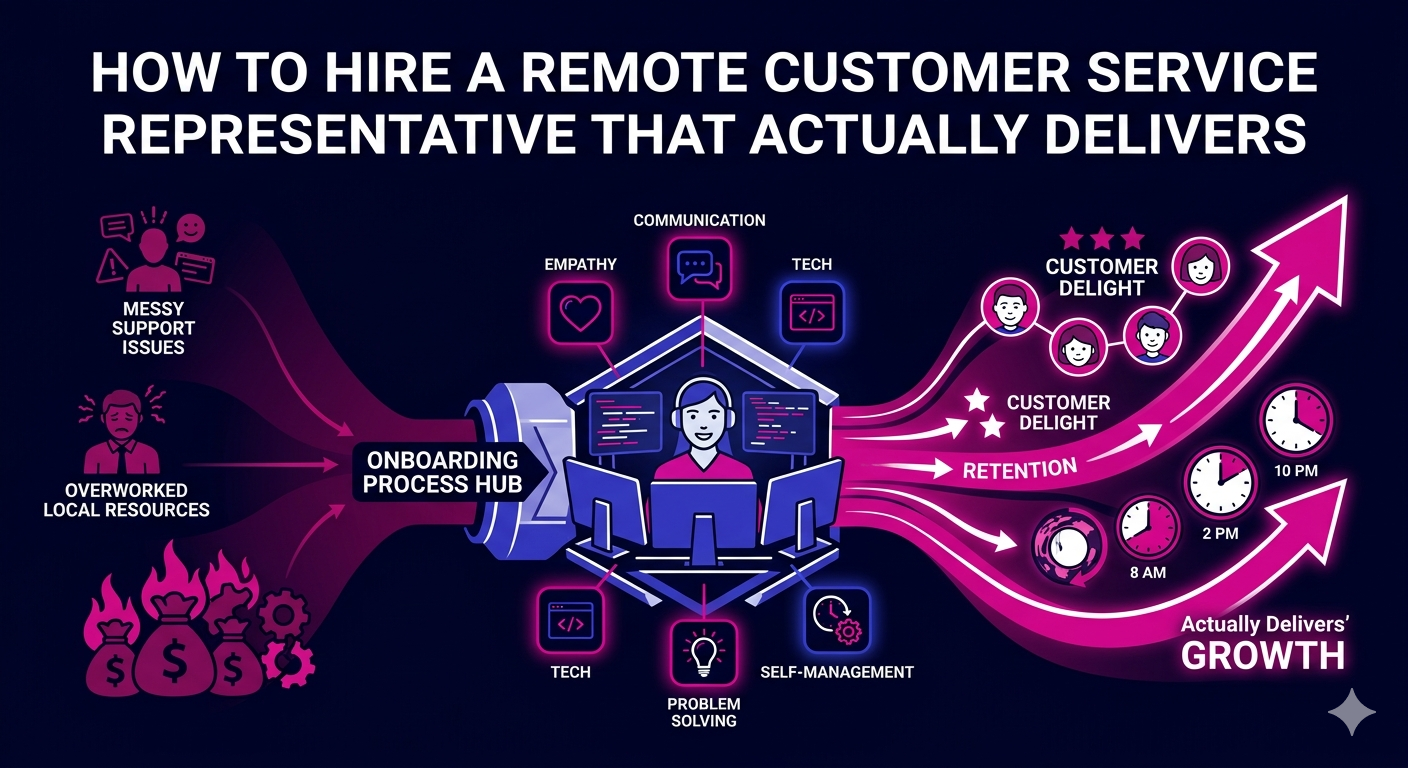
Customer experience is one of the most powerful differentiators a business can have in 2026. Yet many growing companies are still relying on overworked in-house teams or expensive local hires to handle support. The smarter move is to hire a remote customer service representative who brings focused expertise, flexible availability, and significantly lower overhead to your support operations.
This guide walks you through everything you need to know before making that hire, from what to look for in a candidate to how to set them up for long-term success.
Why More Businesses Are Choosing to Hire Remote Customer Service Representatives
The shift toward remote customer support is not a trend. It is a structural change in how businesses operate. Companies that have made the transition consistently report lower support costs, faster response times, and higher customer satisfaction scores when they hire remote customer service talent strategically.
Here is what is driving that shift:
- Remote support professionals often work across multiple time zones, extending your coverage without adding shifts
- The global talent pool means you can find specialists with experience in your exact industry or product type
- Remote hires cost significantly less than in-house equivalents when you factor in office space, equipment, and benefits
- Well-managed remote representatives tend to have lower turnover rates than traditional call center staff
- Scaling up or down based on demand is far easier with remote arrangements than with fixed office-based teams
For e-commerce brands, SaaS companies, healthcare providers, and professional service firms alike, remote customer service has become a core operational strategy rather than a stopgap solution.
What a Remote Customer Service Representative Actually Does
Before you hire a remote customer service representative, it is worth being clear on the full scope of what this role covers. The responsibilities vary by business type but typically include:
Multi-Channel Support Management
Modern customer service extends well beyond phone calls. A skilled remote representative handles inquiries across email, live chat, social media direct messages, helpdesk platforms like Zendesk or Freshdesk, and sometimes SMS. The ability to manage multiple channels simultaneously without sacrificing response quality is a core competency to screen for.
Issue Resolution and Escalation
First-contact resolution is a key metric in customer support. Your remote representative should be able to diagnose problems, find solutions independently, and escalate complex issues to the right internal contact without causing delays or frustrating the customer further. Clear escalation processes need to be documented and shared during onboarding.
Order and Account Management
For e-commerce and subscription businesses, remote customer service representatives often handle order status inquiries, returns and refunds, account updates, and subscription changes. Comfort with your CRM and order management system is essential for this type of work.
Customer Retention and Upselling
The best remote customer service professionals do more than resolve problems. They identify opportunities to retain at-risk customers, communicate the value of upgrades or additional services, and create positive interactions that lead to reviews and referrals. This is a skill to actively screen for during your hiring process.
Documentation and Reporting
A good remote representative keeps clean records of every interaction, updates tickets and CRM entries accurately, and contributes to internal knowledge bases. This documentation is invaluable for identifying recurring issues and improving your product or service over time.
Key Qualities to Look for When You Hire a Remote Customer Service Representative
Technical skills matter, but they are only part of the picture. When evaluating candidates for a remote customer service representative role, prioritize these qualities:
Written and Verbal Communication Skills
Remote support is largely text-based. Your representative needs to write clearly, warmly, and professionally under pressure. In your hiring process, assign a written communication test that mirrors real customer scenarios. Pay attention to tone, clarity, grammar, and how well they de-escalate a frustrated customer.
Empathy and Emotional Intelligence
Customers who reach out to support are often stressed, confused, or disappointed. A representative who can acknowledge frustration without taking it personally, and who responds with genuine care rather than scripted indifference, makes a measurable difference in satisfaction scores and retention rates.
Self-Management and Discipline
Remote work requires a level of self-direction that not every candidate possesses. Look for evidence of previous remote experience, consistent performance in prior roles, and the ability to manage time effectively without in-person supervision. Ask directly how they structure their workday and handle competing priorities.
Tech Comfort and Adaptability
Your remote customer service representative will work across multiple software platforms. Look for comfort with helpdesk tools, CRM systems, live chat software, and communication platforms like Slack or Microsoft Teams. A candidate who picks up new tools quickly will save you significant training time.
Problem-Solving Under Pressure
Customer service is unpredictable. Candidates who can stay calm, think logically, and find solutions in situations they have not seen before will consistently outperform those who rely strictly on scripts. Use scenario-based interview questions to evaluate this quality directly.
How Much Does It Cost to Hire a Remote Customer Service Representative?
Cost is one of the primary reasons businesses make this hire. The range depends on experience level, language requirements, and the complexity of your support needs:
- Entry-level remote representative: $800 to $1,800 per month for part-time or lower-complexity support roles
- Experienced remote representative: $1,800 to $3,500 per month for full-time roles requiring product knowledge and multi-channel management
- Senior or team lead level: $3,500 to $5,500 per month for candidates who can also train and oversee junior representatives
Compared to the fully-loaded cost of an in-house hire in most Western markets, these figures represent savings of 40 to 65 percent without any sacrifice in service quality when the hire is made correctly.
Where to Find Qualified Remote Customer Service Representatives
General job boards produce high volumes of unvetted applications that consume recruiting time without guaranteeing quality. The most efficient path is working with a remote staffing platform that specializes in customer support talent.
The Remote Reps offers a curated roster of remote customer support experts who are pre-screened, experienced, and ready to integrate into your operations from day one. Our placement process matches you with candidates based on your industry, communication style requirements, and technical environment.
For businesses that also need administrative or operational support alongside customer service, our remote virtual assistants offer a complementary skill set that many growing teams find valuable.
If you want to understand what best-in-class remote customer service looks like from an industry perspective, Zendesk’s guide to building a remote customer service team offers useful benchmarks and operational frameworks.
How to Onboard Your Remote Customer Service Representative Successfully
Hiring is only the beginning. A structured onboarding process directly determines how quickly your new representative reaches full productivity and how long they stay with your business.
Prepare Before Day One
Set up all platform access before your new hire’s first day. This includes your helpdesk system, CRM, internal communication tools, and any customer-facing platforms they will manage. Nothing undermines a remote onboarding faster than spending the first week waiting for logins.
Build a Knowledge Base
Document your products, services, common customer issues, resolution workflows, and escalation paths. A well-organized internal knowledge base reduces time-to-competency dramatically and gives your representative a reference point they can return to without needing to ask for help on every edge case.
Set Clear Performance Expectations
Define the metrics you will use to evaluate performance from the start. Common KPIs for remote customer service representatives include first response time, first contact resolution rate, customer satisfaction score, average handle time, and ticket volume. Review these metrics regularly and provide specific, constructive feedback.
Schedule Regular Check-Ins
Remote representatives who feel connected to their team and manager consistently perform better and stay longer. Build in weekly one-on-ones during the first 90 days and maintain a regular cadence after that. Create space for your representative to flag challenges, share feedback, and contribute ideas for process improvements.
FAQ: Hire Remote Customer Service Representative
What is the best way to hire a remote customer service representative?
The most effective approach to hire a remote customer service representative is to work with a specialist remote staffing platform rather than general job boards. This gives you access to pre-vetted candidates with verified experience, reducing time-to-hire and lowering the risk of a bad placement. Supplement platform hiring with a skills assessment and scenario-based interview to confirm communication quality and problem-solving ability before making an offer.
What tools does a remote customer service representative need?
A remote customer service representative typically needs access to a helpdesk platform such as Zendesk, Freshdesk, or Help Scout, a CRM system, a live chat tool, and a team communication platform like Slack or Microsoft Teams. For video-based support or onboarding calls, a reliable video conferencing setup is also important. Confirm that candidates are already familiar with the tools in your stack to minimize training time.
How do I manage a remote customer service representative effectively?
Managing a remote customer service representative effectively comes down to clarity and consistency. Set clear KPIs from day one, provide a documented knowledge base for reference, schedule regular performance check-ins, and use shared dashboards so both sides can track progress in real time. Recognize strong performance publicly within your team to build engagement and loyalty over time.
Can a remote customer service representative handle multiple languages?
Yes. One of the advantages of choosing to hire a remote customer service representative from a global talent pool is access to multilingual candidates. If your customer base spans multiple regions or languages, you can find representatives with native or professional fluency in the languages you need. Be explicit about language requirements in your job brief so candidates are accurately matched to the role.
How long does it take to onboard a remote customer service representative?
Most remote customer service representatives reach a basic level of operational competency within the first two to three weeks when onboarding is structured and documentation is in place. Full competency, including the ability to handle edge cases and complex escalations independently, typically takes 60 to 90 days. Investing time in thorough onboarding materials upfront significantly shortens this timeline.
What industries benefit most from choosing to hire remote customer service representatives?
Almost every industry benefits from the decision to hire remote customer service representatives, but it is particularly impactful for e-commerce brands managing high order volumes, SaaS companies supporting technical users, subscription businesses focused on churn reduction, healthcare adjacent services requiring empathetic support, and professional service firms managing ongoing client relationships. The remote model works wherever consistent, high-quality customer communication matters.