
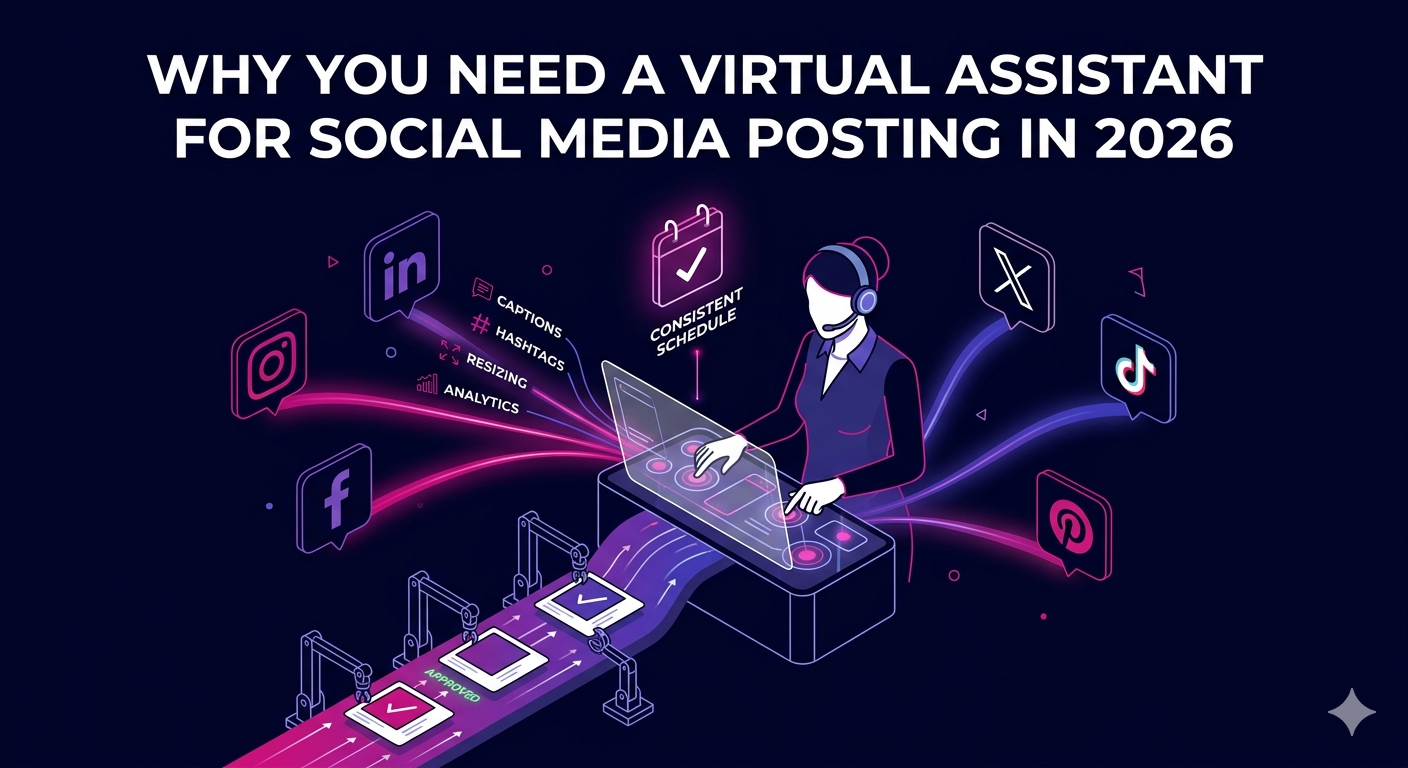
Social media never stops. Every platform demands fresh content, consistent engagement, and a steady posting schedule, day after day. For most business owners and marketing teams, keeping up is exhausting and time-consuming. That is exactly why hiring a virtual assistant for social media posting has become one of the smartest operational decisions a growing brand can make in 2026.
A dedicated virtual assistant takes the repetitive, time-intensive work of managing your social presence off your plate. You stay focused on strategy and growth while they handle execution with precision and consistency. This guide covers everything you need to know before making your hire.
What Does a Virtual Assistant for Social Media Posting Do?
A virtual assistant for social media posting is a remote professional who manages the day-to-day execution of your brand’s content across one or more social platforms. They handle the operational side of social media so you do not have to.
This is different from a social media strategist or manager. A social media VA focuses primarily on execution. They take your content direction and bring it to life consistently across your chosen platforms, freeing up higher-level team members for strategy and creative work.
Typical Tasks a Social Media Posting VA Handles
- Scheduling and publishing posts across platforms like Instagram, LinkedIn, Facebook, X, TikTok, and Pinterest
- Resizing and formatting visual content for each platform’s specifications
- Writing and proofreading captions in line with your brand voice
- Researching and applying relevant hashtags for each post
- Responding to comments and basic engagement on published posts
- Organizing content libraries and digital asset folders
- Repurposing existing content into new formats for different platforms
- Monitoring post performance and compiling basic analytics summaries
- Coordinating with designers or videographers to gather finished assets
Why Businesses Are Turning to Social Media Virtual Assistants in 2026
The volume of content required to stay competitive on social media has increased significantly. In 2026, brands that post consistently and across multiple platforms generate far more visibility than those who post sporadically. Maintaining that consistency in-house, without dedicated support, is no longer realistic for most teams.
Remote work infrastructure has also matured considerably. Tools for collaboration, file sharing, scheduling, and communication make it seamless to work with a virtual assistant regardless of time zone. Many businesses now manage their entire social media posting workflow asynchronously, with the VA handling execution independently within agreed guidelines.
The Cost Advantage of Hiring a Social Media VA
Hiring a full-time, in-house social media coordinator carries significant overhead: salary, benefits, office space, equipment, and onboarding costs. A virtual assistant for social media posting offers a leaner model. You pay for the hours or scope of work you need, scale up during campaigns, and scale back during slower periods without the complexity of traditional employment.
For early-stage businesses and lean marketing teams, this flexibility is invaluable. For larger organizations, it is a smart way to extend capacity without expanding headcount.
What Skills Should You Look for in a Social Media Posting Virtual Assistant?
Not every virtual assistant is equipped to handle social media work at a professional level. When evaluating candidates, look for a specific combination of platform knowledge, technical ability, and communication skills.
Platform and Tool Knowledge
- Hands-on experience with scheduling tools such as Buffer, Later, Hootsuite, or Metricool
- Familiarity with each major platform’s posting formats, dimensions, and best practices
- Basic graphic design ability using Canva or Adobe Express for simple visual formatting
- Understanding of hashtag research and platform-specific tagging conventions
- Comfort with content management tools like Notion, Airtable, or Google Sheets for calendar tracking
Professional and Communication Skills
- Strong written English with the ability to match and maintain brand voice across posts
- Attention to detail for consistent formatting, spelling, and visual quality
- Reliability and self-management in a fully remote working environment
- Proactive communication around deadlines, missing assets, or potential issues
- Ability to follow detailed content briefs and brand guidelines without constant supervision
How a Social Media Posting VA Fits Into Your Broader Marketing Setup
A virtual assistant for social media posting works best when they are part of a clearly defined content workflow. They are not responsible for strategy or campaign planning. Their role is to execute the plan that you or your marketing lead has built.
In practice, this means your VA receives a finalized content calendar, along with copy, visuals, and posting instructions. They schedule everything, manage the publishing queue, handle light engagement, and report back on what has gone live. The workflow runs smoothly with minimal management once systems are established.
Integrating Your VA with Other Remote Team Members
Many businesses pair their social media posting VA with a more senior specialist who handles strategy, creative direction, and performance optimization. This division of labor keeps costs efficient while ensuring quality. A social media posting assistant focuses on volume and consistency, while the strategist focuses on direction and results.
If you are building a more complete remote marketing team, pairing your VA with a dedicated platform specialist is a natural next step. Explore how our remote social media managers can lead strategy while your virtual assistant handles posting and day-to-day execution.
You can also extend your support structure further. Businesses that need executive-level coordination alongside their social media operations often bring in our experienced remote virtual assistants to manage scheduling, communications, and admin tasks that keep the whole team running smoothly.
Setting Up Your Virtual Assistant for Social Media Posting Success
A great VA can only perform as well as the systems and guidance you put in place. Before their first day, invest time in building a strong onboarding foundation.
What to Prepare Before Onboarding
- A written brand voice guide with tone, vocabulary, and style examples
- Access credentials for all relevant social media accounts and scheduling tools
- A content calendar template that includes platform, copy, visual, hashtags, and publish date
- A folder structure for organizing approved assets, drafts, and published content
- A clear brief on which platforms to prioritize and what posting frequency to maintain
- An approval workflow so your VA knows which posts need sign-off before going live
With these systems in place, most virtual assistants are fully operational within one to two weeks and delivering consistent, on-brand posting from day one.
What to Expect in Terms of Results and Timeline
A virtual assistant for social media posting is not a growth hacker. Their primary contribution is consistency, reliability, and time savings. Here is a realistic picture of what to expect.
Within the first 30 days, your posting schedule should become noticeably more consistent. Backlogs of unscheduled content get cleared. Your platforms start reflecting your brand more accurately and regularly. Between 60 and 90 days, the compounding effect of consistent posting typically begins to show up in reach, impressions, and follower growth data.
According to research shared by Sprout Social’s annual social media statistics report, brands that post consistently with a virtual assistant for social media posting or a dedicated coordinator see significantly stronger audience growth and engagement metrics compared to brands with irregular posting patterns.
Long-term results depend on the quality of your content strategy, but the operational foundation your VA builds makes every other marketing effort more effective.
FAQ Section
What is the difference between a virtual assistant for social media posting and a social media manager?
A virtual assistant for social media posting focuses on execution: scheduling content, formatting posts, applying hashtags, and managing the publishing queue. A social media manager takes on a broader strategic role, including content planning, campaign creation, audience growth, and performance analysis. Many businesses use both, with the VA handling daily posting tasks and the manager directing overall strategy and creative output.
How many hours per week does a virtual assistant for social media posting typically work?
The number of hours varies based on how many platforms you are active on and your posting frequency. For a brand posting five to seven times per week across two or three platforms, a virtual assistant for social media posting typically needs between 10 and 20 hours per week. Brands with higher volume, active community management, or regular content repurposing may require closer to 25 to 30 hours per week.
Can a virtual assistant for social media posting create original content from scratch?
Some virtual assistants for social media posting do have copywriting or basic design skills and can handle light content creation. However, most VAs at this level are strongest in execution rather than creation. If you need original captions, graphics, or video content created from scratch, it is best to hire a specialist with a content creation background or pair your VA with a dedicated content creator who supplies the assets for the VA to schedule and publish.
What tools does a virtual assistant for social media posting typically use?
A virtual assistant for social media posting commonly works with scheduling platforms such as Buffer, Later, Hootsuite, or Metricool. For visual formatting, they typically use Canva or Adobe Express. Content calendars are usually managed in Notion, Airtable, or Google Sheets. Communication and task management tools like Slack, Trello, or Asana are standard for keeping workflows organized and transparent between the VA and the rest of the team.
How do I make sure a virtual assistant for social media posting stays on brand?
The key to keeping a virtual assistant for social media posting on brand is a thorough onboarding process and clear reference materials. Provide a written brand voice guide, a library of approved visual assets, examples of past posts you liked, and a content brief template they follow for every piece of content. Regular check-ins during the first month, combined with a content approval step before publishing, ensure quality while the VA learns your brand deeply. Most experienced VAs adapt to new brand guidelines quickly with the right documentation in place.