
The decision to outsource marketing operations is one of the highest-leverage moves a growing business can make. Instead of building every capability in-house, spending months recruiting, and managing a large internal team, you hand off specific marketing functions to specialists who hit the ground running. The result is faster execution, lower overhead, and access to expertise that would take years to develop internally.
In 2026, outsourcing marketing operations is no longer a niche strategy reserved for large enterprises. Companies of every size, from bootstrapped startups to established mid-market firms, are using it to stay competitive without ballooning their payroll. This guide covers exactly what to outsource, how to evaluate providers, and how to avoid the common pitfalls that cause outsourced marketing programs to underperform.
What Does It Mean to Outsource Marketing Operations?
Marketing operations refers to the systems, processes, people, and technology that power your marketing function. When you outsource marketing operations, you are delegating one or more of those components to an external team rather than managing them with in-house staff.
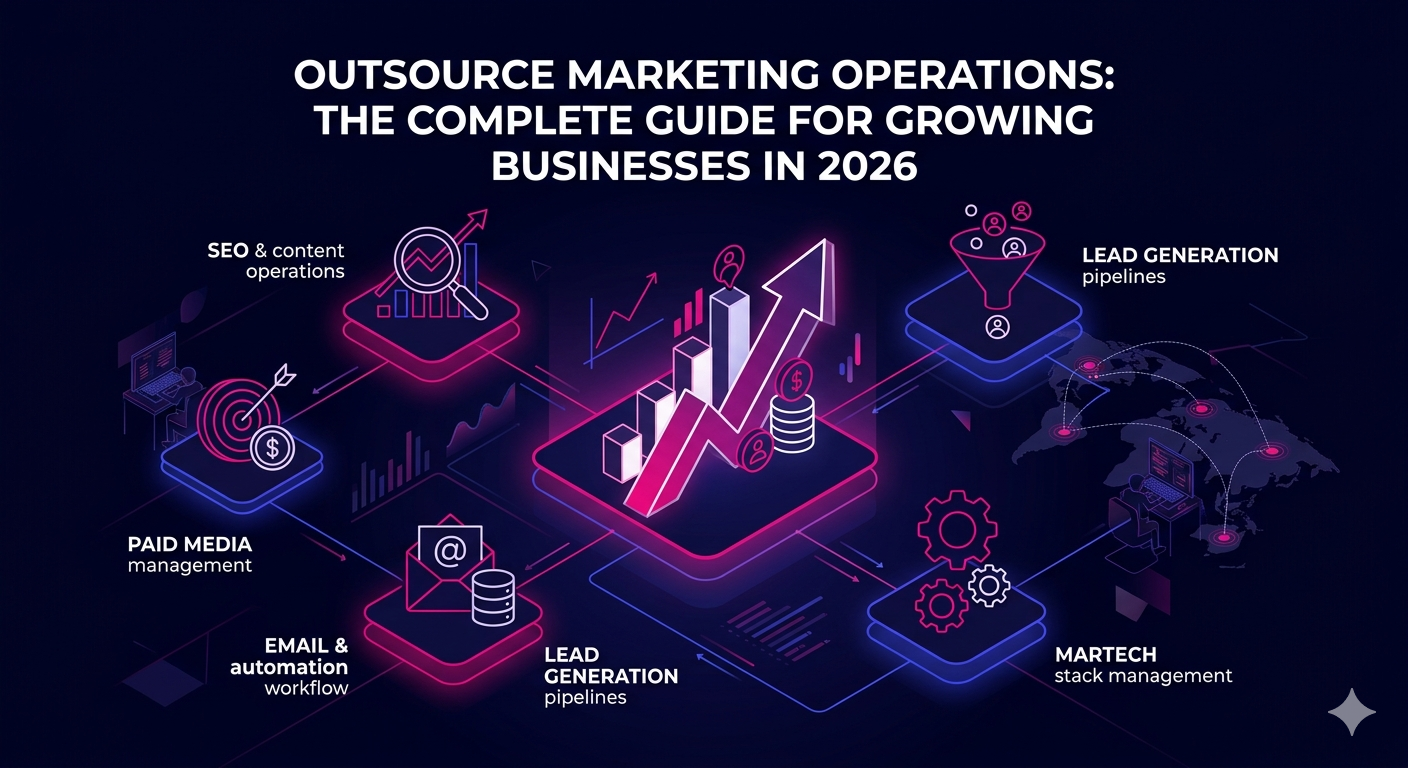
This is different from simply hiring a freelancer to write a blog post. Outsourcing marketing operations involves handing over ongoing, process-driven work such as campaign execution, performance reporting, paid media management, SEO programs, or lead generation pipelines.
Common Marketing Functions Companies Choose to Outsource
- Search engine optimization and content marketing
- Pay-per-click advertising and paid social management
- Email marketing and marketing automation workflows
- Social media management and community engagement
- Lead generation and outbound prospecting
- Performance analytics and reporting
- Marketing technology stack management and integration
- E-commerce product marketing and listing optimization
Each of these functions requires specialized skills, dedicated tools, and consistent time investment. Outsourcing allows you to access all three without maintaining the internal overhead that comes with full-time employees.
Why More Businesses Are Choosing to Outsource Marketing Operations in 2026
The business case for outsourcing marketing operations has strengthened considerably over the past few years. Three forces are driving this acceleration in 2026.
1. The Cost of In-House Marketing Talent Has Risen Sharply
Salaries for experienced digital marketers, paid media specialists, and marketing analysts have climbed steadily. When you add benefits, employer taxes, software subscriptions, and management overhead, a single in-house marketing specialist can cost well over $100,000 per year in total. Outsourcing the same function to a vetted remote specialist often reduces that cost by 40 to 60 percent without sacrificing quality.
2. Marketing Has Become More Specialized Than Ever
Modern marketing requires deep expertise across multiple disciplines. The skills needed to run a sophisticated paid search program are fundamentally different from those required to build an organic content strategy or manage a marketing automation platform. Trying to hire one or two generalists to cover all these areas leads to mediocre results across the board. Outsourcing allows you to bring in the right specialist for each function.
3. Speed to Market Is a Competitive Advantage
Hiring internally takes time. Job postings, interviews, offers, notice periods, and onboarding can add four to six months before a new hire is fully productive. When you outsource marketing operations to an experienced team, you can have qualified specialists working on your campaigns within days. In a fast-moving market, that speed advantage compounds quickly.
What to Look for in an Outsourced Marketing Operations Partner
Not all outsourcing arrangements are created equal. The difference between a productive partnership and a frustrating one usually comes down to a few critical factors.
Proven Track Record With Measurable Results
Ask any provider you are considering for specific case studies with quantifiable outcomes. Strong outsourced marketing teams do not just list the services they provide. They show the revenue impact, the leads generated, the conversion rate improvements, and the cost reductions they delivered for previous clients. If a provider cannot produce concrete evidence of results, that is a clear warning sign.
Transparent Communication and Reporting Cadence
One of the most common frustrations with outsourced marketing is the feeling that work is happening in a black box. A good partner sets clear reporting expectations upfront, shares dashboards you can access in real time, and proactively flags issues rather than waiting for you to ask. Weekly or biweekly check-ins and monthly performance reviews should be standard.
Alignment With Your Existing Technology Stack
Your outsourced marketing operations team needs to work within your existing CRM, analytics platform, ad accounts, and project management tools. Providers who insist on using only their own proprietary tools create dependency and make it difficult to transition if the relationship ends. Look for teams that integrate with what you already have.
Flexibility to Scale Up or Down
Your marketing needs will fluctuate with product launches, seasonal demand, and business cycles. A good outsourced marketing operations partner can scale resources up quickly when you need more support and scale back during quieter periods without a cumbersome renegotiation process.
How to Structure an Outsourced Marketing Operations Model
There is no single right way to structure outsourced marketing, but the most successful models tend to follow a similar pattern.
Keep Strategy In-House, Outsource Execution
The most effective approach for most businesses is to retain strategic decision-making internally while outsourcing execution to specialists. This means your internal marketing lead or CMO sets goals, defines the audience, and approves campaigns, while your outsourced team handles day-to-day execution, reporting, and optimization.
This structure gives you control over your brand and messaging while freeing your internal team from time-consuming operational tasks. It also makes it much easier to hold your outsourced team accountable, since success is measured against clearly defined strategic objectives.
Start With One or Two Functions Before Expanding
Trying to outsource your entire marketing operation at once is a recipe for chaos. Start with the function that is either consuming the most internal time or producing the weakest results. Prove the model with one successful partnership, then gradually expand outsourcing to other areas as your confidence and processes mature.
Build Clear Handoff Processes
Document exactly how work moves between your internal team and your outsourced partners. Who approves copy before it goes live? Who has access to which ad accounts? What does the briefing process look like for new campaigns? Clear handoff documentation eliminates the miscommunication that derails most outsourced marketing programs in their early stages.
Which Marketing Operations Functions Deliver the Best ROI When Outsourced
Based on what businesses consistently report in 2026, certain marketing functions tend to generate the highest return when outsourced to the right specialists.
Paid Media Management
PPC and paid social require constant monitoring, testing, and bid optimization to perform well. An experienced outsourced media buyer who manages multiple accounts daily will almost always outperform an in-house generalist who handles paid media alongside five other responsibilities. The efficiency gains alone typically justify the outsourcing cost within the first quarter.
SEO and Content Operations
Organic search is a long-game investment. Outsourcing SEO operations to a dedicated team means you get consistent content production, technical audits, link building, and performance tracking without the internal bandwidth required to manage all those moving parts. Results compound over time, making this one of the highest-ROI outsourcing decisions for businesses with a 12-month or longer horizon.
Lead Generation and Outbound Prospecting
Building and running an outbound lead generation engine requires specialized skills in data sourcing, copywriting, email sequencing, and follow-up management. Outsourcing this function to a dedicated team lets your sales reps focus on closing deals rather than filling their own pipeline.
If you are ready to outsource your lead generation operations to a dedicated team of remote lead generation experts, working with specialists who focus exclusively on this function produces significantly better results than generalist support.
Mistakes to Avoid When You Outsource Marketing Operations
Even well-intentioned outsourcing arrangements fail when businesses make avoidable mistakes in how they structure and manage the relationship.
- Choosing on price alone: The cheapest provider is rarely the best value. Low-cost outsourcing often means high turnover, poor communication, and shallow expertise that produces mediocre results.
- Skipping the onboarding investment: Your outsourced team needs context to perform well. Cutting corners on onboarding documentation leads to misaligned campaigns and wasted budget.
- Failing to define success metrics upfront: Without agreed-upon KPIs, it is impossible to evaluate performance objectively. Define success metrics before work begins, not three months in.
- Micromanaging execution: If you outsource marketing operations but then require approval on every small decision, you eliminate the speed advantage that makes outsourcing valuable in the first place.
- Not reviewing performance data regularly: Outsourcing does not mean abdicating oversight. Schedule regular reviews and hold your partner accountable to the metrics you set together.
According to Gartner’s research on the future of marketing operations and outsourcing strategies, organizations that establish clear performance frameworks and governance processes before outsourcing report significantly higher satisfaction and ROI from their external marketing partnerships.
Conclusion: The Smart Way to Outsource Marketing Operations in 2026
Outsourcing marketing operations is not about doing less. It is about doing more of what matters by ensuring every marketing function is handled by someone who specializes in exactly that thing. When you match the right outsourced talent to the right function and manage the relationship with clear expectations and consistent oversight, the results consistently outperform what most internal teams can deliver at the same cost.
Start by identifying the one or two marketing functions consuming the most time or producing the weakest results. Build a clear brief, define your success metrics, and partner with a team that has the track record to back up their proposals. Explore the full range of outsourced marketing operations specialists and remote digital marketing talent at TheRemoteReps and find the right fit for your business today.
Frequently Asked Questions About Outsourcing Marketing Operations
What are the main benefits of choosing to outsource marketing operations?
When you outsource marketing operations, you gain immediate access to specialized expertise, reduce fixed payroll costs, accelerate execution timelines, and free your internal team to focus on higher-level strategy. Businesses that outsource marketing operations consistently report lower cost-per-lead and faster campaign deployment compared to managing equivalent functions in-house.
How do I know which marketing functions to outsource first?
Start with functions that are either consuming disproportionate internal time or consistently underperforming against benchmarks. Paid media management, SEO operations, and lead generation are the most commonly outsourced marketing operations because they require deep specialization and continuous optimization that is difficult to sustain with generalist in-house staff.
How much does it cost to outsource marketing operations?
The cost to outsource marketing operations varies based on scope, specialization, and the provider model you choose. Outsourcing a single function such as paid media or SEO to a remote specialist typically costs between $2,000 and $8,000 per month depending on complexity and account size. Full-service outsourced marketing operations programs range from $5,000 to $20,000 or more per month. In most cases, outsourcing delivers significant savings compared to hiring equivalent in-house talent.
What is the difference between outsourcing marketing operations and hiring a marketing agency?
Traditional marketing agencies often work on retainer and manage multiple clients simultaneously with shared account teams. When you outsource marketing operations through a remote staffing model, you get dedicated specialists who work specifically on your business, integrate into your internal workflows, and operate as an extension of your team rather than as a separate vendor. This model typically produces better accountability, stronger institutional knowledge, and faster iteration cycles.
How do I measure success after I outsource marketing operations?
Define your key performance indicators before the engagement begins. Common success metrics for outsourced marketing operations include cost-per-lead, marketing-qualified leads generated per month, paid media return on ad spend, organic traffic growth, email open and click-through rates, and pipeline contribution from marketing channels. Review these metrics monthly and hold your outsourced team to the benchmarks established in the original brief.