
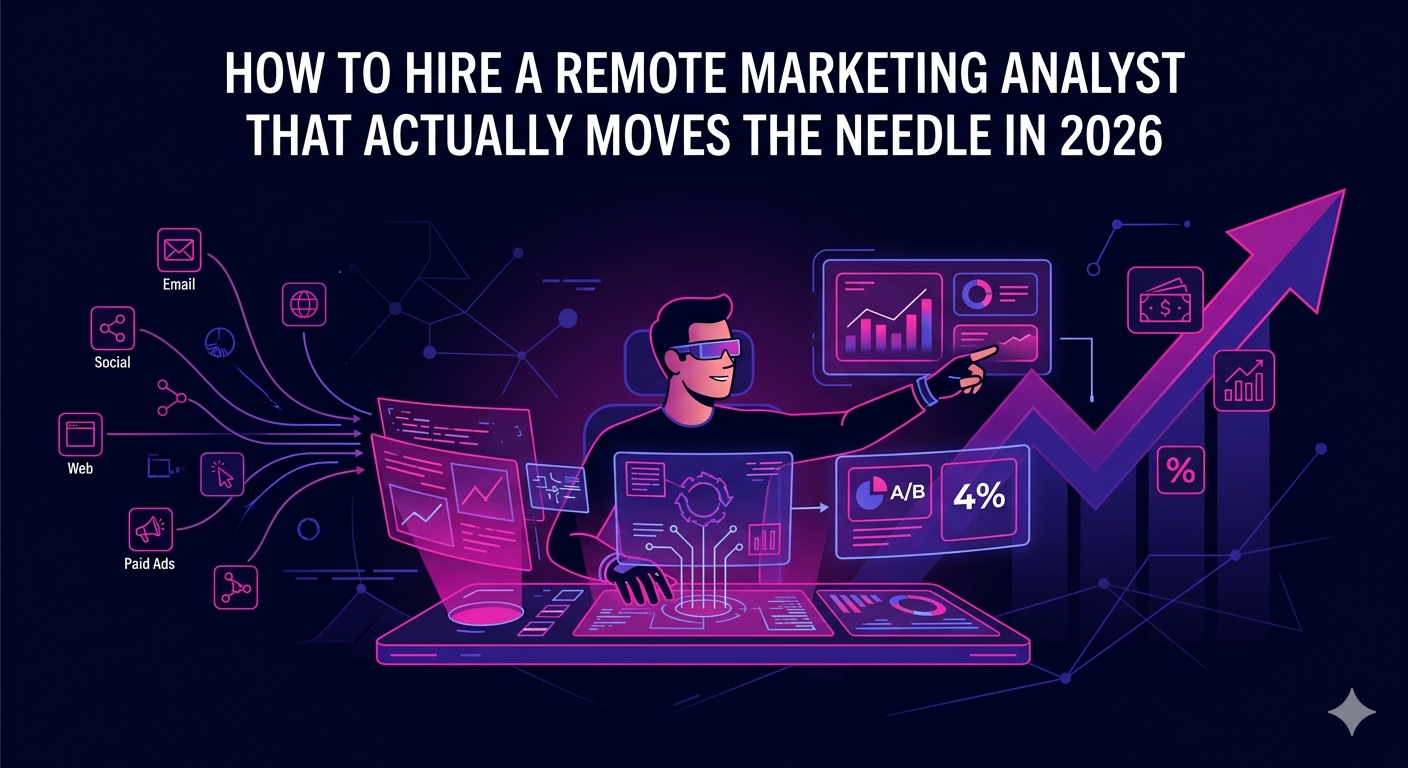
If you have been searching for ways to hire a remote marketing analyst without burning through your budget or wasting months on the wrong candidate, you are not alone. In 2026, the demand for skilled remote marketing analysts has surged dramatically as companies of every size realize that deep data expertise does not have to sit in a corner office to be effective. The challenge is knowing exactly what to look for, where to find the best talent, and how to set that person up for measurable success from day one.
This guide walks you through everything you need to know, from defining the role to evaluating candidates and managing your new hire remotely, so your marketing decisions are backed by sharp, reliable analysis.
What Does a Remote Marketing Analyst Actually Do?
Before you post a job listing, it pays to understand the full scope of the role. A remote marketing analyst is responsible for turning raw data into clear, actionable insights that drive campaign performance, budget efficiency, and revenue growth. Their day-to-day work typically spans several critical areas.
Core Responsibilities of a Remote Marketing Analyst
- Tracking and interpreting key performance indicators (KPIs) across paid, organic, and social channels
- Building dashboards and reports in tools like Google Looker Studio, Tableau, or Power BI
- Conducting A/B tests and multivariate experiments to improve conversion rates
- Identifying audience segments and behavior patterns from CRM and web analytics data
- Collaborating with SEO specialists, paid media buyers, and content teams to align strategy with data
- Forecasting campaign performance based on historical trends and market research
When you hire a remote marketing analyst with strong skills in all these areas, you gain a strategic partner who keeps every marketing dollar accountable.
Why Hiring a Remote Marketing Analyst Makes Business Sense in 2026
The remote work economy has matured considerably. Employers who hesitated five years ago are now discovering that remote marketing analysts consistently deliver exceptional results, often outperforming in-house counterparts because they operate in focused, distraction-free environments and are accustomed to clear documentation and communication.
Key Business Benefits
- Significant cost savings: Remote analysts typically cost 30 to 50 percent less than equivalent in-office hires when you factor in benefits, office space, and equipment.
- Access to a global talent pool: You are no longer limited to candidates who can commute to your city. The best marketing analyst for your needs may be based in a different time zone and available to start immediately.
- Faster hiring cycles: Specialized remote staffing platforms can match you with pre-vetted talent in days rather than weeks.
- Scalability: Need two analysts for a product launch and one afterward? Remote arrangements flex with your business cycle more easily than traditional employment.
- Round-the-clock data monitoring: A distributed team means someone is always watching your dashboards, even when your local team is offline.
According to research published by Harvard Business Review on remote work and organizational performance, companies that embrace distributed talent models report higher employee retention and broader skill diversity than those relying solely on local hiring.
Where to Find the Best Remote Marketing Analyst Candidates
Knowing where to look is half the battle. Generic job boards surface a high volume of applicants but rarely the right ones. For a specialized role like a remote marketing analyst, the following approaches work best.
Specialized Remote Staffing Platforms
Platforms purpose-built for remote marketing talent handle the hardest parts of hiring for you. They pre-screen candidates for technical skills, communication ability, and cultural fit before a single interview is scheduled. This is the fastest path to a qualified hire.
If you want to hire vetted remote marketing analysts and digital marketing specialists with proven track records, working with a dedicated remote staffing agency cuts your time-to-hire dramatically while reducing the risk of a costly mis-hire.
Professional Networks and LinkedIn
LinkedIn remains a strong channel for sourcing mid-level and senior analysts. Look for candidates with certifications in Google Analytics 4, HubSpot, or Meta Blueprint alongside measurable results in past roles. A candidate who lists percentage improvements in conversion rates or cost-per-acquisition is far more credible than one who simply lists job titles.
Referrals from Your Existing Marketing Team
Your current team members often know skilled analysts who are open to new opportunities. Offering a referral bonus for successful hires through this channel tends to surface high-quality candidates quickly.
How to Evaluate a Remote Marketing Analyst Before You Hire
The interview process for a remote marketing analyst should be structured around demonstrating skills, not just discussing them. Here is a proven evaluation framework.
Step 1: Review a Work Portfolio or Sample Analysis
Ask candidates to share a real or anonymized report they have built. You want to see how they organize data, what story they tell with it, and whether their visualizations are clear enough for a non-technical executive to understand. Cluttered dashboards are a red flag; clean, insight-driven reports are a green light.
Step 2: Administer a Practical Skills Test
Provide a sample dataset and ask the candidate to complete a short analysis within a defined time frame. This tests analytical thinking, tool proficiency, and the ability to work independently. Good remote marketing analysts thrive under this kind of task-based assessment.
Step 3: Assess Communication and Documentation Habits
Remote work lives and dies by written communication. Ask candidates how they document their analysis process, how they report findings to stakeholders who are not data-literate, and how they handle situations where the data contradicts the team’s assumptions. Clear, confident communicators make the transition to remote work seamless.
Step 4: Check References Carefully
Speak directly with former managers or clients rather than relying on written recommendations. Ask specifically about the candidate’s ability to meet deadlines independently, flag problems proactively, and deliver insights that led to concrete business decisions.
How to Onboard and Manage Your Remote Marketing Analyst Successfully
Hiring the right person is only the first step. A structured onboarding process determines how quickly your new remote marketing analyst starts contributing at full capacity.
First 30 Days: Orientation and Access
- Grant access to all necessary analytics platforms, ad accounts, and CRM systems on day one
- Share your current marketing strategy, existing reports, and historical performance data
- Introduce them to key stakeholders across marketing, sales, and product teams
- Set clear expectations around reporting cadence and communication channels
Days 31 to 90: Ownership and Output
- Assign a defined project with measurable outcomes as their first major deliverable
- Schedule weekly one-on-one check-ins to review progress and remove blockers
- Encourage them to challenge existing metrics frameworks if they identify gaps
Remote analysts who are given clear ownership from the start typically reach full productivity significantly faster than those kept in an observational role during their first months.
Compensation Benchmarks for Remote Marketing Analysts in 2026
Compensation varies considerably based on experience, specialization, and geography. Here is a general benchmark for 2026.
- Junior remote marketing analyst (0 to 2 years): $45,000 to $60,000 annually or $22 to $30 per hour
- Mid-level remote marketing analyst (3 to 5 years): $65,000 to $90,000 annually or $32 to $45 per hour
- Senior remote marketing analyst (6 or more years): $95,000 to $130,000 annually or $48 to $65 per hour
- Contract or freelance remote marketing analyst: $50 to $85 per hour depending on specialization
Analysts with deep expertise in paid media attribution, marketing mix modeling, or multi-touch attribution command a premium at every level.
Red Flags to Watch for When You Hire a Remote Marketing Analyst
Not every candidate who looks good on paper will perform well in a remote setting. Watch for these warning signs during your hiring process.
- Vague answers about specific tools or methodologies they have used
- Inability to explain complex data concepts in plain language
- No concrete examples of how their analysis led to a business decision
- Poor responsiveness during the interview process itself, which often predicts remote communication habits
- Overreliance on a single tool, indicating limited analytical versatility
Conclusion: Make Your Next Marketing Hire a Remote One
The case for hiring a remote marketing analyst has never been stronger. You get access to specialist talent without geographic limits, significant cost advantages over in-office hiring, and the flexibility to scale your analytical capacity as your business grows.
The key is approaching the process with the same rigor you would apply to any senior hire: define the role clearly, evaluate candidates on demonstrated skills, and set them up for success with a structured onboarding plan. Do that, and your remote marketing analyst will quickly become one of your most valuable assets.
Ready to take the next step? Explore the full range of pre-vetted remote digital marketers and marketing analysts available through TheRemoteReps and connect with the right hire today.
Frequently Asked Questions About Hiring a Remote Marketing Analyst
What qualifications should I look for when I hire a remote marketing analyst?
When you hire a remote marketing analyst, prioritize candidates with a degree in marketing, statistics, business, or a related field alongside hands-on certifications such as Google Analytics 4, HubSpot Analytics, or Meta Blueprint. More important than formal credentials is a demonstrated ability to translate data into business decisions, strong proficiency with tools like Excel, SQL, Tableau, or Looker, and a history of working autonomously in remote roles.
How long does it typically take to hire a remote marketing analyst?
The timeline to hire a remote marketing analyst depends heavily on your hiring channel. Using a specialized remote staffing agency can reduce the process to as little as one to two weeks, since candidates are pre-vetted. Hiring through general job boards or direct outreach typically takes four to eight weeks when you account for sourcing, screening, interviews, and offer negotiation.
Is it more cost-effective to hire a remote marketing analyst on a contract or full-time basis?
The answer depends on your workload. For ongoing reporting, recurring campaign analysis, and long-term strategic support, a full-time remote marketing analyst is usually more cost-effective over a 12-month horizon. For project-based work, a product launch analysis, or a one-time audit, contracting a remote marketing analyst on an hourly or project fee basis gives you expert support without a long-term commitment.
What tools should a remote marketing analyst be proficient in?
A well-rounded remote marketing analyst should be comfortable with web analytics platforms such as Google Analytics 4 or Adobe Analytics, data visualization tools such as Tableau, Looker Studio, or Power BI, CRM platforms such as Salesforce or HubSpot, spreadsheet tools including advanced Excel and Google Sheets, and ideally SQL for querying databases directly. Familiarity with paid media dashboards from Google Ads and Meta Ads Manager is a strong additional plus.
How do I manage and retain a remote marketing analyst effectively?
Retaining a strong remote marketing analyst comes down to three things: clarity, ownership, and growth. Provide clear goals and reporting expectations from the start. Give them genuine ownership over dashboards, reports, and analytical frameworks rather than just assigning them manual tasks. Invest in their professional development through access to industry courses, conferences, or certifications. Regular one-on-one check-ins and genuine recognition of impactful work go a long way in building loyalty in a remote environment.