
Growing a pipeline is expensive when you rely entirely on local talent. Salaries, benefits, office space, and recruiting fees add up quickly, and in many markets, qualified outbound specialists are simply hard to find. That is why more B2B companies in 2026 are choosing to build an offshore lead gen team. Done right, this model delivers the same quality of prospecting and outreach at a fraction of the cost, without sacrificing performance or control.
This guide walks you through everything you need to know to build, manage, and scale an offshore lead generation team that consistently fills your pipeline.
What Is an Offshore Lead Gen Team and Why Does It Work?
An offshore lead gen team is a group of remote lead generation specialists based in a different country from your headquarters, typically in regions like Southeast Asia, Eastern Europe, Latin America, or South Asia. These specialists handle outbound prospecting, cold outreach, list building, and lead qualification on behalf of your business.
The model works because lead generation is a process-driven, tool-dependent function. It does not require physical presence, proximity to your customers, or local market knowledge in most B2B contexts. What it requires is skill, discipline, the right technology stack, and clear direction from your leadership team.
Why Companies Are Choosing Offshore Lead Generation in 2026
- Labor costs in offshore markets are 50 to 70 percent lower than comparable US or UK roles
- The talent pool for outbound sales and lead generation has expanded globally
- Remote work tools make collaboration across time zones seamless
- Companies can scale team size up or down based on demand without the complexity of local hiring
- Offshore specialists often bring multilingual capabilities useful for international outreach
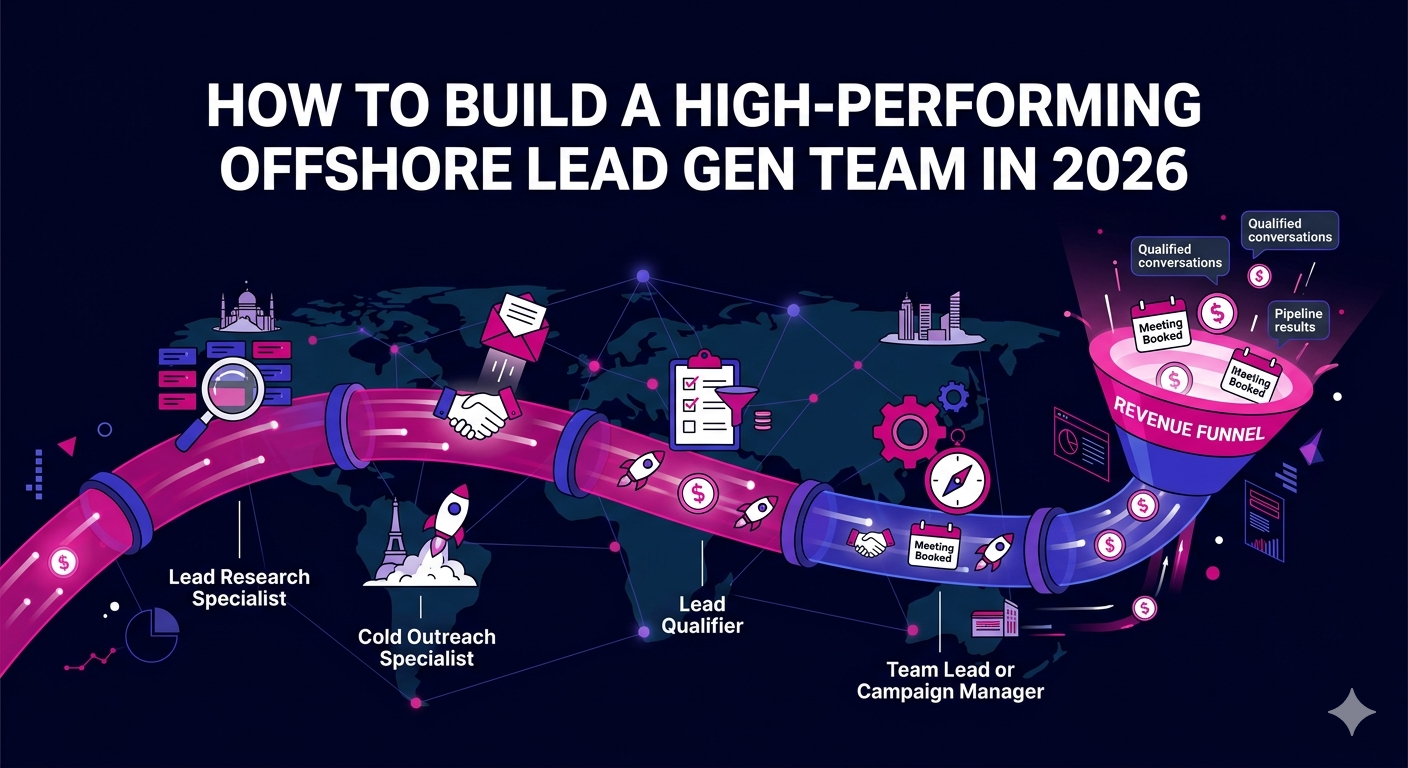
The Core Roles in a Productive Offshore Lead Gen Team
A well-structured offshore lead generation team is not just a group of people sending emails. It is a set of complementary roles that each contribute to a specific part of the outbound process.
Lead Research Specialist
This person is responsible for building accurate, targeted prospect lists. They use tools like Apollo, ZoomInfo, or Clay to identify companies and contacts that match your ideal customer profile. Quality list building is the foundation of every campaign. Without it, even the best copy will underperform.
Cold Outreach Specialist
The cold outreach specialist writes and sends the actual emails and LinkedIn messages. They manage sending sequences using platforms like Instantly or Smartlead, monitor deliverability, and run A/B tests on subject lines and body copy. Their core metric is reply rate, and strong performers consistently hit between 5 and 15 percent on well-targeted campaigns.
Lead Qualifier
Not every reply is a good lead. The qualifier reviews responses, determines whether a prospect fits your criteria, and either routes them to your sales team or continues nurturing them. This role keeps your account executives focused on opportunities that are actually worth their time.
Team Lead or Campaign Manager
For teams of three or more, a dedicated team lead is worth the investment. This person oversees daily operations, reviews campaign performance, manages quality control, and serves as the primary point of contact between your offshore team and your internal leadership. A strong team lead dramatically reduces the management overhead on your side.
How to Find and Hire the Right Offshore Lead Gen Talent
Sourcing strong offshore talent takes more than posting a job ad. The best candidates are not always active job seekers. Here is how to find people who are genuinely skilled at outbound lead generation.
Work With a Specialized Talent Platform
General outsourcing platforms tend to attract candidates with broad skills rather than deep expertise. If you want specialists who have actually run cold email campaigns, built prospect lists, and driven pipeline results, work with a platform that vets candidates specifically for sales and lead generation roles. You can build your offshore lead gen team with vetted lead generation experts who are screened for the exact skills your outbound function requires, cutting weeks from your sourcing and reducing the risk of a costly mis-hire.
Use LinkedIn to Identify Active Practitioners
Search for candidates in your target regions using titles like SDR, BDR, Outbound Specialist, or Lead Generation Analyst. Look at their activity. People who post about outbound tactics, share campaign learnings, or engage with sales communities are usually more current and capable than those with strong resumes but no visible professional presence.
Assess Candidates With a Practical Test
Before making any offer, give finalists a short assignment. Provide your ideal customer profile and ask them to build a sample prospect list of 10 contacts with sourcing notes, write a three-email cold outreach sequence, and explain how they would measure campaign success. This single exercise reveals targeting logic, writing quality, and analytical thinking in a way no interview can replicate.
Managing an Offshore Lead Gen Team for Maximum Performance
The biggest reason offshore lead generation teams underperform is poor management, not poor talent. If your team lacks direction, feedback, or clear metrics, results will be inconsistent regardless of how skilled the individuals are.
Set Clear KPIs From Day One
Define success before your team sends a single message. Core metrics for an offshore lead gen team should include leads contacted per week, email open rate, reply rate, positive reply rate, and meetings booked. Secondary metrics include domain health, bounce rate, and sequence completion rate. Review these numbers weekly and make sure every team member understands what they are working toward.
Build a Strong Onboarding Process
Your offshore team cannot perform without context. Provide them with a detailed ideal customer profile, documented value propositions, competitive differentiators, case studies they can reference, and examples of your best-performing past campaigns. The more they understand your business and your buyers, the more relevant and effective their outreach will be.
Use Async Communication Tools Effectively
Time zone differences are manageable with the right tools and habits. Use Slack or a similar platform for ongoing communication, Loom for video updates and feedback, and a shared dashboard in your CRM for real-time campaign visibility. Schedule at least one live call per week for strategic alignment, and use async updates for daily reporting to avoid unnecessary meeting overhead.
Provide Regular Feedback on Copy and Targeting
Your offshore team is only as good as the feedback loop you create. Review email sequences before they launch. Share feedback on what is working and what is not. When a campaign underperforms, dig into the data together and identify whether the issue is the list, the messaging, or the offer. Teams that receive clear, actionable feedback improve rapidly. Teams that operate in a vacuum plateau quickly.
What Results Can You Expect From an Offshore Lead Gen Team?
Results vary based on your market, offer, and list quality, but the economics of an offshore lead gen team are almost always favorable compared to building equivalent capacity with local hires.
A three-person offshore team running well-structured outbound campaigns can realistically generate 15 to 40 qualified conversations per month depending on your average deal size and target market. At a fraction of the cost of a local SDR team, the return on investment for most B2B businesses is clear within the first 90 days.
Research published by Deloitte’s Global Outsourcing Survey consistently shows that cost reduction and access to skilled talent are the two primary drivers behind offshore team decisions, with the majority of companies reporting that their offshore functions met or exceeded expectations. For lead generation in particular, where the work is measurable and process-driven, offshore teams tend to deliver strong and consistent results when properly structured and managed.
Common Mistakes to Avoid When Building an Offshore Lead Gen Team
- Hiring based on cost alone without assessing outbound-specific skills
- Failing to provide a clear ideal customer profile before campaigns launch
- Setting up a team and expecting it to run without regular management input
- Not investing in quality tools like a proper sending platform and CRM integration
- Measuring output (emails sent) instead of outcomes (qualified replies and meetings booked)
- Skipping domain warmup and deliverability setup, which tanks campaign performance from the start
FAQ: Building an Offshore Lead Gen Team
What is an offshore lead gen team and how is it different from a local team?
An offshore lead gen team is a group of lead generation specialists based in a different country from your headquarters who handle outbound prospecting, cold outreach, and lead qualification remotely. The core difference from a local team is cost structure and sourcing geography. An offshore lead gen team typically costs 50 to 70 percent less than an equivalent local team while delivering comparable output when properly managed and equipped.
Which countries are best for building an offshore lead gen team?
Popular locations for building an offshore lead gen team include the Philippines, India, Colombia, Poland, and Ukraine. The best choice depends on your target market, language requirements, and budget. For English-language outreach targeting North American or European buyers, the Philippines and Colombia are particularly strong options due to high English proficiency and strong familiarity with Western business culture.
How much does it cost to build an offshore lead gen team?
The cost of an offshore lead gen team varies by region and role seniority. In the Philippines or Colombia, a skilled cold outreach specialist typically earns between $1,000 and $2,500 per month. A team of three including a researcher, outreach specialist, and qualifier can often be built and operated for $4,000 to $7,000 per month, including management and tooling costs. This compares favorably to a single mid-level SDR in a major US market.
How do I manage an offshore lead gen team across different time zones?
Managing an offshore lead gen team across time zones is straightforward with the right tools and routines. Use Slack for async daily updates, Loom for video feedback, and a shared CRM dashboard for real-time visibility into campaign performance. Schedule one weekly live call for strategic alignment and feedback. Most offshore teams in the Philippines or Latin America can also work hours that overlap with US business hours, which simplifies real-time communication significantly.
How long does it take for an offshore lead gen team to start delivering results?
A newly formed offshore lead gen team typically needs two to three weeks for onboarding, tool setup, domain warmup, and initial list building before the first sequences go live. Early replies often come in during the first send week. By the 60 to 90 day mark, a well-managed offshore lead gen team should be producing a consistent and predictable volume of qualified pipeline every month.
Conclusion
Building an offshore lead gen team is one of the most cost-effective decisions a B2B company can make in 2026. The talent is available, the tools are reliable, and the process is proven. What separates teams that succeed from those that stall is the quality of the hire, the clarity of the direction, and the consistency of the management.
If you are ready to build a pipeline engine that works while you sleep, start with the right foundation. Explore vetted offshore lead gen team talent and connect with specialists who are ready to build and run your outbound from day one.