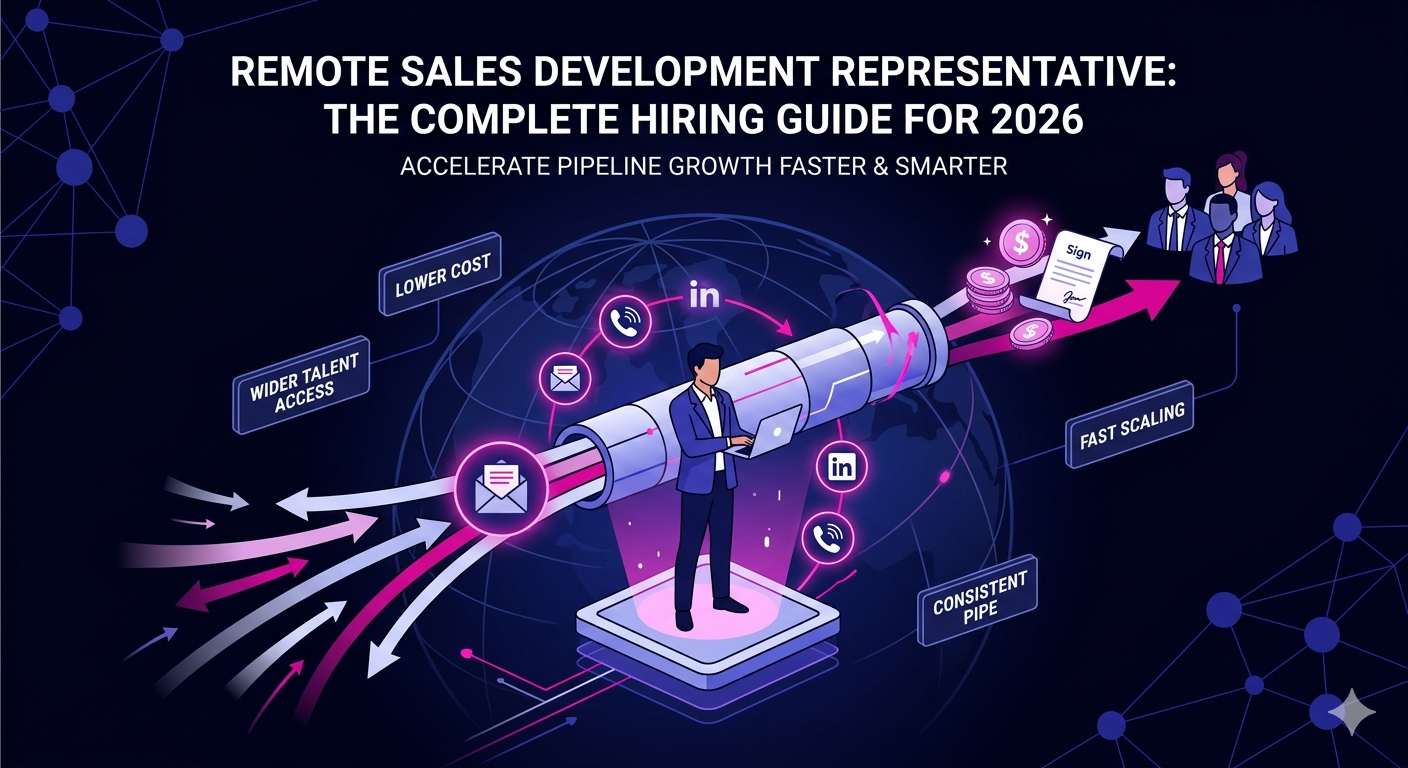
The way B2B companies build their sales pipeline has changed permanently. In 2026, the remote sales development representative is no longer a compromise or a workaround. It is the preferred model for forward-thinking companies that want to scale their outbound efforts faster, smarter, and at a lower cost than traditional in-house hiring allows.
Whether you are building your first SDR function or looking to expand an existing team, this guide covers everything you need to know about hiring, managing, and maximizing the performance of a remote sales development representative in today’s competitive market.
What Is a Remote Sales Development Representative?
A remote sales development representative performs the same core function as an on-site SDR, but works entirely from a remote location, whether that is across the country or on the other side of the world. Their primary job is to generate qualified pipeline for your closing team by identifying prospects, initiating conversations, and booking discovery meetings or demos.
The day-to-day responsibilities of a remote sales development representative typically include:
- Researching and building targeted prospect lists based on your ideal customer profile
- Sending personalized outbound cold emails through sequencing tools
- Engaging prospects via LinkedIn with connection requests and follow-up messages
- Making outbound calls to qualify interest and schedule meetings
- Managing multi-touch outreach cadences across email, phone, and social
- Qualifying inbound leads and routing them appropriately
- Logging all activities and updating contact records in the CRM
- Collaborating with Account Executives to ensure smooth handoffs
The remote format changes where the work happens, not the quality or scope of what gets done. With the right tools and management structure, a remote sales development representative consistently matches and often exceeds the output of an office-based counterpart.
Why Companies Are Choosing Remote Sales Development Representatives in 2026
Lower Cost, Same Caliber of Output
Hiring a full-time, in-office SDR in North America or Western Europe in 2026 carries a fully loaded cost of $65,000 to $90,000 per year once salary, benefits, payroll taxes, office overhead, and tooling are included. A remote sales development representative sourced through a specialist provider can deliver the same results at 40 to 65 percent lower total cost, particularly when talent is sourced from regions such as the Philippines, Latin America, or Eastern Europe.
Wider Access to Qualified Talent
The remote model removes geography as a hiring constraint entirely. Instead of competing with every sales team in your city for a limited supply of candidates, you gain access to a global pool of trained, English-proficient sales professionals who have direct experience with outbound prospecting, CRM management, and multi-channel outreach strategies.
Faster Time to First Meeting Booked
When you work with an established remote staffing provider, you skip the multi-week hiring cycle and jump straight to onboarding. A well-placed remote sales development representative can complete onboarding within one to two weeks and begin producing pipeline activity in their third week. That speed matters when your revenue goals are tied to quarterly pipeline targets.
Built-in Flexibility to Scale
Business growth is rarely linear. With remote sales development representatives, you can add headcount during a campaign sprint or reduce it between growth phases without the HR complexity of office-based employment contracts, severance, or extended notice periods. This flexibility is one of the most cited reasons sales leaders make the shift to remote SDR models.
Core Skills to Look for in a Remote Sales Development Representative
Not every remote candidate has the skills to perform well in an SDR role. When evaluating candidates, prioritize these qualities:
Written and Spoken English Proficiency
Cold emails, LinkedIn messages, and discovery calls all depend on clear, professional, persuasive communication. A remote sales development representative must be able to write outreach that sounds natural and confident, and to hold a qualifying call without language barriers undermining the conversation. Always test written and spoken English directly during the interview process.
CRM and Outreach Tool Competency
Your remote SDR should be able to work independently inside your existing tech stack. Look for hands-on experience with platforms like Salesforce, HubSpot, Apollo, Instantly, Outreach, or Salesloft. A candidate who needs to be taught basic tool usage from scratch will take significantly longer to produce results.
Self-Discipline and Remote Work Maturity
This is one of the most important differentiators between a great remote sales development representative and a mediocre one. Remote SDRs must manage their own daily activity targets, follow structured cadences, and stay motivated without a physical office environment to anchor them. Ask candidates for examples of how they have managed their own pipeline in previous remote roles.
Coachability and a Growth Orientation
The best SDRs, remote or otherwise, are the ones who take feedback seriously and adjust quickly. During interviews, present a short outreach scenario and ask how they would respond to specific prospect objections. Watch how they incorporate your feedback in follow-up responses.
Data Literacy and Attention to Detail
A strong remote sales development representative tracks their own metrics, understands what is working and what is not, and can speak to their numbers with confidence. They also keep CRM records clean and up to date, which is critical for the broader sales team to operate efficiently.
How to Set Up a Remote Sales Development Representative for Success
Build a Thorough Onboarding Program
Your remote SDR needs to understand your product deeply, your buyer personas clearly, and your competitive landscape honestly before making a single outreach attempt. A structured onboarding program covering product training, ICP definition, message frameworks, objection handling, and tool setup should span at least five to ten business days. This investment pays back many times over in campaign quality.
Equip Them with the Right Tools
Before day one, ensure your remote sales development representative has full access to your CRM, a verified email sending domain, a LinkedIn Sales Navigator license if needed, and any relevant prospecting databases. Tool access delays are one of the most preventable sources of lost productivity in remote SDR onboarding.
Establish Weekly Performance Reviews
Set a recurring weekly check-in to review key metrics: emails sent, reply rates, calls completed, meetings booked, and pipeline value generated. Use call recordings to provide specific, scene-by-scene coaching feedback. The quality of your management cadence is directly correlated to the quality of your remote SDR’s output over time.
Create a Collaborative Team Culture
Remote SDRs perform better when they feel connected to the broader sales team. Include them in team meetings, share wins publicly, and create clear pathways for career development. Isolation is one of the leading causes of turnover in remote sales roles, and preventing it starts with intentional culture-building from the hiring manager.
For a deeper understanding of how top-performing remote sales development representatives are structured within high-growth companies, LinkedIn’s research on remote sales development representative effectiveness provides data-backed insights into the habits and structures that drive consistent results.
If you are ready to hire a vetted remote sales development representative without the lengthy search process, explore The Remote Reps’ dedicated SDR placement service and connect with top remote SDR talent matched to your specific business needs.
Measuring the ROI of a Remote Sales Development Representative
Hiring a remote SDR is an investment, and like any investment, it needs to be measured against clear benchmarks. Here are the key performance indicators to track from month one:
- Meetings booked per month: A fully ramped remote sales development representative should consistently book between 8 and 20 qualified meetings per month depending on your market and outreach volume.
- Email reply rate: Industry benchmarks for cold email hover between 5 and 15 percent. Anything consistently above 10 percent indicates strong personalization and targeting.
- Call connect and conversion rate: Track how many calls connect and what percentage lead to a qualified conversation or next step.
- Pipeline value sourced: Beyond meetings, measure the total value of opportunities your SDR has contributed to the pipeline over a 30, 60, and 90 day period.
- Meeting to opportunity conversion: How many SDR-sourced meetings progress to a formal sales opportunity? This metric reveals both SDR quality and ICP accuracy.
FAQ: Remote Sales Development Representative
What does a remote sales development representative actually do every day?
A remote sales development representative spends the majority of their day on outbound prospecting activities: researching target accounts, sending personalized emails, making calls, and engaging prospects on LinkedIn. They manage multi-touch sequences across channels, qualify incoming leads, book meetings for Account Executives, and maintain accurate CRM records. Their output is measured primarily by the volume and quality of qualified meetings they generate each month.
How is a remote sales development representative different from an inside sales rep?
A remote sales development representative focuses exclusively on the top of the funnel. Their job is to identify, engage, and qualify prospects, then hand them off to a closing rep. An inside sales representative, by contrast, typically handles the entire sales cycle from prospecting through to closing. SDRs are specialists in pipeline generation; inside sales reps are generalists who both develop and close deals.
What tools does a remote sales development representative need to be effective?
A remote sales development representative needs access to a CRM such as Salesforce or HubSpot for pipeline management, an email sequencing tool such as Apollo, Instantly, or Outreach for campaign management, a prospecting database for building targeted lists, LinkedIn Sales Navigator for social outreach, and a calling or dialier tool for phone prospecting. A reliable internet connection and a quiet, professional workspace are also non-negotiable for call-based activities.
How long does it take a remote sales development representative to become fully productive?
Most remote sales development representatives reach full productivity within four to eight weeks of starting, assuming a structured onboarding program is in place. The first two weeks typically focus on product training, messaging, and tool setup. Weeks three and four involve live outreach with close coaching. By weeks five through eight, a well-onboarded remote SDR should be meeting or approaching their monthly meeting targets consistently.
How do I keep a remote sales development representative motivated and engaged long-term?
Keeping a remote sales development representative motivated over the long term requires a combination of fair compensation, consistent recognition, clear career progression pathways, and regular coaching that helps them improve. Include remote SDRs in team meetings and broader company updates, celebrate their wins publicly, and provide a roadmap for advancement into Account Executive or senior sales roles. SDRs who see a future at your company stay and perform significantly longer than those who feel stagnant.
Can a remote sales development representative handle outreach in multiple industries or verticals?
Yes, many experienced remote sales development representatives have worked across multiple industries and can adapt their prospecting and messaging approach to different verticals. However, performance is typically stronger when a remote SDR is focused on a single, clearly defined target market with a consistent ICP. The more specific the targeting, the more personalized the outreach, and the higher the reply and meeting conversion rates will be.
Build Your Pipeline with a Remote Sales Development Representative Today
In 2026, the remote sales development representative model is not just viable. It is one of the most cost-effective, scalable, and strategically sound ways to build consistent pipeline for your business. With the right hiring partner, a structured onboarding process, and a clear management framework, your remote SDR can become one of the highest-returning investments in your sales operation.
The Remote Reps connects growing businesses with pre-vetted remote sales development representatives who are ready to generate pipeline from day one. Stop waiting for a local hire to ramp and start booking qualified meetings faster.