
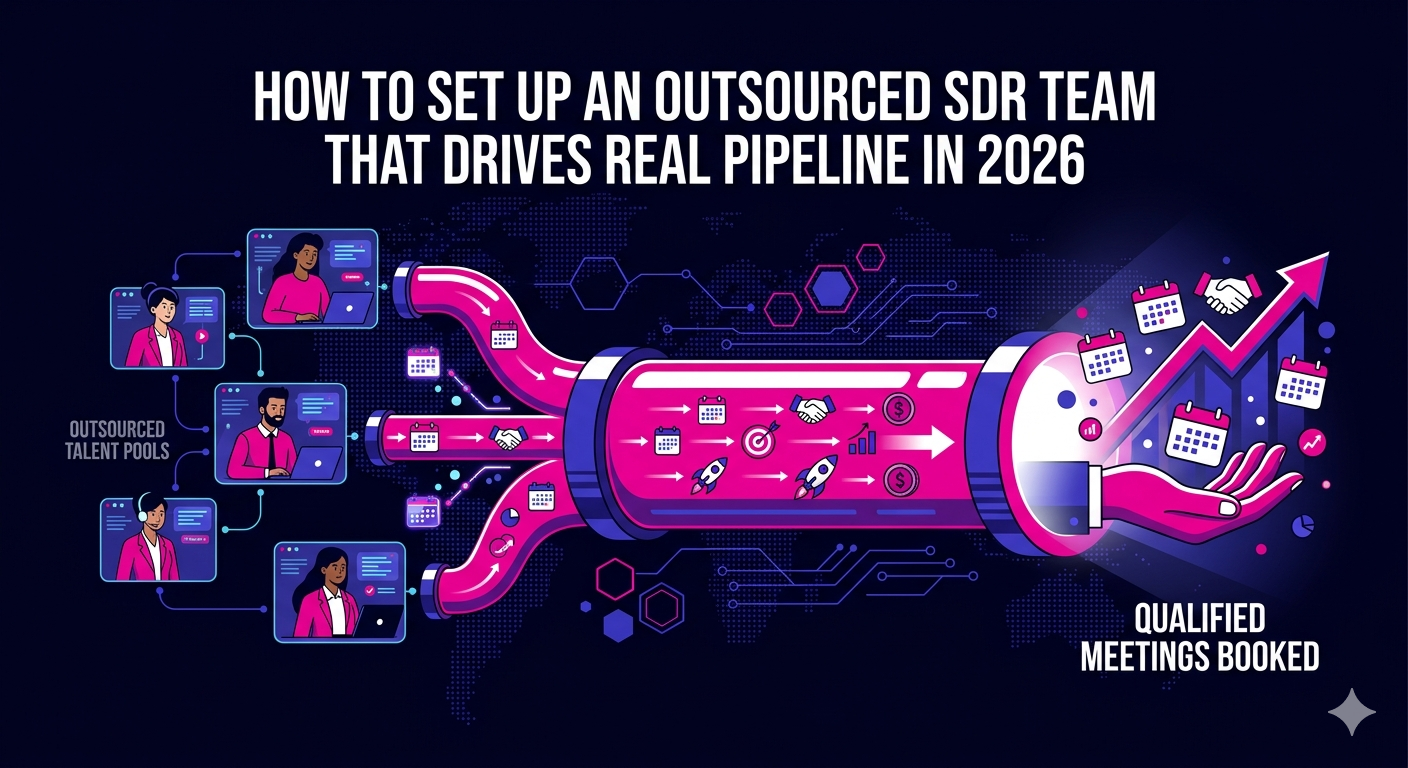
If your sales pipeline has slowed down or your internal team is stretched thin, learning how to set up an outsourced SDR team could be the most important decision you make this year. In 2026, more B2B companies than ever are moving away from costly in-house hiring and turning to outsourced Sales Development Representatives to generate qualified leads faster, cheaper, and with far less management overhead.
This guide walks you through every step of the process, from defining your goals to onboarding your first rep, so you can build a team that books meetings and drives revenue from day one.
What Is an Outsourced SDR Team?
An outsourced SDR team is a group of Sales Development Representatives who work for your company on a contract or managed-service basis, typically sourced and supervised through a specialist staffing or sales outsourcing provider. Unlike full-time employees, outsourced SDRs are hired for specific outputs: booked meetings, qualified leads, and top-of-funnel pipeline growth.
The model is popular because it eliminates the long ramp time of internal hires, reduces payroll costs, and gives you access to reps who are already trained in cold outreach, objection handling, and CRM tools.
Why Outsource Your SDR Function in 2026?
The business case for outsourcing your SDR function has only grown stronger in recent years. Here is why companies are making the shift:
- Lower cost per meeting: Outsourced SDRs typically cost 40 to 60 percent less than an equivalent in-house hire when you factor in salary, benefits, tools, and management time.
- Faster time to pipeline: A well-run outsourced team can be live within two to three weeks versus three to six months for an internal hire.
- Flexibility: Scale up or down based on campaign cycles, product launches, or seasonal demand without the risk of redundancies.
- Access to specialized talent: Top outsourcing providers give you SDRs with experience in your specific industry or ICP, reducing ramp time further.
- Focus on closing: Your account executives can focus entirely on closing deals while outsourced SDRs fill the top of the funnel.
Step-by-Step: How to Set Up an Outsourced SDR Team
Step 1 — Define Your Goals and KPIs
Before you contact any provider, get crystal clear on what you need. Ask yourself:
- How many qualified meetings per month do you need to hit your revenue targets?
- What does your ideal customer profile (ICP) look like?
- What channels will your SDRs use: cold email, cold calling, LinkedIn outreach, or a multi-channel mix?
- What does a “qualified lead” mean to your sales team?
Documenting clear KPIs before you start, such as meetings booked per week, reply rates, and pipeline value generated, gives your outsourced team specific targets to work toward and gives you a clear way to measure ROI.
Step 2 — Choose the Right Outsourcing Model
There are three main models for outsourcing your SDR function:
- Fully managed: The provider handles hiring, training, management, and reporting. Best for companies with no internal sales ops infrastructure.
- Staff augmentation: You hire individual SDRs who integrate into your existing team and tools. Best when you already have a sales process and just need execution capacity.
- Project-based: SDRs are engaged for a specific campaign, product launch, or market expansion. Best for short-term pipeline sprints.
For most growing B2B companies, staff augmentation offers the best balance of control and cost efficiency. You can explore dedicated outsourced SDR services to find the right model for your business stage and growth goals.
Step 3 — Build Your Ideal Candidate Profile
Even when outsourcing, you should define what a great SDR looks like for your business. Consider:
- Industry experience (SaaS, fintech, healthcare, logistics, etc.)
- Familiarity with your CRM (HubSpot, Salesforce, Pipedrive)
- Experience with cold outreach tools like Apollo, Outreach, or Lemlist
- Communication style that fits your brand voice
- Time zone alignment with your target market
Sharing this profile with your outsourcing partner early in the process dramatically improves the quality of candidates you receive.
Step 4 — Create a Scalable Onboarding Process
One of the most common mistakes companies make when setting up an outsourced SDR team is skipping onboarding. Even experienced SDRs need context about your product, your buyer personas, and your competitive positioning.
A solid onboarding checklist should include:
- A product and value proposition overview (video or deck format works well)
- Persona deep-dives for each ICP segment
- Approved email and call scripts with room for personalization
- Access to your CRM, sequencing tool, and LinkedIn Sales Navigator
- A shadow week where the SDR observes sales calls before making their own
- A 30-day ramp plan with milestone check-ins
The better your onboarding, the faster your outsourced SDRs will generate pipeline. Treat them like your own team from day one.
Step 5 — Set Up Your Tech Stack
Your outsourced SDR team needs the right tools to operate efficiently. The core stack for most teams in 2026 includes:
- CRM: Salesforce, HubSpot, or Pipedrive for logging activity and tracking pipeline
- Sales engagement platform: Outreach, Salesloft, or Instantly for email and call sequences
- Data provider: Apollo.io, ZoomInfo, or Clay for contact data and enrichment
- LinkedIn automation: LinkedIn Sales Navigator with or without a tool like Expandi for social touches
- Calling software: Aircall or JustCall for logged, recorded outbound calls
If you want even more leverage in your outbound motion, pairing your SDR team with dedicated cold email experts can accelerate results by running a high-volume email channel in parallel with phone and LinkedIn outreach.
Step 6 — Establish Communication and Reporting Cadences
Outsourced does not mean invisible. The most successful outsourced SDR teams operate with structured, regular communication. Build in:
- A weekly sync between your internal team and the SDR lead to review pipeline, blockers, and messaging performance
- A shared dashboard showing activity metrics, meeting volumes, and pipeline value in real time
- A monthly strategy review to assess ICP fit, adjust messaging, and plan the next sprint
- A Slack or Teams channel for day-to-day communication and quick feedback loops
Treat your outsourced team like an extension of your revenue function, not a vendor you check in on quarterly.
Step 7 — Iterate and Optimize Continuously
No outbound strategy works perfectly from day one. Plan for a two to four week testing period where you run A/B tests on subject lines, call scripts, and offer messaging. Use data from your CRM and engagement platform to identify what is resonating and what needs to change.
Track your reply rate, positive reply rate, meeting show rate, and meeting-to-opportunity conversion as your four core SDR health metrics. If any of these fall below benchmark, use your weekly sync to diagnose the root cause and adjust.
How Much Does It Cost to Set Up an Outsourced SDR Team?
Costs vary widely depending on geography, experience level, and the outsourcing model you choose. In 2026, typical ranges look like this:
- Offshore SDRs (Philippines, Latin America, Eastern Europe): $1,500 to $3,500 per month per rep
- Nearshore SDRs (Mexico, Colombia, Poland): $2,500 to $5,000 per month per rep
- Fully managed programs: $5,000 to $15,000 per month depending on team size and deliverables
When comparing costs, always benchmark against the fully loaded cost of an in-house SDR, which in 2026 averages $80,000 to $110,000 per year in the US when you include salary, benefits, tools, and onboarding costs.
Common Mistakes to Avoid When Setting Up an Outsourced SDR Team
- Skipping onboarding: Assuming the provider knows your product well enough to start booking meetings immediately is a costly mistake.
- Vague KPIs: Without clear, agreed-upon targets, both parties will end up frustrated.
- Underinvesting in the tech stack: SDRs without the right tools will produce lower quality data and fewer meetings.
- Lack of feedback loops: If SDRs never hear what happened to the meetings they booked, messaging quality will stagnate.
- Treating it as a set-and-forget solution: The best results come from treating your outsourced team as an integrated part of your revenue engine.
Is an Outsourced SDR Team Right for Your Business?
An outsourced SDR team is a strong fit if you are a B2B company with a defined ICP, a proven sales process, and a need to scale pipeline without the overhead of full-time headcount. It works especially well for Series A to Series C startups, mid-market companies entering new verticals, and enterprise teams running targeted account campaigns.
If you are still validating product-market fit or have no sales process in place, invest in those foundations first before outsourcing your SDR function.
Conclusion
Knowing how to set up an outsourced SDR team is a genuine competitive advantage in 2026. When done correctly, it gives you faster pipeline growth, lower costs, and a scalable outbound engine that does not depend on long hiring cycles or expensive in-house talent.
Start with clear goals, choose the right model, invest in onboarding, and treat your outsourced reps like your own team. The results will follow.
Ready to build your outsourced SDR team? Explore our dedicated SDR services at The Remote Reps and start filling your pipeline today.
Frequently Asked Questions About Setting Up an Outsourced SDR Team
How long does it take to set up an outsourced SDR team?
With the right provider, you can set up an outsourced SDR team within two to four weeks. This includes defining your ICP, selecting candidates, completing onboarding, and launching your first outbound sequences. A fully managed program may take slightly longer if extensive training or tech stack setup is required.
What is the main benefit of an outsourced SDR team over an in-house team?
The primary benefit of an outsourced SDR team is speed and cost efficiency. You avoid the six-month ramp time of in-house hires, reduce payroll and benefits overhead, and gain access to reps who are already experienced in cold outreach and lead qualification from day one.
How do I measure the success of an outsourced SDR team?
To measure the success of your outsourced SDR team, track four core metrics: meetings booked per rep per week, positive reply rate on outbound sequences, meeting show rate, and meeting-to-qualified-opportunity conversion rate. Benchmark these against industry averages and your historical in-house performance.
Can an outsourced SDR team work for small businesses?
Yes. An outsourced SDR team can be an excellent fit for small businesses that cannot afford a full-time in-house hire. Outsourcing allows smaller companies to access professional SDR talent on a part-time or project basis, making it a flexible and affordable way to generate leads without adding permanent headcount.
What tools does an outsourced SDR team need?
A high-performing outsourced SDR team typically needs access to a CRM such as HubSpot or Salesforce, a sales engagement platform like Outreach or Instantly, a data provider such as Apollo.io, LinkedIn Sales Navigator, and a calling tool like Aircall. Your provider may supply some of these tools, so confirm what is included before signing a contract.
How do I maintain quality control with an outsourced SDR team?
Maintaining quality with an outsourced SDR team requires structured weekly syncs, real-time reporting dashboards, regular call reviews, and fast feedback loops from your account executives on meeting quality. Treating the outsourced team as a core part of your revenue function rather than a detached vendor is the single biggest factor in sustained quality.