Hiring a strong Sales Development Representative is only half the job. The real work begins on day one of onboarding. If you have ever wondered how to train a remote SDR in a way that actually produces consistent pipeline results, you are not alone. It is one of the most searched questions among sales leaders and founders building distributed teams in 2026.
Remote SDR training fails far more often than it should, not because remote work is harder, but because most companies apply an in-office training model to a remote environment and expect the same outcomes. This guide gives you a structured, practical framework for training remote SDRs so they ramp faster, perform better, and stay longer.
Why Remote SDR Training Requires a Different Approach
In an office, an SDR absorbs a huge amount of information passively. They overhear calls, watch senior reps handle objections, and get informal coaching during lunch. None of that exists in a remote environment. Every piece of knowledge your remote SDR needs must be deliberately designed, documented, and delivered.
The good news is that a well-structured remote SDR training program actually produces more consistent results than informal in-office onboarding. When training is intentional, every rep gets the same foundation, and nothing critical gets missed.
The Core Challenges of Training a Remote SDR
- No passive learning from overhearing team conversations
- Limited real-time feedback on calls and outreach in the early weeks
- Harder to gauge engagement and confidence without physical presence
- Risk of isolation leading to disengagement before full ramp is reached
- Dependence on written communication means documentation quality matters more
Before Training Starts: Build Your Remote SDR Training Infrastructure
The most common reason remote SDR training fails is that the infrastructure is not ready before the rep’s first day. You cannot train someone effectively if the tools, documents, and processes are being built in parallel with their onboarding.
What You Need in Place Before Day One
- A documented Ideal Customer Profile with company attributes, personas, pain points, and buying signals
- A messaging library with cold email templates, LinkedIn scripts, voicemail frameworks, and objection responses
- Full tool access set up in advance, including CRM, sales engagement platform, prospecting data tool, and calendar booking software
- A recorded product walkthrough so the SDR can review core use cases on demand
- A written training plan with clear week-by-week milestones for the first 90 days
- A designated manager or onboarding buddy available for daily check-ins in weeks one and two
Investing two to three hours upfront to build this infrastructure saves weeks of confusion and misalignment later.
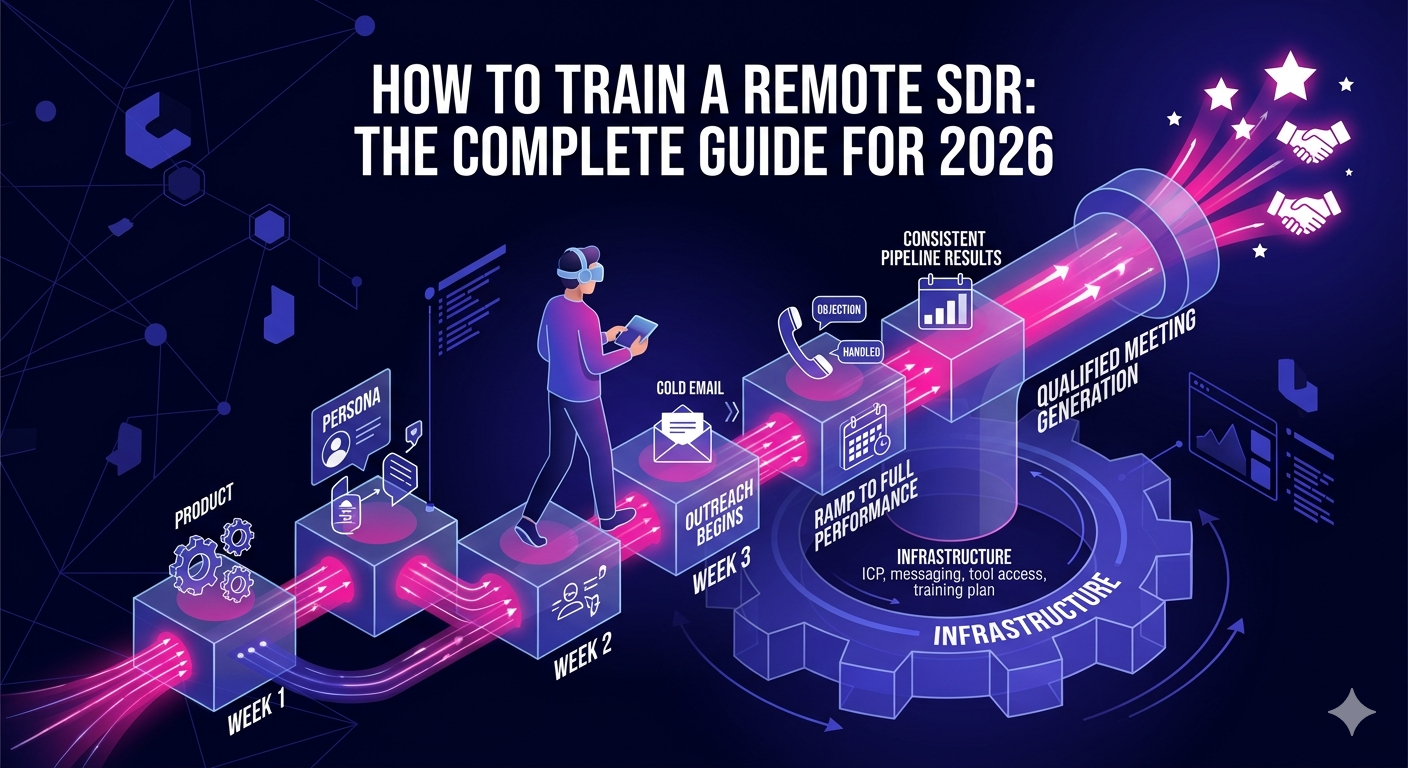
How to Train a Remote SDR: A Week-by-Week Framework
A structured 90-day remote SDR training plan is the gold standard for distributed sales teams in 2026. Here is how to build one that works.
Week 1: Foundation and Context
The first week is not about outreach. It is about context. Your remote SDR needs to deeply understand your product, your buyers, your competitive landscape, and your company story before they send a single email.
- Complete product onboarding and record questions for a live Q and A session
- Review the ICP documentation and identify five to ten example target accounts
- Listen to at least six recorded discovery calls, three from successful deals and three from lost deals
- Complete tool setup and walk through CRM workflow with the manager
- Write a first draft cold email targeting the primary ICP persona for manager review
Week 2: Messaging and Skills Development
The second week moves from understanding to application. This is where you begin coaching your remote SDR on outreach craft, not just content knowledge.
- Review and iterate on the cold email draft through at least two rounds of feedback
- Practice LinkedIn connection requests and follow-up messaging with the manager
- Run two to three mock cold call role-plays covering the opening, the value statement, and common objections
- Build the first prospect list using the data platform, reviewed for ICP accuracy before use
- Shadow the manager or a senior rep on at least one live discovery call
Week 3: Live Outreach Begins With Close Oversight
By week three, your remote SDR should be ready to begin real outreach. The key at this stage is close oversight without micromanagement. Every reply they receive should be reviewed together to identify what is working and what needs adjustment.
- Launch the first outbound sequence targeting 30 to 50 prospects
- Daily async review of all replies, including negative responses and out-of-office messages
- Weekly 30-minute coaching call focused on one specific area of improvement
- Track daily activity metrics and review against weekly targets
- Refine messaging based on reply patterns observed in live outreach
Week 4 Through Day 90: Ramp to Full Performance
From week four onward, the goal is to move your remote SDR from supervised outreach to independent pipeline generation. Coaching frequency can taper, but it should never disappear entirely.
- Increase prospecting volume as messaging confidence improves
- Weekly performance review against agreed 30, 60, and 90-day targets
- Bi-weekly coaching calls focused on metrics, objections, and messaging tests
- First qualified meeting target should be hit by the end of week four or five
- Formal 90-day performance review to assess ramp completion and set ongoing targets
Coaching Tactics That Actually Work for Remote SDR Training
Knowing how to train a remote SDR also means knowing how to coach one on an ongoing basis. One-time onboarding is not training. Consistent, structured coaching is what separates remote SDRs who plateau from those who keep improving.
Call Recording Review
Every remote SDR should record their calls and review at least one recording per week with their manager. Ask the SDR to self-evaluate first before the manager provides feedback. This builds self-awareness and makes the coaching conversation far more productive than a one-sided critique.
Email and Message Audits
Set aside time monthly to review a sample of the SDR’s outbound messaging. Look at open rates, reply rates, and the actual content together. Identify patterns in what is generating positive responses and use those patterns to update your messaging library. This turns individual rep performance data into a team asset.
Objection Handling Practice
Objection handling is a perishable skill. Remote SDRs who are not regularly practicing responses to common objections will lose sharpness over time. Run a short role-play at the start of your weekly coaching call. Present an objection and let the SDR respond in real time. Give immediate, specific feedback.
Peer Learning and Team Calls
If you have more than one remote SDR, create a shared space for the team to exchange what is working. A weekly or bi-weekly group call where each SDR shares one thing they tested and what happened builds a culture of continuous improvement across the whole team.
Metrics to Track During Remote SDR Training
You cannot improve what you do not measure. These are the metrics that matter most during remote SDR training in 2026.
- Daily outreach activity volume against target
- Email open rate and reply rate week over week
- Number of connected calls per week
- Meetings booked per month from week three onward
- Show rate on booked meetings
- Time to first qualified meeting from start date
If any of these metrics are significantly off track by the end of week four, that is a signal to revisit your training process or identify a specific skill gap that needs targeted coaching.
Get Support From Remote SDR Experts
If you want to accelerate results and reduce the risk of a slow ramp, working with a provider that specializes in placing and supporting remote SDRs makes a significant difference. The Remote Reps offers access to trained remote SDRs who are ready to generate pipeline for your business, with a model built to get you results faster than a traditional hire-and-train cycle.
For more context on how leading sales organizations are structuring remote SDR training programs, HubSpot’s guide to remote sales training for SDRs provides additional frameworks and data-backed insights on building high-performing distributed sales teams in 2026.
Conclusion: Train Your Remote SDR Right and Watch Pipeline Follow
Understanding how to train a remote SDR correctly is one of the highest-leverage investments a sales leader can make. A well-trained remote SDR produces consistent, measurable pipeline. A poorly trained one costs you time, budget, and momentum you cannot afford to lose.
Use the frameworks in this guide, build your training infrastructure before day one, and commit to ongoing coaching beyond the initial onboarding period. The results will follow.
Frequently Asked Questions: How to Train a Remote SDR
How long does it take to train a remote SDR to full productivity?
When learning how to train a remote SDR properly, most companies find that a well-onboarded remote SDR reaches full productivity within 60 to 90 days. Reps with prior SDR experience in a similar industry can ramp in 30 to 45 days when given a strong onboarding framework. Poorly structured training often extends ramp time to four to six months or results in early attrition.
What is the most important thing to focus on when learning how to train a remote SDR?
The single most important factor when figuring out how to train a remote SDR is building a structured, documented training plan before day one. Remote SDRs cannot learn passively from their environment the way in-office reps can. Every piece of knowledge they need must be deliberately designed and delivered. Without that foundation, even talented reps will underperform.
How often should I coach a remote SDR after initial training?
The best approach when thinking about how to train a remote SDR for sustained performance is weekly coaching during the first 90 days, tapering to bi-weekly once the rep is fully ramped. Each coaching session should focus on one specific metric or skill area, using real data from the SDR’s own outreach activity rather than generic advice.
What tools do I need to train a remote SDR effectively?
To train a remote SDR effectively, you need a CRM for activity tracking, a sales engagement platform for sequence management, a prospecting data tool for list building, a video conferencing tool for coaching calls, and a screen recording or call recording tool for reviewing live outreach. In 2026, tools like HubSpot, Apollo, Outreach, Zoom, and Gong or Chorus cover the core stack for most remote SDR training programs.
How do I know if my remote SDR training program is working?
When evaluating how to train a remote SDR successfully, track these key indicators: time to first qualified meeting, email reply rate trends week over week, meetings booked per month by day 30, day 60, and day 90, and 90-day retention rate. If your remote SDRs are consistently hitting their first qualified meeting by week four or five and ramping to target volume by day 60, your training program is working.
Can I train a remote SDR without prior sales experience?
Yes, but the training timeline and investment required are greater. When learning how to train a remote SDR without prior sales experience, plan for a 90-day full ramp with intensive coaching in weeks one through four. Focus heavily on product knowledge, ICP internalization, and objection handling through role-plays before allowing live outreach to begin. Reps without prior experience often become strong long-term performers when trained well from the start.