
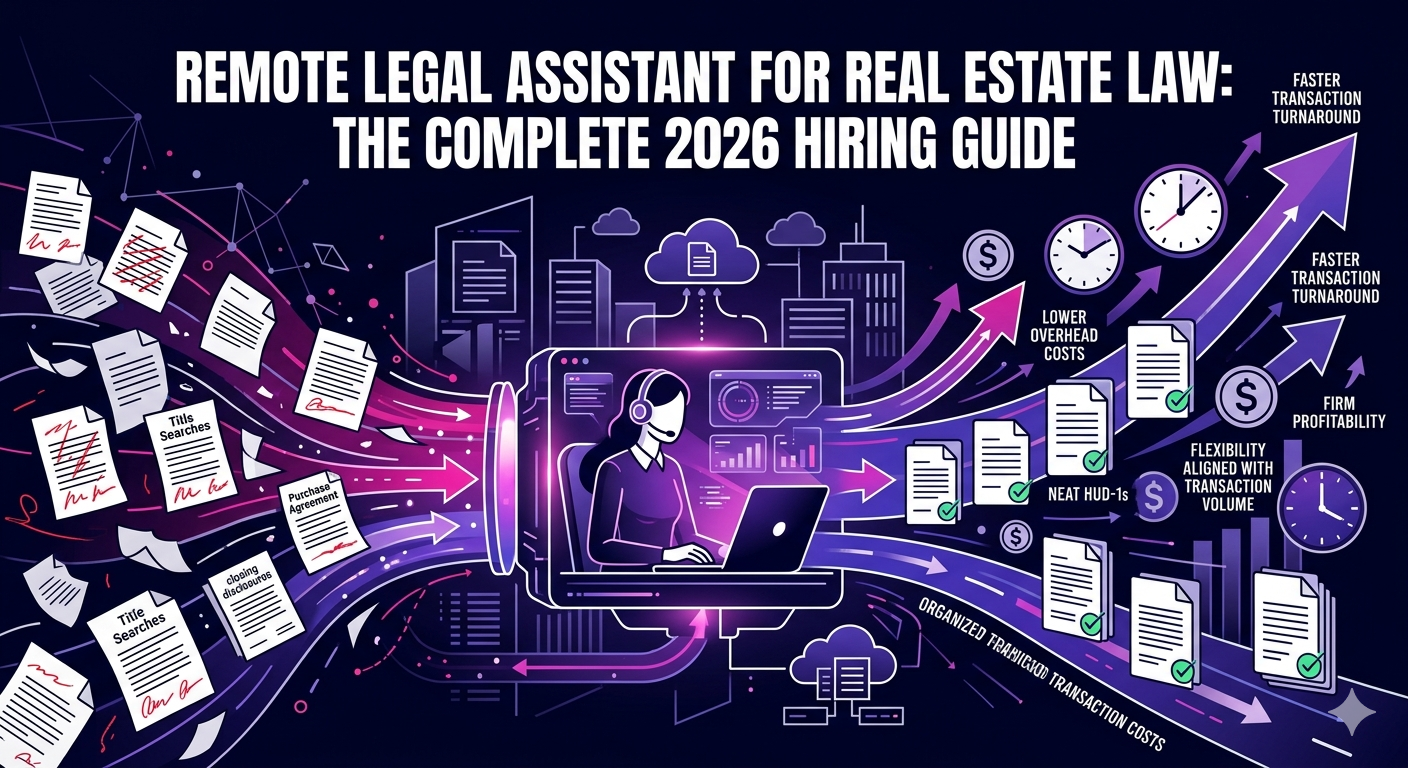
Real estate transactions move fast, and the paperwork volume that accompanies them is relentless. Title searches, purchase agreements, closing disclosures, deed transfers, and lease reviews pile up quickly, especially during active market cycles. If your real estate law practice is struggling to keep pace, hiring a remote legal assistant for real estate law could be the most impactful operational decision you make in 2026.
This guide covers what a remote real estate legal assistant does, what they cost, how to find and vet qualified candidates, and how to onboard them so they contribute value from week one.
What a Remote Legal Assistant for Real Estate Law Actually Does
A remote legal assistant specializing in real estate law handles the administrative and transactional support tasks that keep real estate closings and legal matters running on schedule. Their work sits between pure administrative support and substantive paralegal duties, making them an essential layer in any real estate legal team.
Core Responsibilities in Real Estate Legal Support
- Preparing and formatting purchase and sale agreements, lease agreements, and addenda
- Ordering and tracking title searches and lien certificates
- Coordinating closing schedules with lenders, title companies, and clients
- Drafting routine client correspondence and status update emails
- Managing and organizing transaction files in document management platforms
- Preparing HUD-1 and closing disclosure summaries for attorney review
- Filing deeds, mortgages, and other instruments with county recorders
- Maintaining deadlines for due diligence periods, inspection contingencies, and closing dates
- Handling client intake and collecting required documentation
- Tracking escrow deposits and coordinating wire instruction confirmations
These tasks are time-sensitive and high-volume. A dedicated remote legal assistant absorbs this workload so your attorneys can focus on the legal analysis and client advisory work that only they can provide.
Why Real Estate Law Firms Are Shifting to Remote Legal Assistants in 2026
The trend toward remote legal support has matured significantly. By 2026, the tools, platforms, and talent pipelines are well established, making the transition easier than ever. Here is why real estate law firms are making the shift:
Dramatically Lower Overhead Costs
A full-time in-house legal assistant in the United States earns between $42,000 and $58,000 per year, not including benefits, office space, equipment, or employer taxes. A remote legal assistant for real estate law typically works at hourly rates between $15 and $30, or on a flat monthly retainer starting around $1,800 to $3,000 for part-time to full-time support. The cost difference over a 12-month period is substantial.
Flexibility Aligned with Transaction Volume
Real estate markets are cyclical. A remote assistant model allows you to increase hours during hot market periods and scale back during slower quarters without the burden of layoffs or idle staff costs. This flexibility is especially valuable for smaller real estate practices and solo real estate attorneys.
Access to Experienced Real Estate Legal Talent
The remote work market has opened access to legal assistants with specialized real estate experience from across the country. Rather than being limited to your local labor market, you can hire someone with five to ten years of experience in residential or commercial real estate transactions regardless of geography.
Faster Transaction Turnaround
When a dedicated assistant is tracking every open file, following up on outstanding documents, and flagging approaching deadlines, closings happen on time more often. This improves your firm’s reputation with clients, agents, and lenders who refer business based on reliability.
How to Find a Qualified Remote Legal Assistant for Real Estate Law
Finding the right candidate requires using the right sourcing channels and applying rigorous screening criteria. Here is a practical approach:
Use a Specialized Legal Staffing Service
General freelance marketplaces can surface candidates, but they require significant time investment in screening, testing, and vetting. A specialized legal staffing platform pre-qualifies candidates for legal experience, confidentiality awareness, and relevant skills before presenting them to you.
The Remote Reps offers a curated roster of experienced remote legal assistants for real estate law firms who are already familiar with transaction workflows, document management systems, and the deadline-driven nature of real estate closings. This shortcut saves weeks of sourcing time and reduces the risk of a costly mismatch.
Define Exactly What You Need Before You Search
Before reaching out to any platform or agency, answer these questions clearly:
- Do you handle primarily residential, commercial, or both types of real estate transactions?
- Which software does your firm use for document management and case tracking?
- How many active files does the assistant need to manage at once?
- Do you need client-facing communication support or strictly back-office work?
- What time zone do you need them to work in?
- How many hours per week do you need covered?
A detailed role definition produces better candidates and faster placement decisions on both sides.
Screen for Real Estate-Specific Experience
A general legal assistant with experience in litigation or family law will face a steep learning curve in real estate work. Prioritize candidates who can speak specifically to title search coordination, closing file management, deed preparation, or working with title software platforms like RamQuest, SoftPro, or ResWare.
Run a Practical Skills Test
Give shortlisted candidates a realistic sample task. Ask them to organize a mock closing file, draft a contingency deadline tracking sheet, or write a closing status update email to a buyer client. Pay a nominal fee for their time. This exercise reveals writing quality, attention to detail, and familiarity with real estate workflows more clearly than any interview question.
What to Look for in a Remote Real Estate Legal Assistant
Beyond real estate knowledge, these qualities separate reliable remote legal assistants from average ones:
- Meticulous attention to detail: A missed closing date or an error in a deed description can have serious legal and financial consequences. Accuracy is non-negotiable.
- Proactive communication: Remote assistants who surface problems early and confirm instructions before proceeding prevent costly mistakes and delays.
- Confidentiality discipline: Real estate transactions involve sensitive financial information. Candidates must sign an NDA and demonstrate a clear understanding of data handling protocols.
- Self-directed work style: Unlike in-office staff, a remote assistant cannot tap you on the shoulder for guidance. They need to manage their own time and workload effectively.
- Technology proficiency: Comfortable with cloud-based document management, e-signature platforms like DocuSign, secure email, and video conferencing tools.
For a broader overview of professional standards in legal support roles, the National Association of Legal Assistants resource center provides useful reference material for firms evaluating candidates for remote legal assistant positions in real estate law.
Onboarding Your Remote Real Estate Legal Assistant for Long-Term Success
A well-structured onboarding process is what separates firms that get sustained productivity from those that cycle through assistants every few months.
Document Your Transaction Workflows Before Day One
Write down your process for handling a residential closing from contract to close, including every touchpoint, document required, and deadline to track. Do the same for commercial transactions if applicable. This documentation becomes the assistant’s operational guide and eliminates the need for constant supervision.
Establish Clear Communication Protocols
Specify which communication channel to use for different situations. Urgent closing issues may go through a phone call or instant message, while routine status updates go through email or your project management tool. Clarity on communication expectations prevents both over-communication and critical issues falling through the cracks.
Set Up Secure Technology Access
Provide access to your document management system, secure email, e-signature platform, and any title software on day one. Remote workers lose momentum quickly when they are waiting days for system access. Have IT set up credentials in advance of the start date.
Schedule Weekly Check-Ins for the First 60 Days
Brief weekly calls during the initial period give you a chance to correct workflows early, answer questions, and build the working relationship. After the first two months, most well-onboarded remote assistants can operate with minimal daily supervision.
Expanding Your Remote Legal Support Team Beyond One Role
Many real estate law firms that start with one remote legal assistant eventually build out a broader remote support team. Natural additions include:
- Remote paralegals for title examination, contract review, and closing opinion preparation
- Remote legal secretaries for court filings and attorney correspondence support
- Remote virtual assistants for calendar management and general administrative overflow
A layered remote team gives your firm enterprise-level support capacity at a fraction of the cost of building out an in-house staff.
Conclusion: Build a Leaner, Faster Real Estate Practice in 2026
The right remote legal assistant for real estate law does more than handle paperwork. They become the operational backbone of your transaction practice, ensuring every file moves forward, every deadline is met, and every client stays informed. The cost savings, flexibility, and access to specialized talent make this one of the most practical investments a real estate law firm can make in 2026.
Ready to hire a vetted, experienced remote legal assistant for your real estate law practice? Explore the full range of remote legal assistant services at The Remote Reps and get matched with a qualified professional today.
Frequently Asked Questions
What does a remote legal assistant for real estate law do on a daily basis?
A remote legal assistant for real estate law handles the day-to-day transactional support that keeps real estate closings on track. This includes preparing and organizing transaction documents, coordinating with title companies and lenders, tracking deadlines, drafting client correspondence, and managing closing files. Their work ensures attorneys can focus on legal review and client advising rather than administrative coordination.
How much does it cost to hire a remote legal assistant for real estate law in 2026?
In 2026, hiring a remote legal assistant for real estate law typically costs between $15 and $30 per hour depending on experience and geographic location. Monthly retainer arrangements through legal staffing services generally start around $1,800 to $3,000 for consistent support. Either option is significantly more affordable than a full-time in-house hire when overhead costs are factored in.
What qualifications should a remote legal assistant for real estate law have?
A remote legal assistant for real estate law should have prior experience in real estate transactions, familiarity with closing processes and title coordination, proficiency with document management and e-signature platforms, strong written communication skills, and a clear understanding of client confidentiality requirements. Candidates with experience in title software such as SoftPro or ResWare bring additional value to firms handling high transaction volumes.
How do I ensure confidentiality when using a remote legal assistant for real estate law?
To protect client confidentiality when working with a remote legal assistant for real estate law, require a signed non-disclosure agreement before granting access to any firm materials. Use encrypted file-sharing platforms and firm-approved communication tools. Ensure the assistant understands applicable professional conduct rules around client information and restrict access to only the systems and files relevant to their assigned work.
How long does it take to onboard a remote legal assistant for real estate law?
Most remote legal assistants for real estate law with prior transaction experience reach reliable productivity within two to three weeks when given documented workflows and proper system access from day one. Firms that invest time in creating written procedures before the assistant starts see faster ramp-up times and significantly fewer errors during the initial period.
Can a small real estate law practice benefit from a remote legal assistant?
Yes, small real estate law practices and solo real estate attorneys benefit considerably from a remote legal assistant for real estate law support. Even part-time assistance of 15 to 20 hours per week can handle the administrative load of multiple concurrent transactions, allowing a solo attorney to increase their closing volume without adding a full-time in-house employee. The cost flexibility of remote arrangements makes this model especially accessible for smaller practices.