Every SaaS startup faces the same hiring dilemma: limited budget, aggressive growth targets, and more open roles than you can possibly fill at once. The solution is not to hire everyone. It is to hire the right people in the right order. Knowing the best remote hires for SaaS startups gives you a clear framework for building a lean, high-output team that scales without burning through your runway.
In 2026, remote hiring is no longer a compromise. It is a strategic advantage. The global talent market gives SaaS founders access to specialized professionals at every level, often at significantly lower cost than local equivalents. This guide breaks down the remote roles that deliver the most impact at the earliest stages of SaaS growth.
Why Remote Hiring Is the Default Strategy for SaaS Startups in 2026
The infrastructure for distributed teams has matured to the point where remote and in-office teams perform comparably across most functions. For SaaS startups operating with lean headcount and tight budgets, remote hiring offers three core advantages that in-office hiring simply cannot match.
Access to a Global Talent Pool
When you limit hiring to a single city or metro area, you restrict your candidate pool to a fraction of the global talent available. Remote hiring opens every time zone, every market, and every skill set. For niche roles like go-to-market engineers or SaaS-specialized SDRs, this matters enormously.
Cost Efficiency Without Quality Trade-offs
A remote SDR in Eastern Europe or Latin America with proven SaaS outbound experience often delivers the same output as a local hire at 40 to 60 percent of the total cost. For a startup that needs to stretch a Series A or bridge round, that difference is meaningful.
Faster Time to Hire and Ramp
Specialized remote talent networks pre-vet candidates for specific skill sets, which compresses your hiring timeline significantly. Instead of spending eight to twelve weeks on a full recruitment cycle, you can shortlist and hire within two to three weeks through the right provider.
The Best Remote Hires for SaaS Startups: Role by Role Breakdown
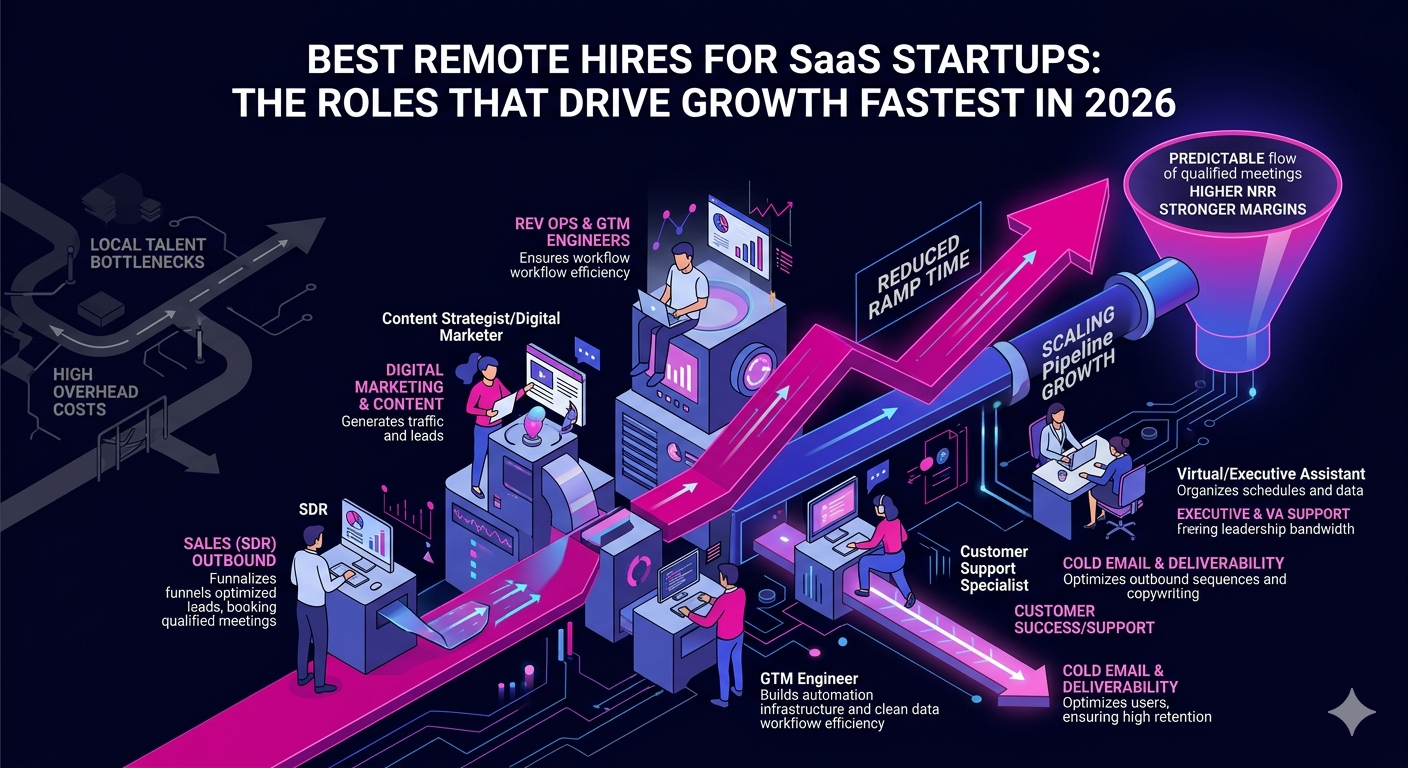
Not every role delivers equal impact at every stage of SaaS growth. The following breakdown prioritizes roles based on their revenue impact and how quickly a strong remote hire can contribute after onboarding.
1. Sales Development Representative (SDR)
If you have product-market fit and need to scale pipeline, a remote SDR is the single highest-leverage hire most SaaS startups can make. An experienced SaaS SDR handles cold outreach, books qualified discovery calls, and frees your founders or account executives to focus on closing deals and building relationships.
Remote SDRs with SaaS backgrounds understand ICP targeting, objection handling for software products, and how to use modern sales engagement platforms. The best ones ramp within 30 to 45 days and begin contributing qualified meetings within the first month of outreach.
When evaluating this role as one of the best remote hires for your SaaS startup, look for candidates with a track record in a comparable SaaS vertical, familiarity with tools like Outreach or Apollo, and strong written communication for cold email.
2. Digital Marketer or Content Strategist
Organic growth is the most capital-efficient channel available to SaaS startups. A remote digital marketer who understands SaaS SEO, content strategy, and buyer journey mapping can build a compounding traffic engine that generates leads without ongoing paid spend.
At the early stage, this person typically wears multiple hats: keyword research, content production, on-page SEO, and performance tracking. As the startup scales, you can add specialists on top of this generalist foundation. Hiring remote for this role gives you access to experienced SaaS marketers who have already done this at similar companies and can execute without a steep learning curve.
3. Go-to-Market (GTM) Engineer
GTM engineers are one of the most in-demand and underutilized roles in early-stage SaaS. They sit at the intersection of sales, marketing, and product, building the automation workflows, data enrichment pipelines, and tooling integrations that make your revenue team dramatically more efficient.
A skilled remote GTM engineer can build a full outbound tech stack, automate lead routing, set up CRM integrations, and create data-driven prospecting lists that would take a sales team weeks to compile manually. For a startup that wants to punch above its weight in outbound, this role is a force multiplier.
4. Customer Support Specialist
Retention is revenue. Every SaaS company understands this in theory, but many underinvest in the support function until churn becomes a crisis. A remote customer support specialist who understands SaaS products, common onboarding friction points, and how to triage technical issues reduces churn before it starts.
For early-stage startups, this person also feeds critical product intelligence back to the team. Patterns in support tickets reveal the features users struggle with most, the integrations they ask about, and the reasons they consider cancelling. That information is invaluable for product roadmap decisions.
5. Cold Email Specialist
Cold email remains one of the most cost-effective outbound channels for SaaS startups when it is executed with precision. A remote cold email specialist handles copywriting, deliverability infrastructure, list building, sequence testing, and performance optimization.
This role is distinct from a general SDR. A dedicated cold email specialist focuses entirely on the top-of-funnel email function, ensuring your domain reputation stays healthy, your open rates stay high, and your reply rates continue improving through systematic A/B testing. For SaaS startups scaling outbound on a lean budget, this is one of the best remote hires available.
6. Virtual or Executive Assistant
Founders and early leadership teams at SaaS startups routinely lose 15 to 20 hours per week to administrative tasks that could be delegated. Scheduling, inbox management, research, vendor coordination, and internal reporting are all tasks that a skilled remote VA or executive assistant handles with ease.
Freeing up founder time for high-leverage activities like customer development, fundraising, and strategic hiring often delivers more impact than any direct revenue-generating hire. For that reason, a remote EA earns its place on any list of the best remote hires for SaaS startups.
How to Prioritize These Hires Based on Your Growth Stage
Not every SaaS startup needs all six of these roles immediately. Here is a simple prioritization framework based on where you are in your growth journey.
Pre-Product-Market Fit
Before you have confirmed PMF, focus on customer support and an executive assistant. Support specialists help you retain early users and gather product feedback. An EA keeps your leadership team focused on the activities that get you to PMF faster.
Post-Product-Market Fit, Pre-Series A
Once you have PMF, pipeline generation becomes the priority. Hire your first remote SDR and cold email specialist together to build a coordinated outbound motion. Add a digital marketer if you have the budget to begin building organic channels in parallel.
Series A and Beyond
At this stage, you need to scale everything systematically. A GTM engineer becomes critical for building the operational backbone that allows your sales and marketing teams to operate at full capacity. Expand support headcount to match your growing user base and add content and SEO specialists to accelerate organic growth.
If you are ready to make your next strategic hire, explore The Remote Reps’ remote GTM engineer services and find the specialist who can build the revenue infrastructure your SaaS startup needs to scale.
What Makes a Great Remote Hire for a SaaS Startup
Beyond role-specific skills, the best remote hires for SaaS startups share a set of core characteristics that determine how well they perform in a distributed, fast-moving environment.
- Bias toward action: Remote team members who wait for instruction slow everything down. The best hires identify what needs to be done and move without constant prompting.
- Strong async communication: In a remote-first startup, written communication is everything. Clarity in Slack, email, and documentation prevents misalignment and saves hours of follow-up.
- SaaS context: Candidates who have worked in SaaS environments before understand the pace, the metrics that matter, and the connection between their role and company-level outcomes.
- Curiosity and coachability: Early-stage startups change direction quickly. Hires who are curious and open to feedback adapt faster and contribute more across multiple functions.
- Ownership mentality: The best remote hires treat their function as if they own it. They track their own performance, identify gaps, and propose solutions without waiting to be asked.
According to LinkedIn’s research on remote hiring trends for high-growth startups, companies that prioritize communication skills and self-direction in remote candidates report significantly higher retention and performance than those who focus exclusively on technical qualifications.
Conclusion: Build Your SaaS Startup Team with Intentional Remote Hiring
The best remote hires for SaaS startups are not just affordable alternatives to local talent. They are strategic assets that, when hired at the right time and set up for success, accelerate your path to the next funding milestone, the next revenue target, and the next phase of growth.
Start with the roles that have the most direct impact on your current bottleneck. Build the onboarding systems and communication infrastructure to support them. And choose partners who specialize in SaaS talent so you are not starting from scratch every time you need to fill a critical seat.
Ready to make your next remote hire count? Connect with The Remote Reps to find pre-vetted remote GTM engineers and other SaaS growth specialists who are ready to contribute from day one.
Frequently Asked Questions About the Best Remote Hires for SaaS Startups
What are the best remote hires for SaaS startups at the earliest stage?
At the earliest stage, the best remote hires for SaaS startups are typically a customer support specialist and an executive assistant. The support specialist helps retain early users and feeds product feedback back to the team, while the executive assistant frees up founder time for the high-leverage activities that drive growth. Once product-market fit is confirmed, an SDR and cold email specialist become the next priority to begin building a scalable outbound pipeline.
How do I evaluate candidates when hiring the best remote talent for my SaaS startup?
When evaluating candidates for the best remote hires for SaaS startups, look for SaaS-specific experience in their portfolio or work history, evidence of self-direction and ownership in previous roles, and strong written communication skills. Run a short paid test project to assess output quality and responsiveness. Pay attention to how candidates communicate during the hiring process itself. Responsiveness, clarity, and the quality of their questions are strong predictors of performance in a remote environment.
Is it better to hire remote generalists or specialists as a SaaS startup?
At the earliest stage, generalists who can cover multiple functions within a discipline are often more valuable than narrow specialists. For example, a remote digital marketer who can handle content, SEO, and basic paid campaigns delivers more flexibility than a specialist who only manages one channel. As you scale and have the budget to add headcount, layering specialists on top of a generalist foundation produces the best results. The best remote hires for SaaS startups match the specificity of the role to the current stage of company growth.
How long does it take to ramp the best remote hires for a SaaS startup?
Ramp time varies by role and onboarding quality. Remote SDRs and cold email specialists typically ramp within 30 to 45 days with a structured onboarding process. Digital marketers and content strategists often need 45 to 60 days to develop deep product knowledge and begin producing optimized content. GTM engineers can contribute meaningful infrastructure within two to four weeks if they receive clear technical documentation and stakeholder access early. The best remote hires for SaaS startups ramp fastest when onboarding is structured, expectations are documented, and feedback loops are established from week one.
What is the average cost of the best remote hires for SaaS startups compared to local hires?
The cost difference depends on the role and geography of the remote hire. In general, remote SaaS talent sourced through a specialized provider costs 40 to 60 percent less than an equivalent local hire when you factor in salary, benefits, office space, and recruitment costs. For a SaaS startup managing a lean budget, this difference often allows you to hire two strong remote specialists for the cost of one local generalist, significantly increasing team output without proportionally increasing burn rate.
How do I retain the best remote hires at my SaaS startup long term?
Retention for the best remote hires for SaaS startups depends on three factors: clear communication of goals and expectations, regular feedback and recognition, and a strong sense of connection to the company mission. Schedule consistent one-on-ones, document performance expectations clearly, and make sure remote team members have visibility into how their work contributes to company outcomes. Competitive compensation, flexible schedules, and opportunities for professional development also play a significant role in keeping high performers engaged and committed over time.