
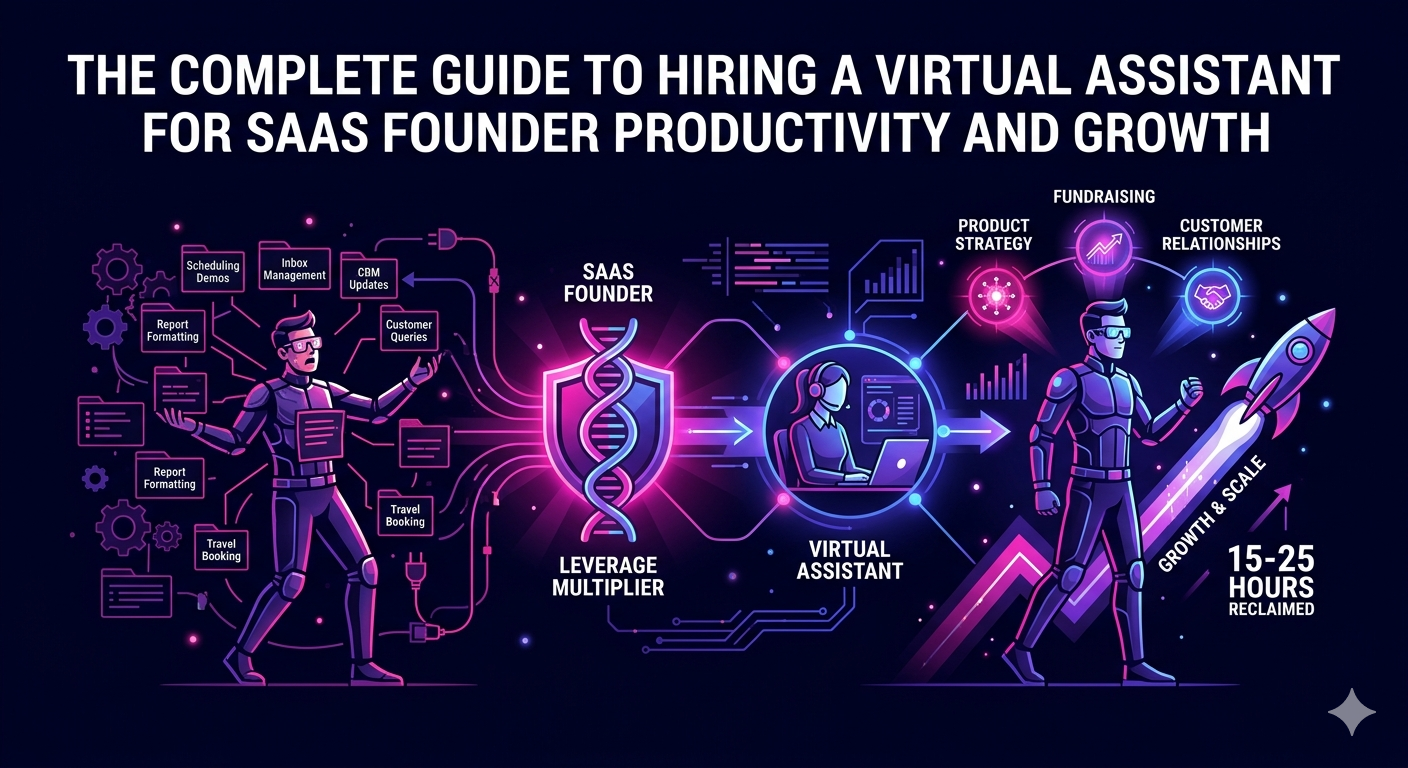
If you are building a SaaS company, your time is your most valuable asset. Yet most founders spend the majority of their week on tasks that do not require their unique expertise. Scheduling meetings, managing inboxes, formatting reports, updating CRM records, and handling basic customer queries are all necessary, but none of them require a founder’s judgment. Hiring a virtual assistant for SaaS founder operations is one of the fastest ways to reclaim your calendar and redirect your energy toward the work that actually grows your company.
This guide covers what a SaaS-focused VA does, which tasks to delegate first, how much to budget, and how to set up the relationship for long-term success.
Why a Virtual Assistant for SaaS Founders Is Different from a Generic VA
Not all virtual assistants are created equal. A VA with experience supporting SaaS founders understands the rhythm of a software business. They are familiar with subscription metrics, product terminology, customer success workflows, and the tools that modern SaaS teams rely on, from HubSpot and Intercom to Notion, Slack, and Stripe dashboards.
A generic VA might handle travel booking and personal errands well. A SaaS-specific VA can manage your content calendar, coordinate with contractors, pull weekly MRR reports, monitor customer support queues, and keep your investor updates on schedule. The level of business fluency is simply higher, and that matters when you are moving fast.
What Sets a SaaS-Focused VA Apart
- Comfort working inside SaaS tools like HubSpot, Notion, Jira, Intercom, and Stripe
- Understanding of basic SaaS metrics such as MRR, churn, LTV, and activation rate
- Ability to communicate with customers, vendors, and contractors in a professional, on-brand voice
- Experience with remote-first workflows, async communication, and documentation standards
- Capacity to manage recurring operational processes without constant supervision
The Tasks Every SaaS Founder Should Delegate First
The best place to start when hiring a virtual assistant for SaaS founder support is to audit one full week of your work. Write down every task you complete and mark anything that does not require your direct judgment. You will likely find that 30 to 50 percent of your week falls into that category. Here are the highest-value areas to delegate first.
Administrative and Calendar Management
- Inbox management, filtering, and drafting responses to routine emails
- Scheduling meetings, demos, and investor calls across time zones
- Managing travel arrangements and expenses
- Preparing agendas and taking notes during team meetings
- Following up on unanswered emails and outstanding action items
Operations and Project Coordination
- Updating project management tools like Asana, Linear, or ClickUp
- Tracking contractor deliverables and keeping freelancers on schedule
- Building and maintaining internal documentation in Notion or Confluence
- Coordinating between your sales, marketing, and product teams on recurring workflows
- Preparing weekly or monthly operational reports from your existing dashboards
Content and Marketing Support
- Managing your content calendar and coordinating with writers or designers
- Scheduling and publishing posts across LinkedIn, Twitter/X, and your blog
- Repurposing long-form content into shorter social clips or newsletter summaries
- Researching topics, competitors, or prospect companies ahead of important calls
- Updating your website copy, landing pages, or help documentation
Customer and Sales Support
- Managing your CRM, logging activities, and keeping contact records current
- Sending follow-up sequences after demos or trials
- Routing inbound support queries to the right team member
- Pulling weekly reports on pipeline activity, trial conversions, or churn signals
If you are looking for a dedicated professional who understands the pace and priorities of a SaaS business, explore the remote virtual assistant services at Remote Reps to find someone who can hit the ground running.
How Much Does a Virtual Assistant for a SaaS Founder Cost in 2026?
Cost depends heavily on the VA’s location, experience level, and the scope of work involved. Here are realistic 2026 benchmarks for dedicated remote VAs with SaaS experience.
2026 Salary Benchmarks by Region
- Latin America (Colombia, Argentina, Mexico): $800 to $1,800 per month for full-time, experienced VAs
- Eastern Europe (Poland, Romania, Ukraine): $1,000 to $2,200 per month for full-time professionals
- Southeast Asia (Philippines, Indonesia): $600 to $1,400 per month for skilled, English-proficient VAs
- US or Canada based: $3,500 to $6,000 per month for comparable roles
For most SaaS founders, hiring a full-time VA from Latin America or Southeast Asia delivers the strongest combination of quality, communication, and cost efficiency. You get a dedicated resource who learns your business deeply, at a fraction of the cost of a domestic hire or a fractional US-based EA.
Part-Time vs. Full-Time: What Level of Support Do You Need?
Early-stage founders with a small task load often start with a part-time VA at 20 hours per week. This is enough to handle inbox management, scheduling, and basic content support without overcommitting budget before the relationship is proven.
Once you have confirmed the VA’s capabilities and identified more tasks to delegate, moving to full-time is usually a straightforward decision. Most SaaS founders who make the switch report wishing they had done it sooner. The increase in personal productivity alone tends to outweigh the cost increase within the first month.
Signs You Are Ready to Go Full-Time
- You frequently run out of VA hours before the week ends
- You are still doing tasks you know could be delegated
- The VA has mastered your workflows and is building momentum
- Your business is growing faster than your personal bandwidth can support
How to Set Up a Virtual Assistant for Long-Term SaaS Founder Success
Hiring is only the first step. The founders who get the most value from a VA invest time upfront in setting the relationship up correctly. Here is a practical framework to get it right.
Step 1: Build a Task Library Before Day One
Document every recurring task you plan to delegate. Include step-by-step instructions, links to relevant tools, and examples of past work. This library becomes your VA’s operating manual and reduces the need for constant back-and-forth in the early weeks.
Step 2: Start With Low-Stakes, High-Frequency Tasks
Give your VA ownership of tasks that are repetitive and well-defined before moving on to judgment-heavy work. This builds confidence on both sides and lets you evaluate their work quality before trusting them with more complex responsibilities.
Step 3: Establish a Daily Check-In Routine
A short daily async update, either via Slack or a shared task tracker, keeps both parties aligned without requiring live meetings. The VA shares what they completed, what is in progress, and any blockers. You respond with priorities and decisions. This structure works exceptionally well across time zones.
Step 4: Create a Clear Escalation Path
Define in advance what the VA should handle independently and what requires your approval. This prevents both under-delegation, where they check in on everything, and over-delegation, where they make decisions that should involve you.
Step 5: Review and Expand Quarterly
Every 90 days, review what is working and what could be added to the VA’s scope. Great VAs grow into the role over time. A VA who starts with scheduling and inbox management can evolve into a true operational partner who runs large parts of your business without daily input.
According to Entrepreneur’s research on virtual assistants for SaaS founder productivity, founders who delegate effectively to trained remote professionals consistently report reclaiming 15 to 25 hours per week, time that flows directly back into product strategy, fundraising, and customer relationships.
Conclusion: Your Time Is the Scarcest Resource in Your Company
Every hour you spend on work that a skilled VA could handle is an hour not spent on strategy, product, fundraising, or customers. A virtual assistant for SaaS founder operations is not a luxury. It is a leverage multiplier that compounds over time as the VA learns your business and takes more off your plate.
Start with a clear task audit, hire someone with SaaS-specific experience, invest in a structured onboarding process, and expand their scope as trust builds. Done right, it is one of the highest-return investments you can make as a founder.
Frequently Asked Questions
What is a virtual assistant for a SaaS founder and how is it different from a regular VA?
A virtual assistant for a SaaS founder is a remote professional specifically experienced in supporting software business operations. Unlike a generic VA who primarily handles personal admin, a SaaS-focused VA understands subscription business models, works comfortably inside tools like HubSpot, Notion, Stripe, and Intercom, and can manage operational workflows such as CRM updates, content coordination, and customer support routing. The added business fluency makes them a more capable operational partner for a fast-moving software company.
How many hours per week does a SaaS founder typically need from a virtual assistant?
Most SaaS founders start with 20 part-time hours per week and move to full-time within two to three months as they identify more tasks to delegate and build confidence in the VA’s capabilities. Founders in high-growth phases often find that a full-time VA still leaves tasks on the table. The right answer depends on the current volume of delegable work and the stage of the business, but starting part-time and expanding is generally the lower-risk path when hiring for the first time.
What is the best way to onboard a virtual assistant for SaaS founder operations?
The most effective approach is to prepare a task library with step-by-step documentation before the VA starts. This includes written SOPs for recurring tasks, access credentials for necessary tools, examples of previous work, and a clear escalation policy for decisions that require founder input. Starting the VA on low-stakes, high-frequency tasks for the first two weeks allows both sides to calibrate expectations before moving to more complex responsibilities.
Can a virtual assistant for a SaaS founder handle customer-facing tasks?
Yes, a skilled virtual assistant for a SaaS founder can handle a range of customer-facing tasks, including routing inbound support queries, sending follow-up emails after trials or demos, managing onboarding scheduling, and responding to basic questions using pre-approved templates. For more complex or sensitive customer interactions, the VA should have a clear handoff process to a customer success manager or the founder directly. Establishing these boundaries upfront prevents customer experience issues and protects your brand voice.
How do I find a reliable virtual assistant for SaaS founder support without spending weeks recruiting?
The fastest path is to work with a specialized remote staffing provider that pre-vets candidates for SaaS-specific experience and communication skills. This eliminates the need to sort through hundreds of applicants, conduct lengthy interview processes, and verify references from scratch. Look for providers that offer dedicated placement rather than shared or pooled VA models, as dedicated professionals who work exclusively on your business learn your workflows and context far more quickly than shared resources split across multiple clients.
What tasks should a virtual assistant for a SaaS founder never be asked to handle?
A virtual assistant for a SaaS founder should not be expected to make strategic business decisions, handle board-level communications independently, manage sensitive HR matters, or take ownership of financial reporting without oversight. They also should not be responsible for tasks that require deep product knowledge before they have had sufficient ramp time to learn your platform. As a general rule, any task where a mistake would have significant business, legal, or reputational consequences should remain with the founder or a senior team member until trust and competency are fully established.