
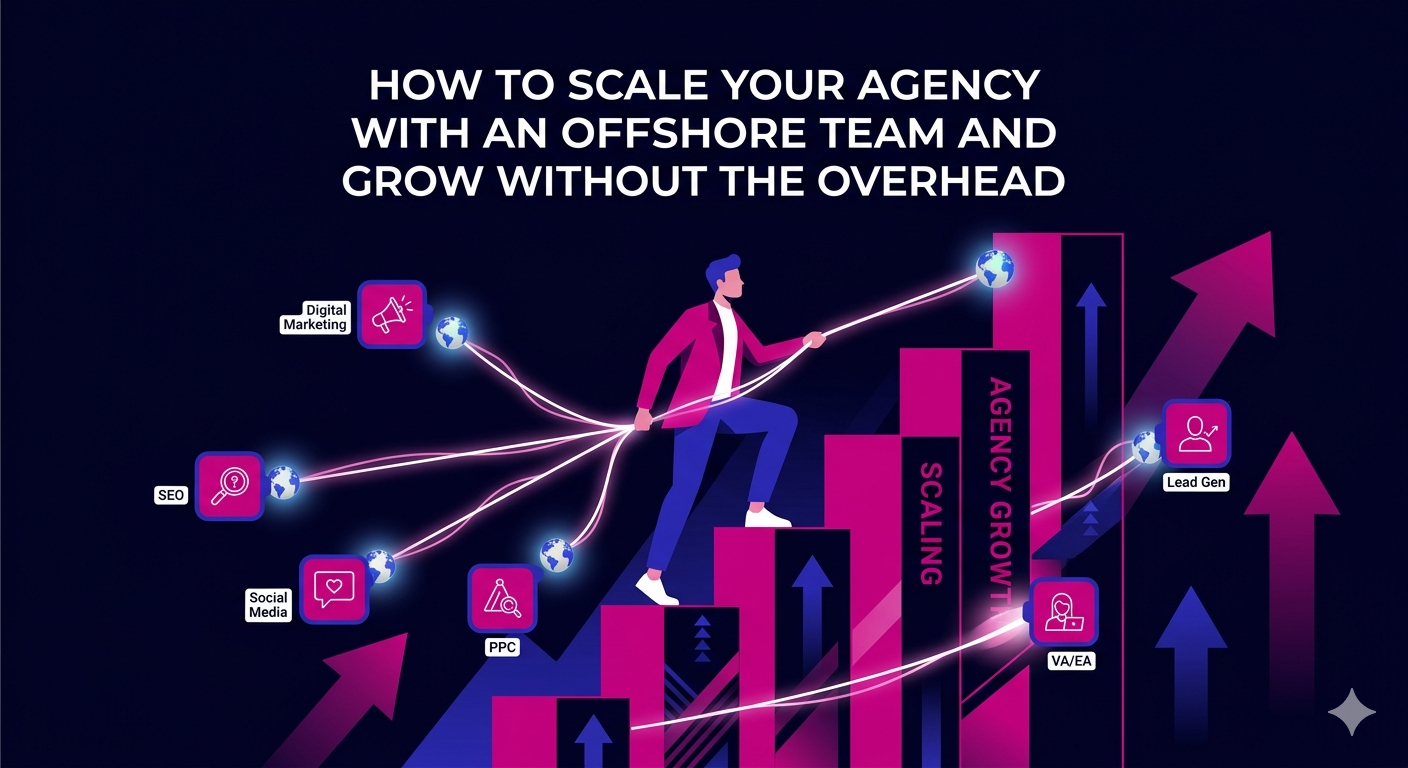
Growth is the goal every agency owner chases, but most hit the same wall: hiring locally is slow, expensive, and increasingly competitive. The agencies that are winning in 2026 are not waiting for the perfect local hire to appear. They are choosing to scale their agency with an offshore team, building lean, high-output operations that deliver more for less without sacrificing quality. If you have been curious about how this works in practice, this guide gives you a complete roadmap.
Why Scaling an Agency with an Offshore Team Makes Strategic Sense in 2026
The economics of agency work have shifted. Client budgets are tighter, competition for talent in major markets is fierce, and the pressure to deliver fast without inflating your cost base is higher than ever. Offshore teams offer a practical solution to all three challenges at once.
Here is why agencies at every stage are making this move:
- Significant cost reduction: Offshore talent in markets like the Philippines, Latin America, Eastern Europe, and South Asia typically costs 50 to 70 percent less than equivalent local hires, without a proportional drop in output quality.
- Access to a deeper talent pool: Limiting your search to one city means competing for a small slice of available talent. Going offshore opens you to a global pool of skilled specialists who are eager to work with international agencies.
- Around-the-clock production: A distributed offshore team across multiple time zones allows your agency to run near-continuous production cycles, delivering faster results to clients.
- Scalability on demand: Offshore talent can be scaled up during busy periods and adjusted during slower ones, giving you flexibility that a fixed local headcount cannot match.
- Reduced risk on new service lines: Want to add SEO, paid media, or social management to your offering? Offshore specialists let you test new services without the commitment of a full-time local hire.
Which Roles Work Best When You Scale an Agency with an Offshore Team
Not every agency role translates equally well to an offshore model. The ones that deliver the highest return are roles where output is measurable, communication can happen asynchronously, and the work itself does not require physical presence.
Digital Marketing Specialists
Offshore remote digital marketing specialists can manage campaigns, build content strategies, run analytics, and handle reporting entirely from their own setup. For agencies that handle digital marketing for multiple clients, this is one of the fastest wins available when scaling offshore.
SEO Professionals
Search engine optimization is among the most offshore-friendly disciplines in the industry. Keyword research, technical audits, content optimization, and link building are all highly asynchronous tasks that can be executed consistently from anywhere. Adding a skilled offshore SEO specialist to your team lets you deliver measurable client results without carrying the cost of a senior in-house hire.
Social Media Managers
Managing social media for multiple clients simultaneously is time-consuming work that does not need to be done in the same city as your clients. Offshore social media managers handle content calendars, community engagement, performance tracking, and platform strategy reliably and cost-effectively.
PPC and Paid Media Experts
Paid advertising requires precision and ongoing optimization. Offshore PPC specialists and media buyers manage budgets, test creatives, optimize bids, and produce performance reports for your clients with the same rigor you would expect from a local hire, at a significantly lower cost.
Lead Generation and Sales Development
Agency growth depends on a consistent new business pipeline. Offshore lead generation experts and sales development representatives can prospect, qualify, and nurture leads so your principals can focus on closing and delivering, not cold outreach.
Virtual and Executive Assistants
Administrative overload kills agency productivity. Offshore virtual assistants and executive assistants handle scheduling, inbox management, research, reporting, and coordination so your senior team can protect their time for high-value activities.
How to Build the Right Foundation Before You Scale with an Offshore Team
The agencies that struggle with offshore teams are typically the ones that skip the preparation phase. Before you bring on a single offshore hire, you need to lay the right groundwork.
Document Your Core Workflows
Offshore team members cannot read your mind. Before onboarding anyone, create clear SOPs (standard operating procedures) for every recurring task they will handle. This does not need to be a 50-page manual. A short Loom video walkthrough or a simple step-by-step checklist in Notion is enough to get someone started and reduce the back-and-forth during onboarding.
Choose the Right Communication Stack
Successful offshore teams run on reliable tools. A typical setup that works well for scaling agencies includes Slack for team communication, Asana or ClickUp for project management, Google Workspace for file sharing and documentation, and Loom for async video updates. Agree on response time expectations and communication norms before your offshore team member starts.
Define Performance Metrics from Day One
Vague expectations produce vague results. Every offshore role you add should come with clear KPIs tied to deliverables, not hours. For a social media manager that might mean number of posts published, engagement rate targets, and monthly reporting deadlines. For a lead generation specialist it might mean number of qualified prospects added to the pipeline per week. Clarity upfront eliminates ambiguity and makes performance reviews objective.
Start with One Role and Build Systems Around It
Many agencies try to scale too quickly offshore and end up managing chaos instead of building leverage. Start with a single offshore hire in your highest-priority bottleneck role. Document what works, refine the onboarding process, and then replicate it as you add more team members. This approach builds a repeatable hiring and onboarding system that scales cleanly.
Common Mistakes Agencies Make When Scaling Offshore
Learning from the mistakes of others is cheaper than making them yourself. Here are the pitfalls most commonly reported by agencies that have scaled with offshore teams:
- Hiring based on rate alone: The cheapest candidate is rarely the best investment. Focus on communication skills, relevant experience, and demonstrated output quality rather than minimizing cost per hour.
- Neglecting onboarding: Dropping a new offshore hire into a live project with no context is a reliable way to produce disappointing results. Invest in structured onboarding and you will recover that time investment within weeks.
- Treating offshore staff as second-tier: Offshore team members who feel valued and included in the agency culture consistently outperform those who feel disconnected. Include them in team meetings, celebrate their wins, and give them a clear path for growth.
- Skipping trial projects: Always run a paid trial assignment before committing to a long-term arrangement. Real work in a realistic context is the most reliable predictor of performance.
- Over-relying on one offshore market: Diversifying across talent markets gives you resilience and access to different skill specializations. A Latin American time zone may suit your real-time needs better than South Asia for certain roles.
Measuring the ROI of Scaling Your Agency with an Offshore Team
The return on investment from building an offshore agency team compounds over time. In the short term, the gains show up in cost savings and faster delivery. Over a 12-month horizon, agencies that scale smartly with offshore talent typically report stronger margins, higher client capacity, and a more resilient operational structure.
A useful benchmark: if replacing two local hires with offshore equivalents saves your agency $4,000 to $6,000 per month, that is $48,000 to $72,000 per year redirected into growth, better tools, or new service development. The compounding effect of reinvesting those savings is what separates agencies that grow steadily from those that plateau.
According to research published by McKinsey on global offshore talent models for scaling teams, organizations that adopt a structured offshore approach with proper systems in place achieve productivity outcomes comparable to local teams in most knowledge-work categories within 90 days of onboarding.
If you are ready to scale your agency with an offshore team and want access to pre-vetted, agency-ready talent, The Remote Reps specializes in matching growing agencies with top offshore professionals across every key function. Start building your offshore team today and turn your growth ambitions into a repeatable operational reality.
FAQ: Scale Agency with Offshore Team
Is it realistic to scale an agency with an offshore team while maintaining quality standards?
Yes, absolutely. Many of the fastest-growing agencies in 2026 scale with offshore teams while maintaining or improving their output quality. The key is hiring through a rigorous vetting process, providing thorough onboarding, and setting clear performance expectations. When you scale your agency with an offshore team that is properly integrated into your workflows, quality is driven by systems and accountability, not geography.
What is the biggest challenge when trying to scale an agency with an offshore team?
The most commonly reported challenge when agencies scale with an offshore team is communication alignment. Time zone differences, unclear briefs, and inconsistent feedback loops can create friction. The solution is investing in the right async tools, setting response time expectations upfront, and building a communication cadence that keeps everyone aligned without requiring constant real-time interaction.
How quickly can I expect results after I scale my agency with an offshore team?
Most agencies that scale with an offshore team start seeing measurable results within 30 to 60 days of a well-structured onboarding. The timeline depends on role complexity, the quality of your documentation, and how actively you invest in the early integration period. Simple task-based roles tend to ramp up fastest, while strategic roles may take 60 to 90 days to reach full productivity.
Which offshore markets are best for agencies looking to scale with offshore teams?
The top offshore markets for agencies scaling with offshore teams in 2026 include the Philippines for digital marketing and virtual assistant roles, Latin America (particularly Colombia, Argentina, and Mexico) for roles requiring close time zone alignment with North American clients, and Eastern Europe for technical and development-heavy positions. The right market depends on the specific role, skill requirements, and your preferred working hours overlap.
How do I manage performance when I scale my agency with an offshore team?
Managing performance across an offshore team requires clear KPIs, a reliable project management system, and regular structured check-ins. Set deliverable-based metrics rather than tracking hours. Use weekly async updates and monthly reviews to assess output against targets. When performance gaps appear, address them quickly with coaching and clearer briefs before assuming the hire is not the right fit.
Do I need a full HR setup to scale my agency with an offshore team?
No. Most agencies that scale with an offshore team do not build a formal HR department. Working with a specialist talent platform handles the sourcing, vetting, and compliance side, so you can focus on managing output rather than paperwork. As your offshore team grows, a light team operations role or a project manager can handle day-to-day coordination without requiring a full HR infrastructure.