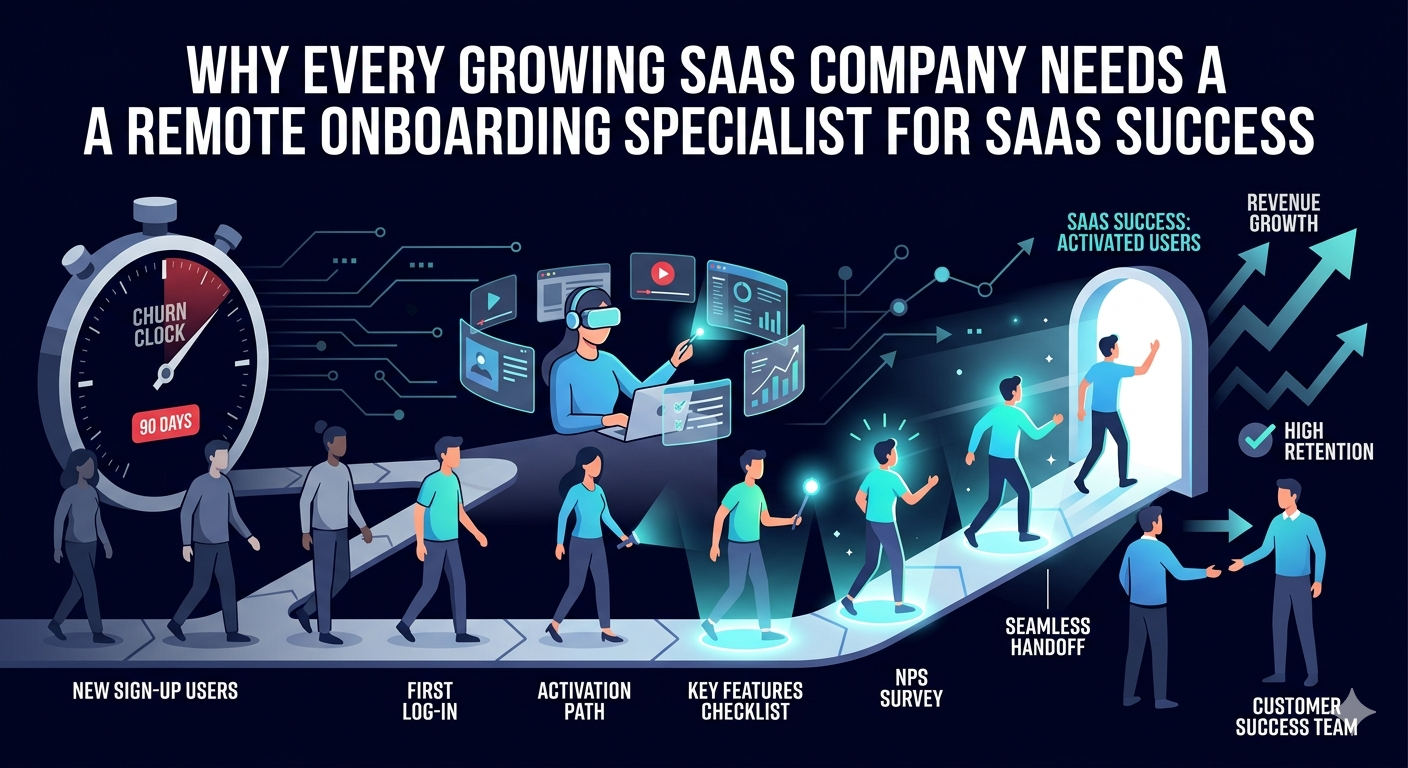
The moment a customer signs up is the moment your churn clock starts ticking. If new users do not reach their first value milestone quickly, they disengage, and disengaged users cancel. Hiring a remote onboarding specialist for SaaS is one of the most cost-effective ways to fix that problem without adding expensive full-time headcount to your payroll.
This guide covers what a SaaS onboarding specialist does, why the remote model works so well in 2026, how much it costs, and how to find and onboard the right person for your product and customer base.
What Is a Remote Onboarding Specialist for SaaS?
A remote onboarding specialist for SaaS is a dedicated professional who guides new customers through the process of adopting your software. Their primary goal is to move users from sign-up to activation as quickly and smoothly as possible, reducing time to first value and setting the foundation for long-term retention.
Unlike a general customer support agent who reacts to problems, an onboarding specialist is proactive. They reach out before customers get stuck, run structured onboarding calls, track product adoption milestones, and flag accounts that are at risk of going cold during the critical first 30 to 90 days.
Core Responsibilities of a SaaS Onboarding Specialist
- Scheduling and running live onboarding calls or product walkthroughs
- Creating and maintaining onboarding email sequences and in-app guides
- Monitoring product usage to identify users who are not activating key features
- Documenting customer goals and mapping them to product capabilities
- Coordinating with technical support when setup issues arise
- Collecting early feedback to improve the onboarding process over time
- Handing off activated accounts to the customer success or account management team
Why Remote Onboarding Works Exceptionally Well for SaaS in 2026
SaaS products are delivered entirely online, which means your customers are already comfortable with video calls, screen sharing, and asynchronous communication. A remote onboarding specialist fits naturally into that environment without the friction or cost of an office-based role.
In 2026, the tools available for remote onboarding have matured significantly. Platforms like Loom for async video walkthroughs, Calendly for seamless scheduling, Intercom and Chameleon for in-app guidance, and Mixpanel or Amplitude for usage analytics make it easier than ever for a remote specialist to do their best work from anywhere in the world.
Advantages of Hiring a Remote Onboarding Specialist Over an In-House Role
- Lower cost: Remote specialists, particularly those based in Latin America, Eastern Europe, or Southeast Asia, offer significant salary savings compared to US or UK-based hires, often 40 to 60 percent less for equivalent skill levels.
- Faster hiring: Sourcing through specialized remote staffing networks reduces time-to-hire from months to weeks.
- Time zone flexibility: Remote hiring lets you cover customer onboarding across multiple time zones without building separate regional offices.
- Scalability: Adding a second or third specialist as your customer base grows is far easier in a remote model than expanding an in-house team.
- Focus: A dedicated remote specialist is not pulled into internal meetings, office politics, or cross-functional projects that dilute their time.
The Business Case: What Happens When Onboarding Is Done Right
Poor onboarding is one of the leading drivers of early churn in SaaS. Customers who do not understand how to use your product within the first few weeks rarely give it a second chance. The cost is not just the lost subscription. It is the marketing and sales spend that acquired that customer in the first place.
Companies that invest in structured onboarding programs consistently report lower churn in the first 90 days, higher feature adoption rates, stronger NPS scores at the 60-day mark, and shorter time to expansion revenue. A single remote onboarding specialist managing 80 to 150 accounts can generate a measurable improvement across all of these metrics within one quarter.
Impact Metrics to Track
- Time to first value (TTFV): How long it takes a new customer to complete their first meaningful action in your product
- Activation rate: Percentage of new sign-ups who reach the activation milestone within 14 or 30 days
- Early churn rate: Cancellations within the first 90 days
- Onboarding completion rate: Percentage of customers who finish the structured onboarding program
- 30 and 60 day NPS: Customer satisfaction scores at early relationship milestones
What Skills Should a Remote Onboarding Specialist for SaaS Have?
Not every customer-facing professional is suited to this role. Onboarding sits at the intersection of project management, product knowledge, communication, and data analysis. Here is what to look for when evaluating candidates.
Must-Have Skills and Attributes
- Clear communicator: Both written and verbal communication must be exceptional, as most customer interactions happen via email, video call, or in-app chat.
- Tech-savvy: Comfort with CRMs, product analytics tools, and customer success platforms like Gainsight, HubSpot, or Totango.
- Process-oriented: Ability to follow and improve structured onboarding playbooks without losing the personal touch.
- Empathetic problem-solver: Customers in the onboarding phase are often frustrated or confused. Patience and calm under pressure are essential.
- Data-driven: Ability to monitor usage dashboards and identify patterns that predict churn risk or expansion potential.
- SaaS product familiarity: Prior experience with SaaS products, even outside your specific niche, dramatically shortens the learning curve.
Nice-to-Have Experience
- Background in customer success, implementation, or solutions engineering
- Familiarity with your product category (HR tech, fintech, martech, etc.)
- Experience building or refining onboarding email sequences
- Comfort with Loom, Notion, Confluence, or similar documentation and async tools
If you need expert customer-facing professionals who are already trained for remote environments, explore the dedicated customer support and onboarding experts at Remote Reps to find the right fit for your SaaS team.
How to Structure the First 90 Days for a New Remote Onboarding Specialist
Even the most experienced remote onboarding specialist needs a structured ramp-up period to perform at their best. Here is a practical framework.
Days 1 to 30: Product and Process Immersion
- Complete a full product walkthrough and set up a personal trial account
- Shadow existing onboarding calls with a senior team member
- Study your onboarding playbook, email sequences, and common customer objections
- Get access to CRM, analytics tools, and customer communication platforms
Days 31 to 60: Managed Ramp-Up
- Begin running onboarding calls independently with a small cohort of new accounts
- Submit weekly reports on activation rates and flagged at-risk accounts
- Start suggesting process improvements based on early observations
Days 61 to 90: Full Ownership
- Own the full onboarding queue for a defined account segment
- Deliver first KPI review against agreed activation and churn benchmarks
- Begin iterating on onboarding materials based on customer feedback
How Much Does a Remote Onboarding Specialist for SaaS Cost?
Compensation varies by region, experience level, and scope of work. Here is a general 2026 benchmark for dedicated remote specialists.
- Latin America: $18,000 to $36,000 per year for mid-level specialists
- Eastern Europe: $22,000 to $42,000 per year for experienced onboarding professionals
- Southeast Asia: $15,000 to $30,000 per year depending on country and experience
- US or Canada based: $55,000 to $85,000 per year for comparable roles
When you factor in no benefits overhead, no office costs, and no recruiting agency fees, the total cost of a remote hire is typically 40 to 65 percent lower than an equivalent in-house role in North America.
According to Gainsight’s 2026 research on SaaS onboarding specialist best practices, companies that hire dedicated onboarding professionals see up to 25 percent improvement in 90-day retention compared to those relying on customer success managers to handle both onboarding and ongoing account management simultaneously.
Conclusion: The Right Hire at the Right Time
In a market where acquisition costs keep rising and customers expect faster results from every tool they buy, investing in a remote onboarding specialist for SaaS is one of the highest-leverage decisions a growing SaaS company can make. You protect your revenue, build stronger customer relationships from day one, and free your core CS team to focus on expansion and advocacy.
If you are ready to hire a remote onboarding specialist for SaaS who can start delivering results within weeks, Remote Reps has the vetted talent and the process to make it happen quickly.
Frequently Asked Questions
What does a remote onboarding specialist for SaaS actually do day to day?
A remote onboarding specialist for SaaS spends most of their day running onboarding calls with new customers, monitoring product usage dashboards for activation signals, sending follow-up emails to accounts that have gone quiet, and updating CRM records with onboarding progress. They also spend time refining onboarding materials, coordinating with the product or support team on common blockers, and preparing weekly reports on activation and churn risk metrics.
How is a remote onboarding specialist for SaaS different from a customer success manager?
A remote onboarding specialist for SaaS is focused exclusively on the early stages of the customer lifecycle, typically the first 30 to 90 days. Their goal is activation and first value. A customer success manager takes over after onboarding is complete and manages the ongoing relationship, including renewals, upsells, and long-term health monitoring. The two roles are complementary, and having both allows each function to operate with focused expertise rather than splitting attention across the full customer journey.
How long does it take a remote onboarding specialist for SaaS to get fully productive?
Most remote onboarding specialists for SaaS reach full productivity within 45 to 60 days, assuming they receive proper access to your product, documentation, and onboarding playbooks from the start. Specialists who come with prior SaaS experience and familiarity with your product category tend to ramp faster. A structured 30-60-90 day onboarding plan for the specialist themselves significantly reduces time to full performance.
What tools should a remote onboarding specialist for SaaS know how to use?
A strong remote onboarding specialist for SaaS should be comfortable with video conferencing platforms like Zoom or Google Meet, CRM tools like HubSpot or Salesforce, customer success platforms like Gainsight or ChurnZero, product analytics tools like Mixpanel or Amplitude, and async video tools like Loom. Familiarity with in-app onboarding tools like Intercom, Appcues, or Chameleon is also a strong advantage, particularly for SaaS products with self-serve onboarding flows.
Can a remote onboarding specialist for SaaS manage enterprise accounts?
Yes, a skilled remote onboarding specialist for SaaS can manage enterprise onboarding with the right support structure in place. Enterprise accounts typically involve multiple stakeholders, complex integrations, and longer time-to-value timelines. The specialist should be paired with a solutions engineer or implementation manager for technical setup, while they focus on stakeholder communication, training coordination, and milestone tracking. For very large strategic accounts, a hybrid approach with on-site touchpoints may still be valuable, but the day-to-day onboarding coordination can absolutely be handled remotely.
How do I measure the ROI of hiring a remote onboarding specialist for SaaS?
The clearest way to measure ROI from a remote onboarding specialist for SaaS is to track the change in your 90-day churn rate before and after hiring. If your average customer pays $200 per month and you prevent 10 early cancellations per quarter, that is $2,000 per month in saved MRR, or $24,000 per year, from a hire that may cost $25,000 to $40,000 annually. Factor in improvements to expansion revenue from better-activated accounts, and the ROI becomes even stronger within the first year.