The shift to remote work did not just change where people work. It fundamentally changed how SaaS companies are built. Understanding how SaaS companies use remote staff reveals a model that is now delivering measurable advantages in speed, cost, talent access, and operational flexibility. In 2026, remote staffing is not an experiment. It is a core growth strategy for software companies at every stage, from pre-revenue startups to post-IPO enterprises.
This guide breaks down the specific roles SaaS companies fill remotely, the business logic behind each decision, and the frameworks that make distributed teams perform at the highest level.
The Business Case for Remote Staffing in SaaS
SaaS companies are uniquely positioned to benefit from remote staffing. Their products are delivered online, their internal workflows are already digital, and their customers are distributed across time zones. The infrastructure required to support remote employees, including cloud tools, async communication platforms, and video conferencing, is the same infrastructure the business already runs on.
The cost advantages are significant. A senior sales development representative (SDR) in New York or London costs $70,000 to $90,000 per year in base salary alone. The same caliber of professional, hired remotely from Latin America or Eastern Europe, typically costs $20,000 to $40,000 per year. Multiply that difference across a team of ten, and the savings fund an entire product sprint, a new marketing channel, or several months of runway.
Why SaaS Is Ideally Suited to the Remote Model
- All core work happens inside digital tools that are already accessible from anywhere
- Customer interactions occur via email, video, and in-app chat regardless of where the team sits
- Async communication is already the norm in most SaaS product and engineering teams
- Performance is measurable by output and metrics rather than hours in an office
- Global hiring expands the talent pool dramatically for specialized, hard-to-fill roles
The Key Roles Where SaaS Companies Deploy Remote Staff
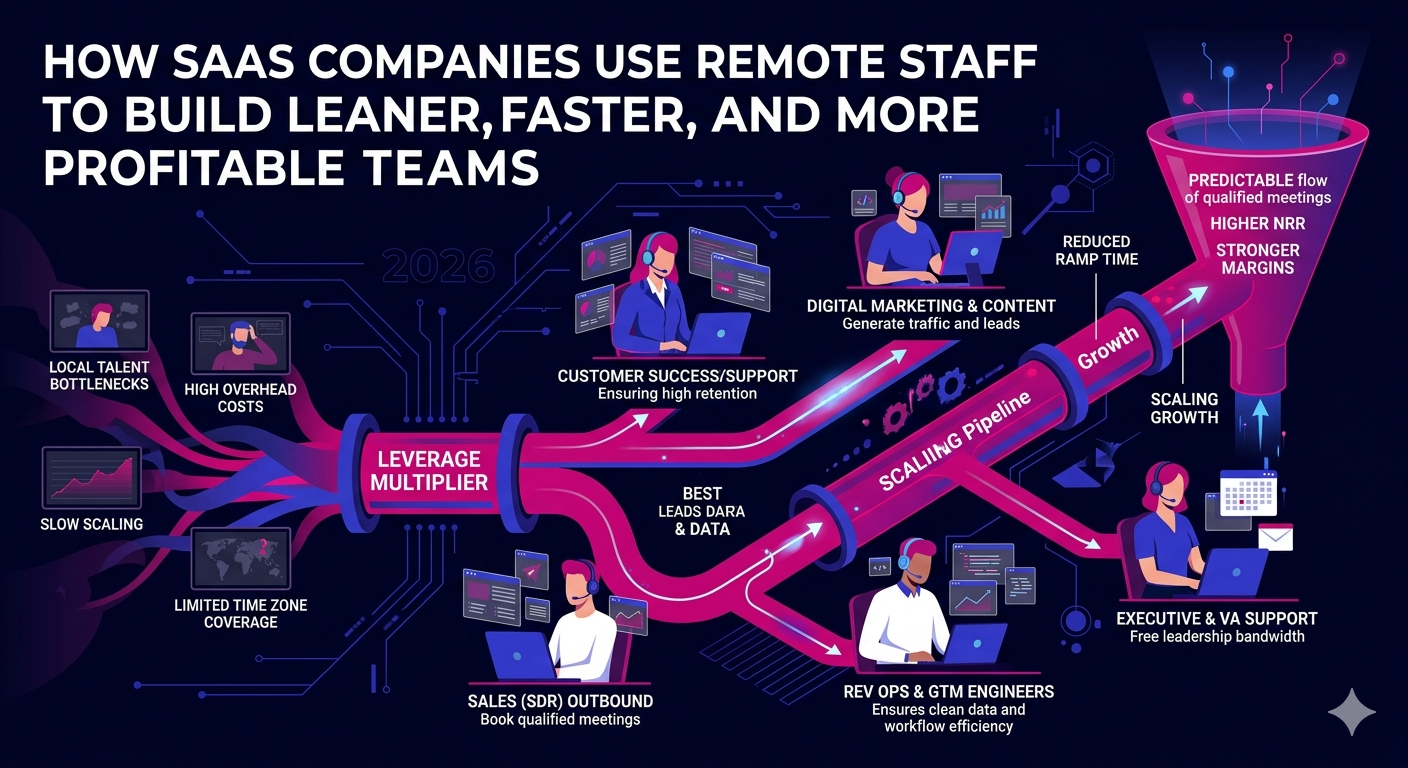
Not every function is equally suited to remote staffing, but the range of roles that SaaS companies now hire for remotely is broader than most founders expect. Here is a breakdown of where the model works best and why.
Sales Development Representatives (SDRs)
SDRs are one of the most commonly outsourced roles in SaaS. Their job is to research prospects, run outbound outreach sequences, qualify inbound leads, and book meetings for account executives. All of this work is done via email, phone, and LinkedIn, making it entirely location-independent.
Remote SDRs with strong English communication skills and SaaS sales experience are available at a significant cost reduction compared to US or UK hires. With proper tooling, training, and management, they produce comparable output and often higher activity volume due to lower distraction levels.
Customer Success and Support
Customer success managers (CSMs) and support specialists are among the highest-value remote roles in SaaS. They communicate with customers over email, chat, and video, manage renewal cycles, monitor health scores, and guide onboarding. None of these activities require physical presence.
Remote customer-facing teams also enable SaaS companies to extend their support coverage across time zones without building expensive regional offices. A support team spanning Latin America, Eastern Europe, and Southeast Asia can cover nearly 24 hours of follow-the-sun support at a fraction of the cost of an all-US team.
Digital Marketing and Content
SaaS companies use remote staff extensively across their marketing functions. Content writers, SEO specialists, social media managers, paid media buyers, and email marketers are all roles that translate seamlessly to remote work. Output quality is easy to measure through traffic, rankings, conversion rates, and campaign ROI, making performance management straightforward.
Remote marketing hires also give SaaS companies access to specialists in narrow disciplines, such as technical SEO or SaaS-specific paid acquisition, who may not be available or affordable in a single geographic market.
Go-to-Market (GTM) Engineers and Operations
GTM engineers sit at the intersection of sales, marketing, and technology. They build and maintain automation workflows, manage RevOps tooling, integrate CRMs with marketing platforms, and ensure the data infrastructure that supports pipeline generation is clean and reliable. This highly technical function is well-suited to remote work and commands strong talent globally.
Virtual Assistants and Executive Support
Founders and senior leaders at SaaS companies increasingly rely on remote virtual assistants and executive assistants to manage calendars, inboxes, research tasks, content coordination, and operational logistics. Delegating these tasks to a skilled remote professional frees leadership bandwidth for the strategic decisions that only they can make.
To see how SaaS companies use remote staff across sales, marketing, and operations functions, explore the dedicated remote SDR services at Remote Reps built specifically for software companies looking to scale pipeline without expanding their office headcount.
How SaaS Companies Structure Remote Teams for Maximum Performance
Knowing which roles to hire remotely is only half the equation. The SaaS companies that get the best results from remote staff are those that build the right structure around their distributed teams.
Clear Ownership and Defined KPIs
Remote workers perform best when they have unambiguous ownership of specific outcomes. Each remote team member should have a written description of their responsibilities, the KPIs they are measured against, and the tools and resources they need to succeed. Vague roles and undefined success metrics are the most common reasons remote hires underperform.
Async-First Communication Norms
The best remote SaaS teams establish async communication as the default. This means using tools like Notion, Loom, and Slack for day-to-day coordination rather than requiring constant live meetings. Live synchronous time is reserved for strategic discussions, complex problem-solving, and relationship-building, not status updates that could be a written message.
Documentation as Infrastructure
Remote teams need comprehensive documentation to function well. This includes onboarding guides, process SOPs, product knowledge bases, brand guidelines, and escalation paths. SaaS companies that invest in documentation upfront reduce ramp times, improve consistency, and make remote team expansion much faster and lower-risk.
Regular Performance Reviews and Feedback Loops
Monthly one-on-ones, weekly KPI reviews, and quarterly performance conversations are essential for keeping remote staff engaged and aligned. These touchpoints also surface problems early, before they become costly. Managers who check in consistently with remote team members report higher retention and better output quality across the board.
Common Mistakes SaaS Companies Make With Remote Staff
Even companies with strong remote hiring intentions make avoidable mistakes. Here are the patterns that consistently undermine remote team performance.
Hiring Without a Structured Onboarding Plan
Remote hires who do not receive structured onboarding take longer to become productive and are more likely to disengage early. A written 30-60-90 day plan with clear milestones, regular check-ins, and access to all necessary tools from day one dramatically improves outcomes.
Treating Remote Staff as Contractors Rather Than Team Members
SaaS companies that isolate remote staff from internal communication channels, team meetings, and company updates consistently see lower performance and higher turnover. Remote professionals who feel like part of the team deliver significantly better results than those who feel like external vendors.
Skipping Time Zone Alignment Conversations
Time zone mismatches do not have to be a barrier, but they do require explicit planning. Define expected overlap hours, set response time expectations, and build workflows that account for asynchronous handoffs. Companies that ignore this create friction, delays, and frustration on both sides.
The 2026 Remote Staffing Landscape for SaaS
The remote talent market has matured significantly. In 2026, the professionals seeking remote SaaS roles are not entry-level candidates looking for flexibility. They are experienced specialists who have built careers in distributed teams, understand SaaS business models, and are equipped with the tools and habits that make remote work genuinely high-performing.
For SaaS founders and operators who want to build efficient, scalable teams without the constraints of a single labor market, the strategic advantages are clear and growing. The companies that learn how to hire, structure, and manage remote staff effectively will build faster and more profitably than those still competing for local talent in high-cost markets.
According to Buffer’s State of Remote Work research on how SaaS companies use remote staff, over 97 percent of remote workers say they would recommend remote work to others, and SaaS companies consistently rank among the top adopters of fully distributed team structures globally.
Conclusion: Remote Staff Is Not a Workaround, It Is a Competitive Advantage
The most successful SaaS companies in 2026 are not treating remote staffing as a cost-cutting measure of last resort. They are treating it as a deliberate strategic decision that gives them access to better talent, lower costs, broader time zone coverage, and faster scaling velocity than their office-bound competitors.
If you are ready to build a remote team that performs at the level your SaaS company needs, start with a clear role definition, a structured onboarding plan, and a staffing partner who understands the SaaS market.
Frequently Asked Questions
How do SaaS companies use remote staff differently than other types of businesses?
SaaS companies use remote staff in ways that are deeply integrated with their core revenue operations, not just administrative support. Because the product is delivered digitally and the entire customer relationship happens online, remote staff can handle sales outreach, customer onboarding, marketing execution, technical support, and revenue operations as effectively as an in-office team. This level of integration is less common in industries that rely on physical presence, such as manufacturing or retail, making SaaS one of the most effective adopters of the remote model.
What are the most common roles when SaaS companies use remote staff?
The most commonly filled remote roles at SaaS companies include sales development representatives, customer success managers, customer support specialists, content writers, SEO specialists, paid media managers, go-to-market engineers, virtual assistants, and executive assistants. These roles share a common trait: their output is measurable, their work happens inside digital tools, and their performance does not depend on physical co-location with the rest of the team.
How do SaaS companies use remote staff without sacrificing team culture?
The SaaS companies that maintain strong culture with remote teams do so by treating remote employees as full team members rather than external contractors. This means including them in company all-hands meetings, team Slack channels, product updates, and performance recognition. Regular one-on-one meetings, annual or semi-annual in-person gatherings, and clear company values that are communicated consistently all contribute to a cohesive culture regardless of geography.
How do SaaS companies manage performance when they use remote staff?
Performance management for remote staff in SaaS is built around clearly defined KPIs that are reviewed regularly. SDRs are measured on meetings booked and outreach activity. Customer success managers are measured on churn rate, NPS, and renewal rates. Marketing hires are measured on traffic, leads, and conversion metrics. Weekly dashboards, monthly one-on-ones, and quarterly reviews give managers the visibility they need to course-correct quickly and reward high performers consistently.
How much can SaaS companies save when they use remote staff instead of local hires?
Cost savings vary by role and region, but SaaS companies typically save 40 to 65 percent on fully loaded compensation costs when hiring equivalent-quality remote professionals from Latin America, Eastern Europe, or Southeast Asia compared to US or UK-based hires. For a team of ten remote staff members across sales, marketing, and customer success, the annual savings often exceed $300,000 to $500,000 while maintaining comparable output quality, which represents a substantial reinvestment opportunity back into the product or growth channels.
What tools do SaaS companies need in place before they use remote staff?
Before onboarding remote staff, SaaS companies should have a cloud-based CRM, a team communication platform like Slack or Teams, a project management tool like Asana or Linear, a documentation system like Notion or Confluence, and a video conferencing platform. Access credentials, clear onboarding documentation, and defined KPIs for the new role should be prepared before the hire’s first day. Companies that set up this infrastructure in advance consistently report faster ramp times and higher early-stage performance from their remote hires.