
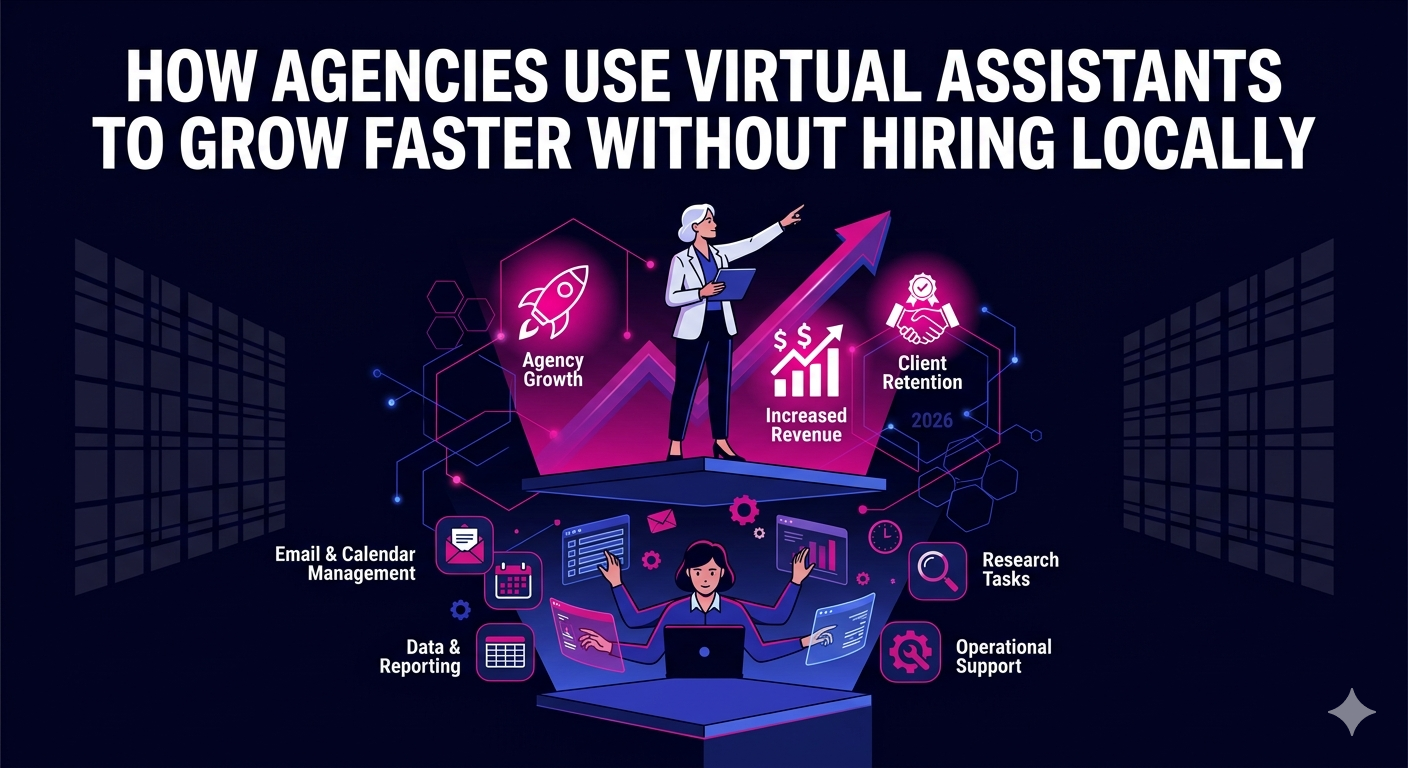
The agencies growing fastest in 2026 are not necessarily the ones with the biggest teams or the largest offices. They are the ones that have figured out how agencies use virtual assistants to grow sustainably, protect their margins, and keep their senior staff focused on high-value work. If you are running an agency and feel like your team is drowning in administrative tasks, coordination work, and repetitive processes, this guide is for you.
Virtual assistants are no longer just inbox managers. They are operational partners who handle everything from research and reporting to client communication and campaign support. When deployed strategically, they become one of the most cost-effective growth tools available to any agency owner.
The Real Reason Agencies Struggle to Grow
Before diving into how agencies use virtual assistants to grow, it is worth understanding the core problem that holds most agencies back. Growth stalls not because of a lack of clients or talent, but because of a lack of capacity. The people who should be driving strategy, building relationships, and delivering exceptional work end up buried in tasks that do not require their skill level.
Consider how much time your senior team spends each week on:
- Scheduling meetings and managing calendars
- Preparing reports and collating data
- Following up on invoices and chasing approvals
- Researching prospects and building contact lists
- Managing inboxes and responding to routine client queries
- Updating project management tools and tracking task status
Every hour a creative director, account lead, or agency principal spends on these tasks is an hour not spent on work that actually moves the needle. Virtual assistants absorb this operational overhead so your best people can do their best work.
How Agencies Use Virtual Assistants to Grow Revenue
The connection between virtual assistants and revenue growth might not seem obvious at first. But when you look at the mechanics, it becomes clear. Agencies use virtual assistants to grow revenue in two primary ways: by freeing up senior capacity for billable and strategic work, and by supporting business development activities that directly generate new clients.
Supporting Business Development
New business is the lifeblood of any agency. But most agency owners and account directors do not have time to consistently prospect, follow up, and nurture leads while also serving existing clients. A virtual assistant changes that equation. They can build targeted prospect lists, research potential clients, manage CRM data, draft outreach emails, schedule discovery calls, and track follow-up sequences so your pipeline never runs cold.
Paired with a dedicated remote lead generation expert, a virtual assistant creates a complete new business support system that keeps opportunities flowing without pulling your senior team away from delivery.
Enabling Faster Client Delivery
Speed is a competitive advantage in agency work. Clients who get faster turnarounds stay longer and refer more. Virtual assistants support delivery by handling the coordination work that slows projects down: gathering assets, chasing approvals, updating briefs, scheduling review calls, and keeping project management tools current. When these tasks are handled reliably, your delivery team moves faster and your clients notice.
Protecting Margins on Existing Accounts
Scope creep and operational inefficiency quietly erode agency margins. Virtual assistants help protect profitability by keeping workflows tight, documentation accurate, and communication consistent. They also free up senior staff time, which means you can take on more clients without increasing your fixed cost base proportionally.
The Key Tasks Virtual Assistants Handle for Growing Agencies
Understanding how agencies use virtual assistants to grow requires getting specific about the work they actually do. The most impactful task categories fall into four areas:
Administrative and Operational Support
- Calendar and meeting management across multiple team members
- Travel and accommodation research and booking
- Invoice tracking, expense documentation, and payment follow-up
- File organization and document management in shared drives
- Internal communications and team coordination tasks
Research and Reporting
- Competitive research and industry landscape summaries
- Client and prospect background research ahead of meetings
- Monthly and weekly performance report compilation
- Social listening and brand mention tracking
- Data entry and database maintenance
Client Communication Support
- Drafting routine client status updates and meeting recaps
- Managing shared inboxes and triaging incoming requests
- Coordinating feedback rounds and approval workflows
- Preparing agendas and post-meeting action summaries
Content and Marketing Assistance
- Scheduling social media posts across client platforms
- Repurposing existing content into new formats
- Sourcing images and assets for campaigns
- Proofreading and formatting blog posts, newsletters, and decks
When you look at the breadth of this list, it becomes clear why understanding how agencies use virtual assistants to grow is so valuable. These are not trivial tasks. They are the operational glue that holds an agency together, and having a reliable person handling them makes a profound difference to agency performance.
How to Hire the Right Virtual Assistant for Your Agency
The quality of your hire determines the quality of your results. Not every virtual assistant will thrive in an agency environment, which moves fast, involves multiple clients, and demands strong written communication. Here is what to prioritize when hiring:
Agency Experience or Awareness
Candidates who have worked with agencies before understand the pace, the client-first culture, and the need for discretion. They adapt faster and require less hand-holding on context that agency-experienced hires already take for granted.
Strong Written Communication
Virtual assistants in an agency setting spend a significant portion of their time communicating in writing, whether drafting client emails, updating project notes, or summarizing research. Clear, professional written communication is non-negotiable.
Tool Proficiency
Look for candidates who are already comfortable with the tools your agency uses, such as Asana, ClickUp, or Notion for project management, Slack for communication, and Google Workspace for documents and email. A virtual assistant who needs to learn your entire stack from scratch is a slower investment than one who arrives ready to contribute.
Proactive Problem-Solving
The best virtual assistants do not wait to be told what to do next. They anticipate needs, flag issues before they escalate, and find solutions independently. Look for evidence of this mindset in their previous work examples and interview responses.
Working with a specialist platform like The Remote Reps virtual assistant service gives you access to pre-vetted candidates who have been assessed for exactly these qualities. You skip the filtering phase and move directly to selecting from a shortlist of agency-ready professionals. You can also explore remote executive assistants if you need higher-level strategic support for agency leadership.
Setting Up Your Virtual Assistant for Success
Hiring is only half the equation. How agencies use virtual assistants to grow depends heavily on how well those assistants are set up to deliver. A poor onboarding experience produces poor results regardless of the candidate’s quality.
Follow these steps to maximize the impact from your first 30 days:
- Create a clear role brief that outlines responsibilities, priorities, preferred communication channels, and expected response times.
- Record short Loom walkthroughs of recurring tasks so your VA can reference them anytime without asking you the same questions repeatedly.
- Assign a real project in week one. Practical experience in a live context is the fastest way to build confidence and identify any gaps.
- Set weekly check-ins for the first month to give feedback, answer questions, and course-correct early if needed.
- Grant tool access immediately so your VA is never blocked from starting a task because of a missing login.
According to data published by Harvard Business Review on how agencies and firms use delegation and virtual support to grow productivity, leaders who effectively delegate lower-priority tasks to skilled support staff recover an average of 20 percent of their working week for strategic activity. For agency owners, that time translates directly into growth.
If you are ready to experience firsthand how agencies use virtual assistants to grow, The Remote Reps can match you with a pre-screened, agency-ready virtual assistant who is prepared to contribute from day one. Stop letting operational overhead limit your agency’s potential and start building the support structure your growth requires.
FAQ: How Agencies Use Virtual Assistants to Grow
How do agencies use virtual assistants to grow without sacrificing quality?
Agencies use virtual assistants to grow while maintaining quality by assigning them clearly defined tasks with detailed briefs and documented workflows. The key is giving virtual assistants ownership of specific operational and administrative functions so senior team members can concentrate on strategic and creative work. With the right systems and regular check-ins, quality improves because everyone is focused on what they do best.
What is the typical cost when agencies use virtual assistants to grow their teams?
The cost varies based on experience level, location, and scope of work. Most agencies use virtual assistants to grow by hiring at full-time rates between $1,200 and $3,000 per month for skilled offshore talent, compared to $45,000 to $65,000 per year for an equivalent local hire. The cost savings are significant and the return on investment is typically visible within the first 60 days.
How quickly do results show when agencies use virtual assistants to grow?
Most agencies that use virtual assistants to grow see measurable time savings and workflow improvements within the first two to four weeks of a well-structured onboarding. The speed of results depends on the clarity of the role brief, the quality of the hire, and how quickly the agency integrates the VA into its existing systems and communication tools.
Which agency roles benefit most from using virtual assistants to grow?
The roles that benefit most when agencies use virtual assistants to grow include agency principals and founders, account managers, creative directors, and business development leads. These are typically the people spending the most time on tasks that are important but do not require their specific expertise. Offloading those tasks to a virtual assistant has the highest leverage effect on overall agency output.
Can small agencies use virtual assistants to grow as effectively as large ones?
Yes, and often more so. Small agencies use virtual assistants to grow particularly effectively because every hour saved by a founder or small team directly translates into more capacity for client work or new business. A one-person or three-person agency with a capable virtual assistant can punch well above its weight in terms of client capacity and delivery quality.
What tools should agencies set up before using virtual assistants to grow their operations?
Before bringing on a virtual assistant, agencies looking to grow should have a project management tool in place (such as Asana, ClickUp, or Notion), a team communication platform (such as Slack), and a shared file system (such as Google Workspace). These tools allow agencies to use virtual assistants to grow efficiently by giving the VA the visibility and access needed to contribute without constant supervision.