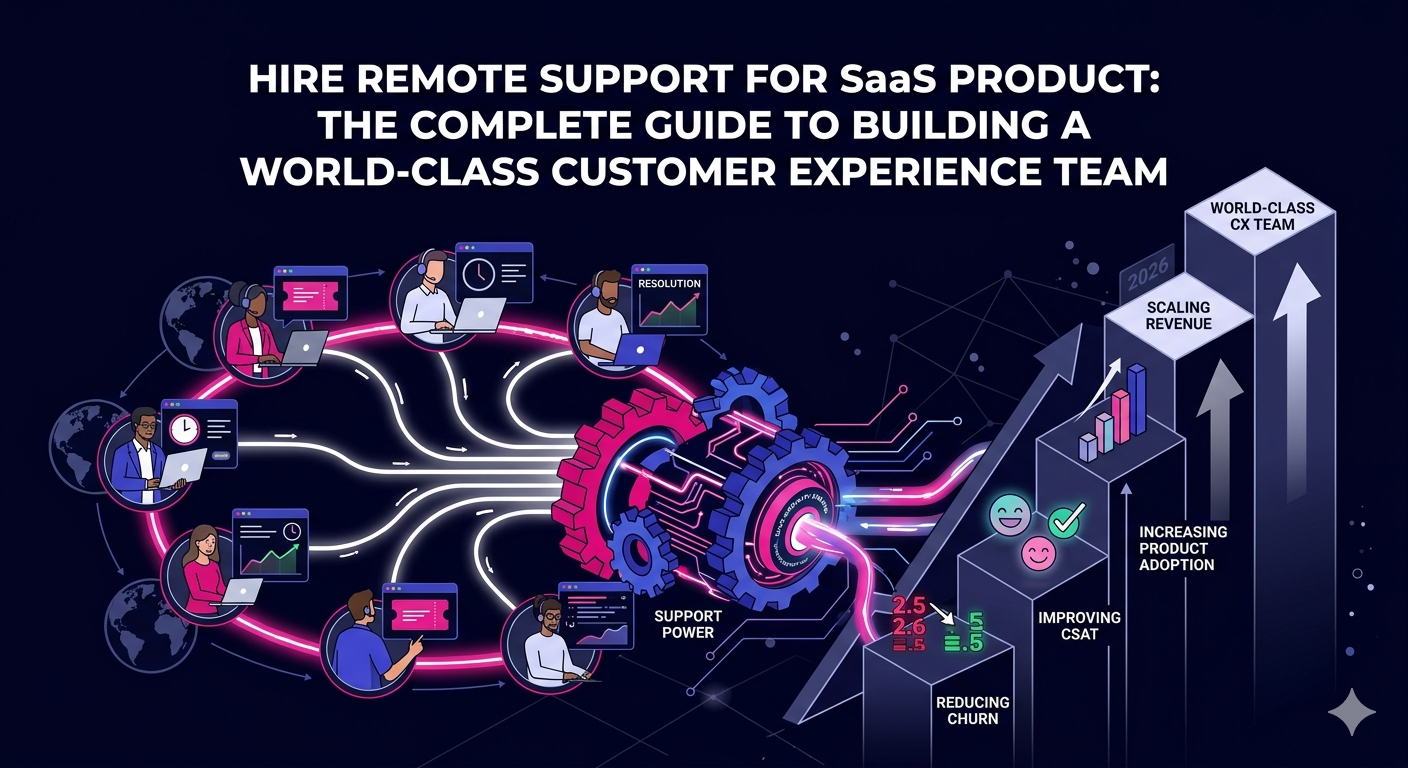
Customer support is no longer a cost center. For SaaS companies competing on retention and expansion revenue, it is a direct growth driver. When you hire remote support for your SaaS product, you make a strategic decision that affects churn rate, net promoter score, product adoption, and ultimately your bottom line. In 2026, the companies winning on support are those that treat it as a core function, not an afterthought.
This guide walks you through everything you need to know to hire, structure, and scale a remote SaaS support team that reduces churn, delights users, and contributes real revenue impact.
Why SaaS Companies Are Prioritizing Remote Customer Support in 2026
The case for remote support has never been stronger. Advances in async communication tools, AI-assisted ticketing, and remote collaboration platforms have eliminated most of the friction that once made remote support teams harder to manage than in-office ones.
At the same time, the talent advantages of remote hiring are significant. When you hire remote support for your SaaS product, you access a global pool of candidates with diverse language skills, technical backgrounds, and time zone coverage that no single office location can match.
The Business Impact of Strong SaaS Customer Support
The numbers make the case clearly. Research consistently shows that SaaS companies with strong customer support experience lower churn, higher expansion revenue, and stronger brand loyalty. Support is often the deciding factor when a customer considers upgrading, renewing, or churning. A single poor support interaction can undo months of onboarding investment. A great one can turn a frustrated user into a loyal advocate.
Why Remote Support Works Especially Well for SaaS
- SaaS products are used globally, and remote teams can provide time zone coverage across regions without overnight shifts.
- Support interactions for software products happen primarily through digital channels, making them naturally suited to remote delivery.
- Remote support specialists can be onboarded quickly using your existing documentation, knowledge base, and product training resources.
- You can scale headcount up or down in response to user growth or seasonal demand without the lag of local recruiting.
What to Look for When You Hire Remote Support for a SaaS Product
Not every customer support professional is equipped to handle the demands of a SaaS environment. Before you post a job or work with a talent provider, define the specific skills and qualities your support role requires.
Technical Aptitude and Product Curiosity
SaaS support specialists deal with product bugs, integration questions, billing issues, and onboarding friction. They need to be comfortable navigating software interfaces, troubleshooting user issues methodically, and escalating technical problems to the right internal teams. Strong candidates do not need to be developers, but they do need to be genuinely curious about technology and willing to develop deep product knowledge.
Written Communication Skills
The majority of SaaS support interactions happen through text, whether in live chat, email, or help desk tickets. Strong written communication is non-negotiable. Look for candidates who write clearly, concisely, and with appropriate empathy. Poorly worded support responses frustrate customers and create more tickets, not fewer.
Comfort with Support Tools and Platforms
Modern SaaS support teams rely on platforms like Intercom, Zendesk, Freshdesk, or Help Scout. When you hire remote support for your SaaS product, prioritize candidates with hands-on experience in at least one major support platform. Onboarding a rep who already understands ticket workflows, macros, and reporting dashboards takes significantly less time than starting from scratch.
Ownership Mindset and Low Supervision Needs
Remote support reps need to manage their own time, prioritize their queue, and resolve issues without constant manager oversight. During the interview process, ask candidates about how they handle competing priorities, what they do when they hit an issue they cannot resolve alone, and how they stay organized across multiple tickets. Their answers will reveal whether they are self-directed or dependent on close supervision.
How to Structure Your Remote SaaS Support Team
The right team structure depends on your product complexity, user volume, and support channels. Here is a framework that works well for most SaaS companies in the growth stage.
Tier 1: Front-Line Support Specialists
These are your first responders. They handle the majority of incoming tickets covering account questions, basic troubleshooting, billing inquiries, and feature guidance. A well-trained Tier 1 team should be able to resolve 70 to 80 percent of tickets without escalation. When you hire remote support for your SaaS product at this tier, look for strong communicators with good product knowledge and a calm, patient approach to frustrated users.
Tier 2: Technical Support Specialists
More complex issues like integration failures, API questions, data imports, and edge-case bugs need a higher level of technical knowledge. Tier 2 reps bridge the gap between the front-line team and your engineering or product teams. They often write bug reports, document workarounds, and contribute to the internal knowledge base.
Support Team Lead or Manager
As your team scales beyond three or four reps, a team lead becomes essential. They handle escalations, conduct quality reviews, manage schedules across time zones, and run regular team check-ins. In a remote setup, this role is critical for maintaining consistency and morale across the team.
Key Channels Your Remote Support Team Should Cover
SaaS users expect support across multiple channels. Before you hire remote support for your SaaS product, map out exactly which channels you need covered and at what hours.
- Live chat: Provides real-time support for in-app users who hit issues during active sessions. High urgency and high impact on product experience.
- Email and help desk: The workhorse of SaaS support. Suitable for detailed technical issues and billing questions where a quick back-and-forth may be needed.
- In-app messaging: Triggered messages and support prompts within the product itself, often handled through the same platform as live chat.
- Community and forum support: Larger SaaS companies often maintain user communities where support reps answer questions publicly, creating reusable knowledge for all users.
- Video or screen-sharing support: For complex onboarding or technical troubleshooting sessions where async communication is not enough.
If you are building out a full customer experience function and want to pair your support team with other remote specialists, explore The Remote Reps’ vetted remote customer support experts who are pre-screened for SaaS environments and ready to contribute from day one.
Onboarding Your Remote SaaS Support Team Effectively
Even experienced support professionals need a structured onboarding process to perform well in your specific product environment. Without it, you will face inconsistent responses, longer resolution times, and avoidable escalations.
Build a Comprehensive Knowledge Base First
Before your remote support hires start, make sure your internal knowledge base is thorough and up to date. This should include common user issues and their resolutions, product feature documentation, escalation paths for different issue types, and brand voice and communication guidelines. A well-documented knowledge base reduces the time new reps spend asking internal questions and accelerates their path to independence.
Run a Structured Ramp Program
A 30-to-60-day ramp program should include product demos, shadowing senior reps, handling low-complexity tickets under review, and weekly check-ins with the team lead. Set clear milestones for when a new hire should be handling tickets independently, meeting first-response time targets, and achieving satisfactory customer satisfaction scores.
Measuring the Performance of Your Remote SaaS Support Team
Define your success metrics before you hire. The right KPIs keep your team aligned and give you clear data to act on when performance needs to improve. According to Zendesk’s guide to customer support metrics for SaaS teams, the metrics that matter most are first response time, resolution time, customer satisfaction score, and ticket deflection rate through self-service.
- First response time: How quickly a user receives an initial reply after submitting a ticket.
- Resolution time: How long it takes to fully resolve an issue from the moment it is submitted.
- Customer satisfaction score (CSAT): Post-ticket ratings that indicate how satisfied users are with the support they received.
- Ticket deflection rate: The percentage of potential tickets resolved through self-service before a user contacts support.
- Churn correlation: Tracking whether users who submit multiple unresolved tickets are more likely to cancel, and using that data to prioritize support quality improvements.
Conclusion: Make Your Next Hire Count
When you hire remote support for your SaaS product, you are investing in the retention engine that keeps hard-won customers paying and expanding. The right remote support team reduces churn, increases product adoption, and generates the kind of customer loyalty that drives word-of-mouth growth.
The investment is worth making, and it is worth making carefully. Prioritize candidates with technical curiosity, strong written communication, and a proven ability to work independently. Build the onboarding systems and knowledge infrastructure before they start. And measure what matters so you can improve continuously.
Ready to find the right remote support professionals for your SaaS product? Explore The Remote Reps’ remote customer support expert services and connect with pre-vetted specialists who understand SaaS environments and are ready to deliver results from day one.
Frequently Asked Questions About Hiring Remote Support for a SaaS Product
Why should I hire remote support for my SaaS product rather than building an in-house team?
When you hire remote support for your SaaS product, you gain access to a significantly larger talent pool, often at lower total cost than a locally-based in-house team. Remote support specialists can cover more time zones, scale faster in response to user growth, and be onboarded efficiently using your existing documentation and training resources. For most SaaS companies in the growth stage, remote support delivers better value without sacrificing quality.
What qualifications should I look for when I hire remote support for a SaaS product?
When you hire remote support for your SaaS product, prioritize candidates with demonstrated experience in a SaaS or technical support environment, strong written communication skills, familiarity with major help desk platforms, and a self-directed work style. Technical aptitude and product curiosity are also essential, as SaaS support often involves troubleshooting software-specific issues that require logical thinking and comfort with technology.
How many remote support reps do I need for my SaaS product?
The right team size depends on your active user count, ticket volume, and the complexity of your product. A common starting benchmark is one support specialist for every 200 to 400 active users, adjusting based on your average tickets per user per month. As you hire remote support for your SaaS product and gather real volume data, you can refine your staffing model. Most early-stage SaaS companies start with one or two generalist reps and add specialization as the team grows.
How do I ensure quality and consistency when I hire remote support for my SaaS product?
Quality and consistency start with strong onboarding, a well-maintained knowledge base, and regular quality reviews. Set clear communication standards and use response templates for common issue types. Conduct weekly ticket audits during the first 60 days and give specific, actionable feedback. A dedicated team lead or support manager is essential as your team scales, since they provide the day-to-day oversight that keeps remote support performance consistent across the team.
What tools does a remote support team need to support a SaaS product effectively?
A remote support team for a SaaS product typically needs a help desk or ticketing platform such as Zendesk, Intercom, or Freshdesk, along with access to your internal knowledge base, CRM data, and product analytics. Screen sharing or video tools are valuable for complex technical sessions. A team communication platform like Slack is essential for internal escalations and handoffs. When you hire remote support for your SaaS product, confirm that candidates are comfortable with these categories of tools even if they have not used your exact stack.
Can remote SaaS support help reduce customer churn?
Yes. When you hire remote support for your SaaS product and set them up with the right tools, training, and KPIs, they directly contribute to churn reduction. Fast, accurate responses to support issues prevent user frustration from reaching the point of cancellation. Proactive support, such as reaching out to users who have not completed onboarding or who submitted multiple tickets without resolution, can save at-risk accounts before they decide to leave. Support quality and churn rate are closely correlated in SaaS businesses across every growth stage.