Running a marketing agency is rewarding. Scaling one is a different challenge entirely. If you are trying to grow revenue without proportionally growing your overhead, the answer is clear: you need to learn how to scale a marketing agency with remote staff. In 2026, the most profitable and fastest-growing agencies are distributed by design. They hire globally, operate lean, and deliver exceptional client results by building remote teams that outperform traditional office-based setups. This guide gives you the exact playbook to do the same.
Why Remote Staffing Is the Smartest Way to Scale a Marketing Agency
The traditional agency growth model is expensive. More clients mean more local hires, more office space, and more fixed costs. That model caps your margins and creates significant risk when client revenue fluctuates.
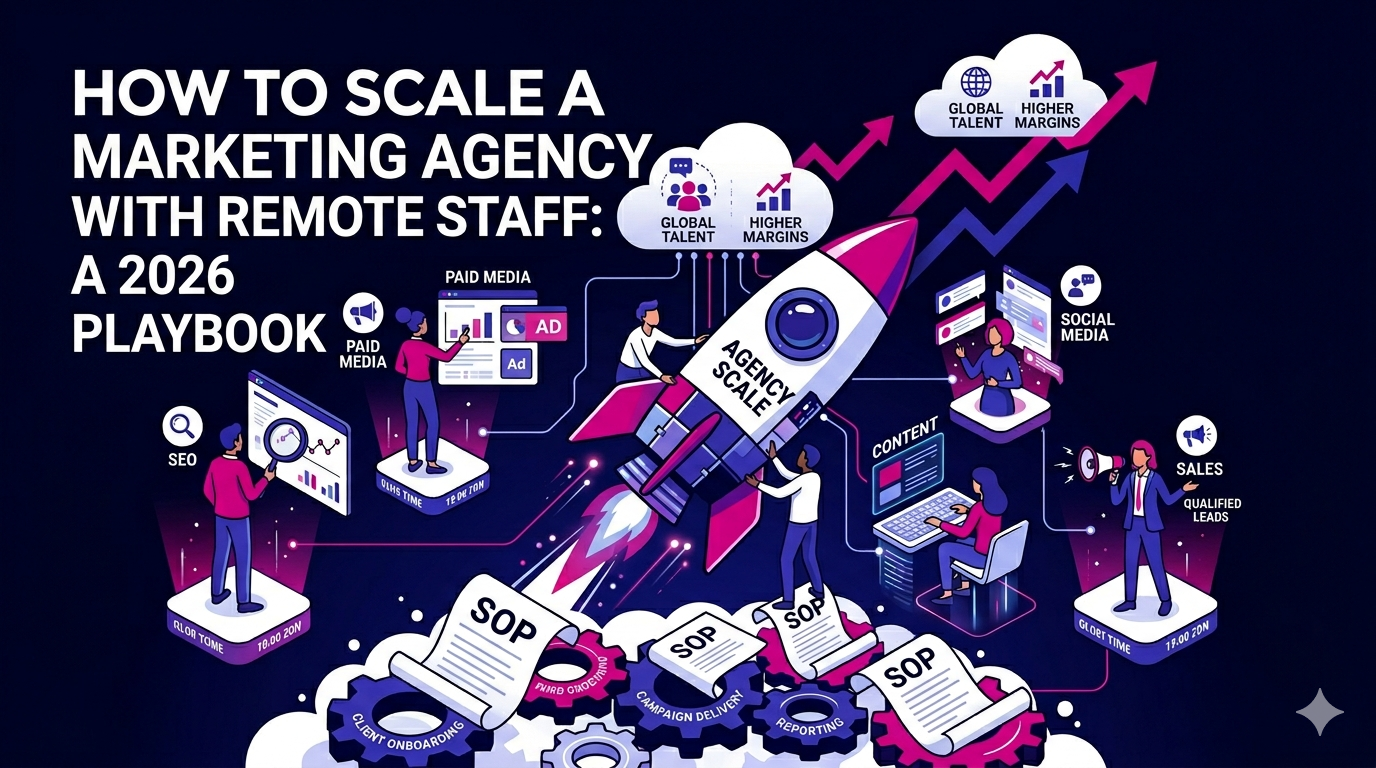
Remote staffing breaks that equation. When you scale a marketing agency with remote staff, you gain access to a global talent pool, reduce overhead dramatically, and build a team that can flex with your client load. Here is why leading agencies have embraced this model in 2026:
- Remote marketing professionals can be hired at 40 to 70 percent lower cost than equivalent local talent in the US or UK
- You can hire specialized talent for specific client needs without committing to full-time salaries
- Remote teams allow you to cover multiple time zones, delivering faster turnaround for clients across geographies
- Lower fixed costs mean higher margins, even on competitively priced retainers
- You are not limited by your local job market when hiring niche specialists like SEO strategists, paid media buyers, or social media managers
The agencies scaling fastest in 2026 are not the ones with the biggest offices. They are the ones with the best remote talent infrastructure.
The Core Roles You Need to Scale a Marketing Agency With Remote Staff
Before you build your remote team, you need clarity on which roles will drive the most growth. Most marketing agencies at the scaling stage need a combination of delivery, strategy, and client-facing talent.
Delivery and Execution Roles
These are the roles that do the work clients pay for. They are also the easiest to hire remotely because the output is measurable and tool-based. Common delivery roles include:
- SEO specialists who handle on-page optimization, link building, and content strategy
- Paid media and PPC experts who manage Google, Meta, and LinkedIn ad accounts
- Social media managers who handle content scheduling, community management, and reporting
- Copywriters and content producers for blogs, email campaigns, and ad creatives
- Media buyers who manage programmatic and direct ad placements across channels
Strategy and Operations Roles
As you scale, you also need remote staff who can own accounts, manage client relationships, and build internal processes. This includes account managers, project managers, and digital marketing strategists who can operate independently without constant oversight.
Sales and Business Development Roles
Scaling a marketing agency with remote staff also means scaling your new business pipeline. Remote SDRs and sales development reps can handle outreach, qualify leads, and book discovery calls so your senior team focuses on closing and delivery rather than prospecting.
Step-by-Step: How to Scale a Marketing Agency With Remote Staff
Step 1: Document Your Service Delivery Process First
The biggest mistake agency owners make when scaling with remote staff is hiring before their processes are documented. Remote team members cannot rely on casual conversations or watching how things are done in the office. Everything needs to be written down.
Before your first remote hire, build standard operating procedures for your core service lines. Document how you onboard a new client, how you run a monthly SEO campaign, how you report performance, and how you handle client feedback. This makes remote hiring far more successful and dramatically reduces your time spent on management.
Step 2: Define Each Role With Outcome-Based Job Descriptions
Remote hires perform best when they know exactly what success looks like. Write job descriptions that specify deliverables, not just responsibilities. Instead of “manage social media accounts,” write “publish 20 pieces of content per month per client account, maintain an average engagement rate above 3 percent, and deliver a monthly performance report by the 5th of each month.”
Outcome-based clarity attracts self-starters who thrive in remote environments and filters out candidates who need constant supervision.
Step 3: Use Specialist Platforms to Find Pre-Vetted Remote Talent
General job boards are inefficient for finding specialist marketing talent. When you scale a marketing agency with remote staff, you want candidates who are already experienced in remote work, familiar with agency workflows, and capable of integrating into a distributed team quickly.
Working with a specialist talent partner that focuses on remote marketing professionals gives you faster access to better candidates without weeks of screening. The Remote Reps’ remote digital marketer service connects growing agencies with pre-vetted digital marketing professionals across SEO, paid media, social, content, and more, ready to contribute to client accounts from day one.
Step 4: Build a Remote Onboarding System That Sets People Up to Win
Remote onboarding is where agency scaling either accelerates or stalls. A new remote hire who is left to figure things out independently will take three to four times longer to reach full productivity than one who goes through a structured onboarding program.
Your remote onboarding system should include:
- A written onboarding guide covering tools, processes, communication expectations, and client account context
- Access to all platforms, dashboards, and client accounts on day one
- A 30-60-90 day milestone plan with clearly defined outcomes for each stage
- Scheduled check-ins with their direct manager during the first four weeks
- A buddy or peer within the team who can answer operational questions quickly
Step 5: Implement a Remote Team Management Stack
Scaling a marketing agency with remote staff requires the right tooling to keep everyone aligned, productive, and accountable. In 2026, the standard remote agency management stack includes:
- Project management: Asana, Monday.com, or ClickUp for task tracking and campaign workflows
- Communication: Slack for async messaging, Zoom for weekly syncs and client calls
- Documentation: Notion or Confluence for SOPs, brand guidelines, and client knowledge bases
- Reporting: Looker Studio or AgencyAnalytics for client-facing performance dashboards
- Time tracking: Toggl or Harvest to monitor capacity and project profitability
These tools do not manage your team for you, but they create the visibility and structure that makes remote management effective at scale.
Step 6: Create a Culture of Accountability Without Micromanagement
One of the most common fears agency owners have about scaling with remote staff is losing control of quality. The solution is not more oversight. It is better systems and clearer standards.
Set weekly output expectations for every role. Use async video updates (via tools like Loom) for status reporting instead of meetings. Conduct monthly performance reviews with clear metrics. Give remote team members genuine ownership over their accounts and outcomes, and recognize strong performance publicly. Accountability comes from clarity, not surveillance.
Step 7: Scale Incrementally and Validate Before Expanding
The most sustainable way to scale a marketing agency with remote staff is to hire one role at a time, validate the fit, and then expand. Avoid the temptation to hire five remote staff at once when you sign a large new client. Bring on one person, get them performing at a high level, and use the learnings from that process to improve your next hire.
This approach keeps your quality consistent, protects your client relationships, and gives you a repeatable hiring and onboarding process that scales cleanly over time.
How Remote Staffing Impacts Agency Profitability
The financial case for scaling a marketing agency with remote staff is compelling. Consider a typical mid-size agency with ten client retainers averaging $5,000 per month. In a traditional local staffing model, the team delivering that work might cost $30,000 to $40,000 per month in salaries and benefits before any overhead.
With a remote staffing model using talent from Latin America, Southeast Asia, or Eastern Europe, the same delivery capacity can be built for $12,000 to $18,000 per month. That difference falls directly to the bottom line, giving you either stronger margins or the ability to price more competitively while maintaining profitability.
For a deeper look at how top agencies are structuring their remote teams in 2026, HubSpot’s 2026 research on scaling a marketing agency with remote staff and distributed teams provides useful benchmarks and case studies from high-growth agencies globally.
If you are ready to build your remote marketing team, explore The Remote Reps’ remote SEO specialist service to add proven SEO talent to your agency delivery team today.
Frequently Asked Questions
How do I start to scale a marketing agency with remote staff if I have never hired remotely before?
The best first step to scale a marketing agency with remote staff is to document one of your core service delivery processes and then hire a single remote specialist for that function. Start with a role where the output is easy to measure, such as SEO or paid media management. Use a specialist platform to find pre-vetted candidates, run a structured interview and trial task, and onboard with a written 30-day plan. One successful remote hire gives you a repeatable model for every hire that follows.
What are the biggest risks when trying to scale a marketing agency with remote staff?
The most common risks when you scale a marketing agency with remote staff are poor communication, undocumented processes, and hiring too fast. These can be mitigated by building SOPs before hiring, using structured onboarding, and expanding your remote team incrementally. Hiring one role at a time and validating fit before expanding ensures quality stays consistent as you grow.
Which remote roles deliver the fastest ROI when scaling a marketing agency?
When looking to scale a marketing agency with remote staff for immediate ROI, delivery roles like SEO specialists, paid media managers, and social media managers typically perform best. These roles are output-driven, tool-based, and easy to quality-check. Adding a remote SDR to handle new business outreach is also high-ROI, as it expands your pipeline without pulling senior team members away from delivery and client management.
How do I maintain service quality when I scale a marketing agency with remote staff?
Maintaining quality as you scale a marketing agency with remote staff comes down to three things: documented processes, outcome-based performance metrics, and consistent feedback loops. Use SOPs to standardize how work is done, track clear KPIs for each role, and conduct monthly performance reviews. Quality tends to improve with remote staff when expectations are explicit and feedback is given regularly and constructively.
How many remote staff do I need to scale a marketing agency to the next revenue tier?
The answer depends on your service model and client load, but most agencies find they can scale a marketing agency with remote staff significantly by adding just two to four specialized remote hires. A remote SEO specialist, a paid media manager, and a social media manager can collectively handle the delivery for five to eight additional client retainers, generating substantial new revenue without a proportional increase in fixed costs.