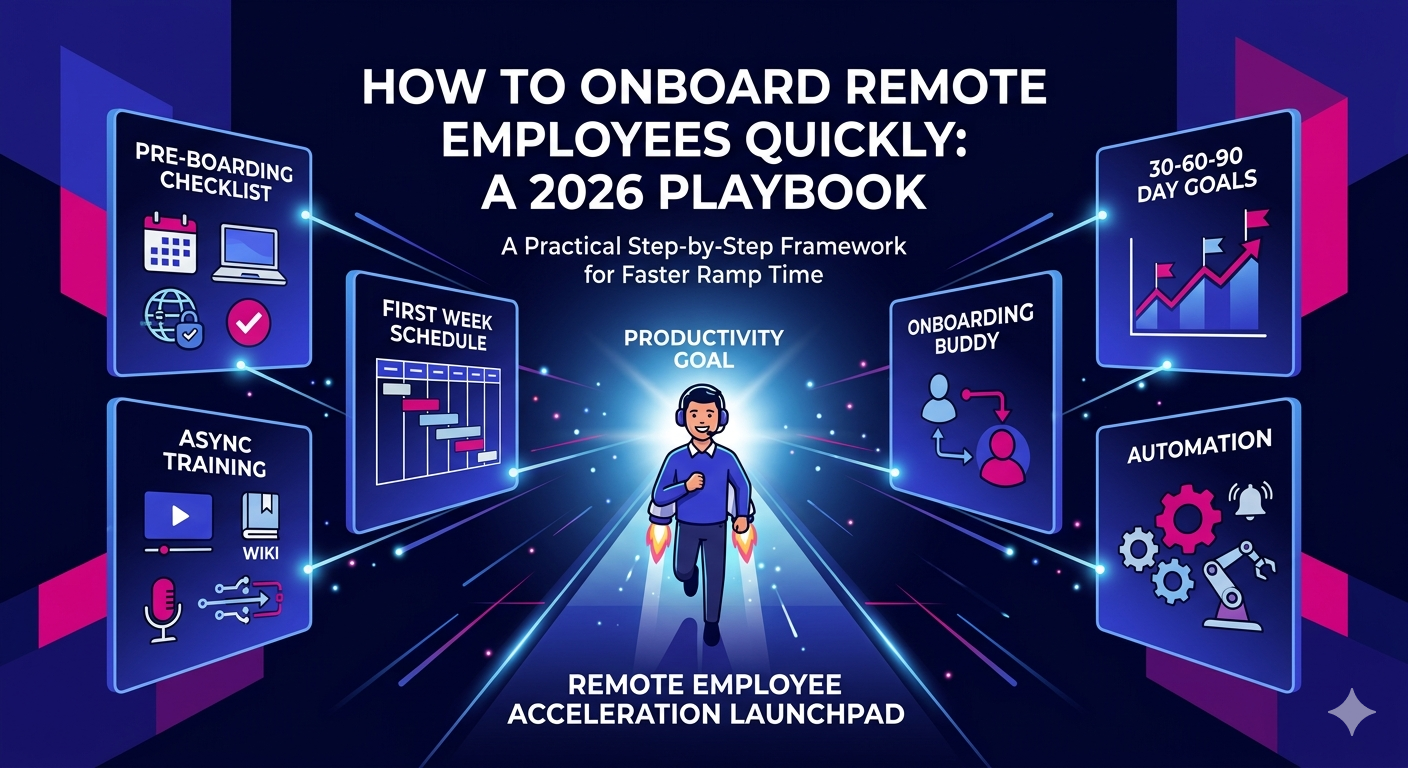
Knowing how to onboard remote employees quickly is one of the most valuable skills a growing company can develop. A slow, disorganized onboarding experience costs you productivity, increases early turnover, and leaves new hires feeling disconnected before they have even started contributing. In 2026, with remote teams spanning multiple time zones and dozens of tools, getting onboarding right from day one is not optional. It is a competitive advantage.
This guide gives you a practical, step-by-step framework to onboard remote employees quickly, reduce ramp time, and build a strong foundation for long-term performance.
Why Fast Remote Employee Onboarding Matters More Than Ever
Research consistently shows that employees who go through a structured onboarding process are significantly more likely to stay with a company beyond their first year. For remote hires, the stakes are even higher. Without a physical office to anchor them, new remote employees rely almost entirely on their onboarding experience to understand your culture, tools, expectations, and team dynamics.
A poorly structured remote onboarding process leads to:
- Delayed productivity and missed ramp targets
- Confusion about roles, responsibilities, and communication norms
- Early disengagement and higher churn
- Increased management time spent on reactive problem-solving
Companies that figure out how to onboard remote employees quickly consistently see faster time-to-productivity, better retention, and stronger team cohesion across distributed teams.
Step 1: Build a Pre-Boarding Checklist Before Day One
Onboarding remote employees quickly starts before the employee ever logs in. Pre-boarding is the window between offer acceptance and the first official day, and it is where most companies lose momentum.
What to Complete During Pre-Boarding
- Send login credentials and tool access at least 48 hours before the start date
- Share a welcome email with a clear agenda for the first week
- Provide access to your employee handbook, brand guidelines, and internal wikis
- Assign a buddy or onboarding partner from the existing team
- Set up communication channels (Slack, Teams, email) and introduce the new hire in relevant group chats
When new hires arrive prepared on day one, you eliminate the dead time of waiting for system access and allow them to start absorbing information immediately.
Step 2: Structure the First Week with a Clear Schedule
One of the most effective ways to onboard remote employees quickly is to eliminate ambiguity from the first week entirely. New hires should not be wondering what to do next or who to ask. Every hour of the first three to five days should be mapped out in advance.
A Sample First-Week Remote Onboarding Schedule
- Day 1: Welcome call with manager, team introduction meeting, tool walkthrough
- Day 2: Role-specific training, review of KPIs and performance expectations, CRM or workflow orientation
- Day 3: Shadow calls or task observations with a senior team member
- Day 4: Independent task attempts with manager review and feedback
- Day 5: End-of-week check-in, open Q and A, 30-60-90 day goal setting
This structure keeps new remote employees engaged, reduces anxiety, and signals that your organization is prepared and professional.
Step 3: Use Async-First Training to Speed Up Learning
When you are trying to onboard remote employees quickly across time zones, live training sessions create scheduling bottlenecks. An async-first training approach lets new hires learn at their best hours and revisit material as needed without waiting for availability windows.
Best Tools for Async Remote Onboarding
- Loom or Vidyard for recorded walkthroughs of tools, processes, and culture
- Notion or Confluence for centralized documentation and SOPs
- Trainual or Guru for structured, role-specific training modules
- Slack or Teams channels dedicated to onboarding questions and resources
A well-built async training library means your remote employee onboarding process scales without adding management hours every time you hire. Build it once, refine it regularly, and deploy it consistently.
Step 4: Assign a Dedicated Onboarding Buddy
One of the fastest ways to onboard remote employees is to pair them with a peer, not just a manager. An onboarding buddy is an existing team member who serves as a go-to resource for informal questions, culture guidance, and day-to-day workflow context that does not always appear in documentation.
Buddy programs reduce the time managers spend answering repetitive questions, speed up social integration, and make new hires feel welcome in a distributed environment where casual hallway conversations do not exist.
What a Good Remote Onboarding Buddy Does
- Checks in daily during the first two weeks via message or short video call
- Answers informal questions without judgment
- Shares unwritten team norms, communication preferences, and cultural context
- Flags any confusion to the manager early before it becomes a performance issue
Step 5: Set Clear 30-60-90 Day Goals from the Start
Fast remote employee onboarding is not just about speed. It is about getting a new hire to meaningful contribution as efficiently as possible. That requires clarity on what success looks like at each stage.
A well-defined 30-60-90 day plan answers three questions:
- What should the employee learn in the first 30 days?
- What should they be doing independently by day 60?
- What results should they be producing by day 90?
Share this plan during the first week and revisit it in regular check-ins. It keeps remote employees focused, gives managers a clear coaching framework, and removes the ambiguity that slows down ramp time in distributed teams.
Step 6: Automate Repetitive Onboarding Tasks
If your team is manually sending welcome emails, setting up accounts, and sharing documents one by one every time you hire, you are wasting hours that could be spent on high-value coaching. Automation is essential for companies that want to scale their ability to onboard remote employees quickly.
Onboarding Tasks Worth Automating
- Account provisioning for tools and software via IT management platforms
- Welcome email sequences triggered on the hire start date
- Training module assignments in your LMS or documentation tool
- Calendar invitations for all first-week meetings and check-ins
- Slack or Teams notifications that introduce the new hire to relevant channels
Automation does not replace human connection in remote onboarding. It frees up the time your managers and buddies need to provide that human connection effectively.
How to Onboard Remote Employees Quickly Without Sacrificing Culture
Speed matters, but culture fit and team cohesion matter just as much for long-term retention. Here is how to move fast without losing the human side of onboarding:
- Schedule a virtual team coffee or casual video call in the first week with no agenda
- Create a digital welcome from the leadership team or founder
- Celebrate the new hire’s first win publicly in team channels
- Share your company’s values documentation and ask the new hire for their reactions
- Send a welcome kit by mail if budget allows, branded merchandise builds belonging fast
Onboarding remote employees quickly becomes far easier when you have a reliable team already in place. If you are scaling a remote sales or marketing function and want a team that arrives pre-vetted and ready to contribute, explore how The Remote Reps virtual assistant services can accelerate your onboarding and delegation workflows from the start.
For additional benchmarks and best practices on building structured remote onboarding programs, the Society for Human Resource Management’s guide to onboarding remote employees is one of the most authoritative resources available.
FAQ: How to Onboard Remote Employees Quickly
What is the fastest way to onboard remote employees quickly?
The fastest way to onboard remote employees quickly is to combine pre-boarding preparation, a structured first-week schedule, and async training resources. When new hires have access to tools, documentation, and clear goals before day one, they can reach productivity in days rather than weeks.
How long should it take to onboard remote employees quickly and effectively?
A well-designed remote onboarding process should bring most employees to functional independence within 30 days and full productivity within 60 to 90 days. If you want to onboard remote employees quickly without cutting corners, aim for a structured 30-day ramp with clear milestones at each stage.
What tools help companies onboard remote employees quickly?
The best tools for onboarding remote employees quickly include Notion or Confluence for documentation, Loom for async video training, Slack or Microsoft Teams for communication, and platforms like Trainual or Guru for structured role-based learning modules. Automating account provisioning with tools like Rippling or Okta also speeds up the process significantly.
How do you onboard remote employees quickly without losing culture?
To onboard remote employees quickly while preserving culture, build human touchpoints into the process from the start. Virtual coffee chats, a dedicated onboarding buddy, a digital welcome from leadership, and public recognition of early wins all help new remote hires feel connected without slowing down ramp time.
What should a remote employee onboarding checklist include?
A remote employee onboarding checklist for quick ramp-up should include: tool and system access before day one, a structured first-week schedule, an assigned onboarding buddy, async training resources, a 30-60-90 day goal plan, and at least one informal team connection activity in the first week.
Why do remote employees struggle when companies fail to onboard them quickly?
When companies do not onboard remote employees quickly or effectively, new hires feel isolated, confused about expectations, and unsure of their role in the team. This leads to slower productivity, reduced confidence, and significantly higher early turnover, all of which cost more time and money than a well-built onboarding process would have required.