
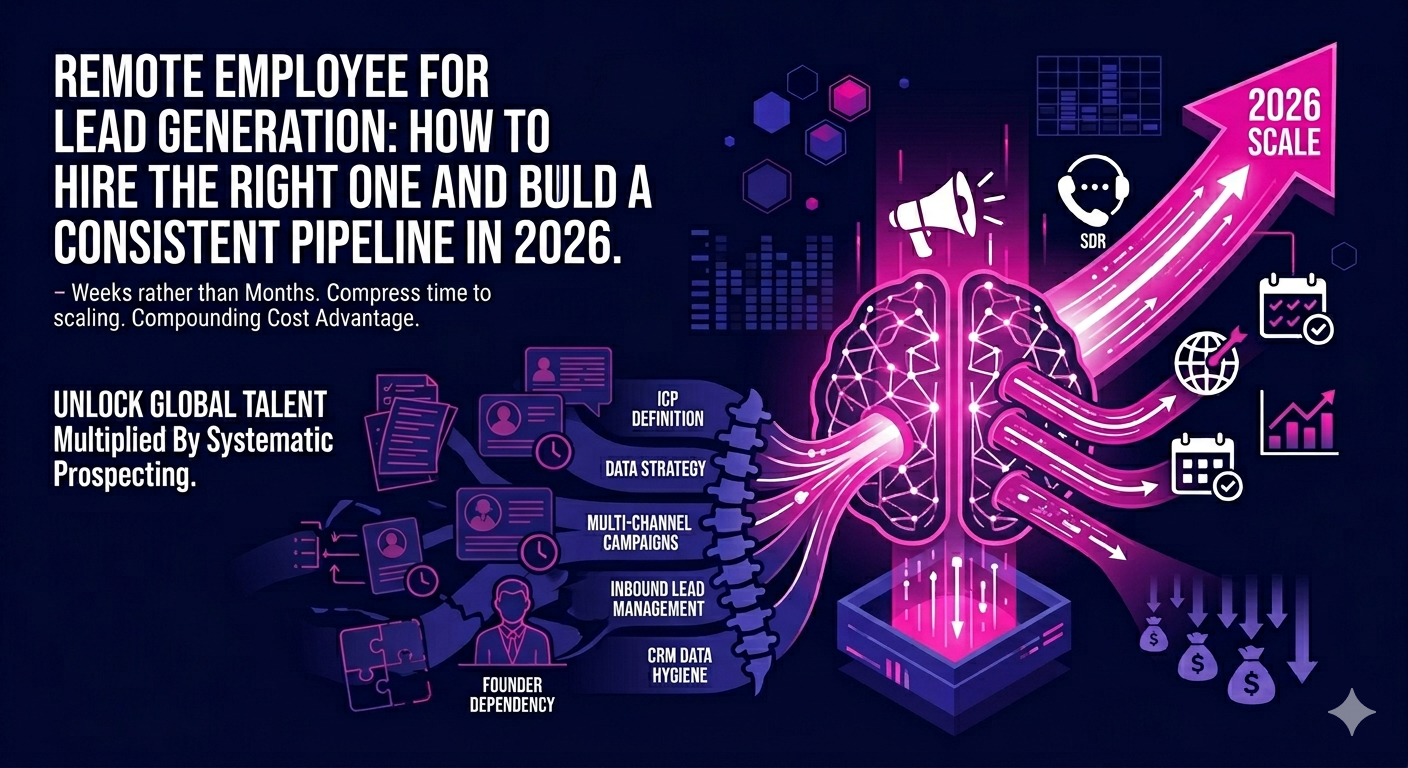
An inconsistent sales pipeline is one of the most dangerous operational problems a B2B business can face. When your revenue depends on a steady flow of qualified prospects entering your funnel, and that flow is irregular, unpredictable, or entirely dependent on your founders’ own outreach efforts, you have a growth constraint that no amount of sales talent can fully compensate for. In 2026, the most cost-effective and rapidly deployable solution to this problem is to hire a dedicated remote employee for lead generation who builds, manages, and continuously optimizes your top-of-funnel prospecting process so your sales team always has qualified opportunities to pursue.
This guide covers everything you need to know about hiring a remote employee for lead generation: what this role involves, how it differs from an SDR, what skills and experience to evaluate, how much it costs, and how to build a working relationship that produces consistent, high-quality pipeline for your business every week.
What Is a Remote Employee for Lead Generation and Why Does Your Business Need One?
A remote employee for lead generation is a dedicated professional who works full-time or part-time exclusively for your business from a remote location, focused entirely on building and managing the prospecting infrastructure and outreach activity that generates qualified leads for your sales team. Unlike a sales development representative whose primary output is booked meetings, a remote lead generation employee has a broader mandate that spans data strategy, CRM management, multi-channel campaign coordination, and the systematic identification of prospects most likely to convert into valuable customers.
Your business needs a dedicated remote employee for lead generation when your pipeline is too thin, too inconsistent, or too dependent on your founders’ or account executives’ personal networks to sustain predictable revenue growth. At that point, the question is not whether you should build a lead generation function. It is whether you should do it in-house at full domestic salary cost or through a cost-efficient dedicated remote model that delivers the same output quality at a fraction of the overhead.
Remote Lead Generation Employee vs. Remote SDR
- Remote employee for lead generation: Broader operational scope covering ICP definition, prospect database building, multi-channel campaign strategy, inbound lead management, CRM data hygiene, lead scoring, and performance reporting across all lead generation channels
- Remote SDR: More focused on direct outbound execution: working through prospect lists, making cold calls, sending cold emails, conducting LinkedIn outreach, qualifying initial conversations, and booking discovery meetings
Many businesses start by hiring a remote employee for lead generation who also handles some outbound SDR execution, and then separate the two functions as pipeline volume grows and the complexity of each justifies dedicated headcount for both.
What Does a Remote Employee for Lead Generation Do Every Day?
The daily work of a remote lead generation employee spans research, data management, campaign coordination, and performance optimization across multiple channels. Here is a comprehensive breakdown of what this role handles.
Prospect Research and Database Management
- Building and maintaining targeted prospect lists based on your ideal customer profile using tools such as Apollo, ZoomInfo, LinkedIn Sales Navigator, and Lusha
- Enriching contact records with firmographic, technographic, and intent data to improve targeting accuracy and personalization relevance
- Maintaining CRM data quality including deduplication, contact validation, and record completeness
- Segmenting prospect databases by industry, company size, geography, buying stage, and any other dimensions relevant to your go-to-market strategy
- Continuously refining the ICP definition based on what conversion data shows about which prospect types actually become customers
Outbound Campaign Management
- Setting up and managing email outreach sequences in platforms such as Apollo, Instantly, Outreach, or Salesloft
- Coordinating LinkedIn outreach campaigns including connection request messaging, follow-up sequences, and InMail strategy
- Managing cold calling campaigns with organized call lists, call scripts, and performance tracking
- Monitoring outreach performance metrics including delivery rates, open rates, reply rates, and conversation conversion rates
- Testing and iterating on messaging, subject lines, and outreach timing based on response data
Inbound Lead Management and Qualification
- Managing inbound lead capture and routing processes to ensure every new inquiry is responded to within defined time windows
- Implementing and managing lead scoring models that prioritize the highest-value inbound inquiries for immediate sales follow-up
- Qualifying inbound leads against defined criteria before routing to sales team members
- Coordinating lead nurture workflows for prospects who are not yet ready for a sales conversation
Performance Reporting and Pipeline Analytics
- Delivering weekly reports on lead volume, lead quality, cost per lead, channel performance, and pipeline contribution
- Tracking lead-to-opportunity conversion rates to identify which sources and qualification criteria predict the highest-value pipeline
- Identifying underperforming channels or targeting approaches and recommending evidence-based adjustments
- Maintaining accurate pipeline forecast data that gives revenue leaders confidence in the company’s growth trajectory
Why Hiring a Remote Employee for Lead Generation Delivers Exceptional Value in 2026
The business case for a dedicated remote lead generation employee is compelling across multiple dimensions. Here is the full argument for making this hire rather than leaving lead generation to part-time attention from existing team members or hoping inbound alone will sustain your pipeline.
Consistency Over Dependency
The most valuable thing a remote employee for lead generation delivers is not any single lead or campaign. It is the systematic, daily execution of a prospecting process that generates a consistent flow of qualified opportunities regardless of whether your founders, sales reps, or account executives are having a busy or quiet week. Pipeline consistency is the foundation of revenue predictability, and a dedicated lead generation employee is the most direct investment in that consistency available to a growing business.
Cost Efficiency That Expands Your Pipeline Budget
A full-time in-house lead generation specialist in the United States in 2026 costs $65,000 to $95,000 per year in base salary plus benefits and overhead, totaling $85,000 to $125,000 fully loaded. A dedicated remote employee for lead generation placed through a quality offshore staffing partner costs $18,000 to $48,000 per year, generating annual savings of $50,000 to $80,000 that can be reinvested directly into prospecting tool subscriptions, paid lead generation, or additional pipeline capacity. That cost advantage allows businesses to staff a more capable lead generation function for the same budget that would be consumed by a single domestic hire.
Access to Global Prospecting Talent
Lead generation expertise, like most digital skills, is globally distributed. Skilled remote lead generation professionals in Latin America, the Philippines, Eastern Europe, and South Africa bring the same prospecting methodology, tool proficiency, and analytical rigor as domestic equivalents. When you hire a remote employee for lead generation through a specialist staffing partner, you access that global talent pool at competitive rates without geographic constraints limiting your options.
Faster Pipeline Building Than DIY Lead Generation
Building a lead generation function from scratch while simultaneously running a business is slow and frequently deprioritized when other urgent demands compete for the founder’s attention. A dedicated remote employee for lead generation focuses entirely on building your pipeline every day without competing priorities. That full-time focus compresses the time from decision to qualified leads in your CRM significantly compared to the gradual, inconsistent pace of lead generation handled as a side responsibility.
What to Look for When Hiring a Remote Employee for Lead Generation
The qualities that define a high-performing remote lead generation employee are specific and worth evaluating rigorously before making a hire. Here is what to assess.
Essential Tool Proficiency
- Hands-on experience with prospecting databases including Apollo, ZoomInfo, LinkedIn Sales Navigator, Lusha, or Clearbit
- Experience with email sequencing and outreach automation platforms such as Outreach, Instantly, Lemlist, or Salesloft
- Strong CRM proficiency in Salesforce, HubSpot, or Pipedrive including data management, lead routing, and pipeline reporting
- Familiarity with LinkedIn and Sales Navigator for social prospecting and relationship-based lead generation
- Experience with lead enrichment and data validation tools to maintain list quality over time
Strategic and Analytical Capability
- Ability to define, refine, and apply ideal customer profile criteria to prospect targeting
- Experience developing multi-channel lead generation strategies that balance inbound and outbound approaches
- Demonstrated ability to analyze lead performance data and make evidence-based optimization recommendations
- Experience with lead scoring methodology and the ability to implement or refine scoring models
- Comfort writing outreach messaging that is clear, personalized, and generates above-average response rates
Documented Pipeline Contribution Evidence
Ask every candidate for specific, measurable evidence of the pipeline they have built in previous roles. What was the weekly or monthly qualified lead volume they generated? What channels produced the highest quality leads? What was the cost per qualified lead? What percentage of leads they sourced converted into active sales opportunities or closed revenue? Candidates who can answer these questions with specific data are demonstrating the kind of performance evidence that predicts strong results in your lead generation role.
How Much Does a Remote Employee for Lead Generation Cost in 2026?
Monthly investment levels for a dedicated remote lead generation employee placed through a quality offshore staffing partner in 2026 typically include:
- Entry to mid-level remote lead generation employee: $1,200 to $2,500 per month for candidates with 1 to 3 years of experience in prospect research, list building, email outreach, and CRM management
- Experienced remote lead generation specialist: $2,500 to $4,000 per month for candidates with 3 to 6 years of multi-channel lead generation experience and documented pipeline contribution results
- Senior remote lead generation strategist: $4,000 to $6,000 per month for highly experienced professionals capable of owning the full lead generation function including strategy, technology management, and team coordination
These rates generate annual savings of $50,000 to $80,000 or more compared to equivalent domestic hires, with no compromise on pipeline output quality when the hiring and management are executed properly.
When you are ready to hire a remote employee for lead generation who can build the consistent pipeline your business needs, explore The Remote Reps’ dedicated remote lead generation specialist placement service. You can also complement your remote lead generation employee with a remote SDR to execute outbound outreach on the lists they build, or a remote cold email expert to optimize the sequences that drive your outbound conversion rates.
How to Set Up Your Remote Lead Generation Employee for Maximum Output
Getting strong pipeline results from a remote lead generation employee requires deliberate setup before they start and consistent management throughout the engagement.
Define Your ICP and Targeting Criteria Before Hiring
Your remote lead generation employee can only target the right prospects if you have given them a precisely documented ideal customer profile. Define your target company attributes, buying persona titles, the pain points your product solves, and any signals that indicate a company is an ideal candidate for your outreach. The more specific this definition, the more accurately your lead generation employee can build targeted lists and personalize outreach for genuine relevance.
Establish the Technology Stack and Access Before Day One
Grant your remote lead generation employee access to all relevant tools and systems before they start: your CRM, your prospecting database, your email sequencing platform, your LinkedIn account or Sales Navigator license, and any analytics tools they will use for reporting. Confirming access on day one rather than spending the first week on logistics dramatically accelerates time to productive prospecting.
Set Clear Weekly KPIs and Review Them Consistently
Define specific, measurable performance indicators from the start: weekly new prospects added to the database, outreach sequences launched, reply rate targets, qualified leads delivered, and cost per lead. Review these metrics in a structured weekly meeting and use them to identify what is working, what needs adjustment, and what new approaches are worth testing. This cadence of measurement and feedback is what turns a capable remote lead generation employee into a continuously improving pipeline engine.
According to HubSpot’s State of Marketing data on remote employee lead generation performance and B2B pipeline building, companies with dedicated lead generation professionals managing their top-of-funnel prospecting consistently generate higher lead volumes, better lead-to-opportunity conversion rates, and more predictable revenue growth than those relying on ad-hoc or part-time prospecting approaches across their existing team.
Complementary Roles That Amplify Your Remote Lead Generation Employee’s Output
A remote lead generation employee handles top-of-funnel prospecting infrastructure. Pairing them with complementary roles creates a complete, self-reinforcing revenue pipeline. Consider adding:
- Remote SDRs to execute outbound outreach and book discovery calls from the prospect lists your lead generation employee builds
- Remote cold email experts to design, test, and continuously improve the email sequences that drive response rates
- Remote GTM engineers to build and automate the technical infrastructure that makes your lead generation workflows faster and more reliable
- Remote digital marketers to run inbound content and paid campaigns that generate warm inbound leads alongside your outbound function
- Remote sales representatives to close the qualified opportunities your lead generation employee and SDR team deliver to the pipeline
Conclusion: Hire a Remote Employee for Lead Generation and Build the Pipeline Your Business Needs to Grow in 2026
Predictable revenue growth requires a predictable pipeline, and a predictable pipeline requires a dedicated professional focused entirely on building it. In 2026, a remote employee for lead generation is the most cost-effective, fastest-to-deploy, and highest-return investment you can make in solving your pipeline problem. The leads they generate in the next 60 days are the revenue your business closes in the next 6 to 12 months.
The Remote Reps places pre-vetted remote lead generation employees for B2B businesses across every industry. Our candidates are assessed for real tool proficiency, real pipeline contribution results, and the systematic discipline that consistent lead generation requires.
Read what our clients say about the pipeline results they have achieved through The Remote Reps, or visit theremotereps.com to start your remote lead generation hire today.
FAQ: Remote Employee for Lead Generation
What is a remote employee for lead generation and how is the role different from an SDR?
A remote employee for lead generation has a broader operational scope than a sales development representative. While an SDR focuses primarily on direct outbound prospecting execution, booking meetings, and qualifying initial conversations, a remote lead generation employee manages the full top-of-funnel infrastructure: building and maintaining prospect databases, designing and managing multi-channel outreach campaigns, handling inbound lead qualification and routing, maintaining CRM data quality, and reporting on pipeline performance across all channels. Many businesses start with a single remote employee for lead generation who handles both the infrastructure and some outbound execution, and later separate the functions as pipeline volume grows.
How much does it cost to hire a remote employee for lead generation in 2026?
A dedicated remote employee for lead generation placed through a specialist offshore staffing partner in 2026 typically costs between $1,200 and $6,000 per month depending on experience level. Entry-level candidates with 1 to 3 years of experience cost $1,200 to $2,500 per month. Experienced lead generation specialists with 3 to 6 years of multi-channel experience fall in the $2,500 to $4,000 range. Senior lead generation strategists capable of owning the full function are priced at $4,000 to $6,000 per month. These rates generate annual savings of $50,000 to $80,000 compared to equivalent domestic hires when total employment costs are factored in.
How many qualified leads can a remote lead generation employee generate per month?
Monthly lead volume from a remote employee for lead generation depends on your target market, ICP definition, outreach channels, and product offer. In B2B markets, a skilled remote lead generation employee working a defined multi-channel strategy typically generates between 40 and 200 qualified leads per month depending on the breadth of the target market and the volume of outreach executed. Lead quality, measured by lead-to-opportunity conversion rate, is more important than raw volume, and the best remote lead generation employees continuously optimize their targeting and messaging to improve conversion rates alongside volume.
What tools does a remote employee for lead generation need?
A productive remote employee for lead generation needs access to your CRM for lead management and pipeline reporting; a prospecting database such as Apollo, ZoomInfo, or LinkedIn Sales Navigator for contact and company research; an email sequencing platform such as Outreach, Instantly, or Lemlist for outbound campaign management; LinkedIn and ideally LinkedIn Sales Navigator for social prospecting; a data enrichment tool for maintaining list accuracy; and a communication platform such as Slack for team coordination. Confirm tool access before your remote lead generation employee’s first day to ensure they can begin productive prospecting immediately without onboarding delays.
How long does it take for a remote lead generation employee to start delivering pipeline results?
Most remote employees for lead generation begin generating measurable pipeline contribution within 3 to 6 weeks of launch. The first 1 to 2 weeks typically involve ICP refinement, tool setup, initial list building, and campaign architecture. From week 3 onward, active outreach begins and the first qualified leads start entering the pipeline. Full campaign optimization, where response rates, lead quality, and conversion rates have been refined through multiple testing cycles, typically takes 60 to 90 days to reach a consistent, high-performing steady state. Setting this realistic expectation upfront prevents premature disappointment and ensures the lead generation function is given the time it needs to reach its potential.
How should I manage a remote employee for lead generation to ensure consistent output?
Effective management of a remote employee for lead generation requires three core practices applied consistently. First, set clear weekly KPIs covering prospect volume added, outreach activity, reply rates, and qualified leads delivered, and review these metrics in a structured weekly meeting. Second, use CRM reporting and outreach platform analytics to track performance data in real time so you can identify issues or opportunities as they emerge rather than at month-end. Third, provide regular feedback on lead quality based on what your sales team reports about the prospects they receive, and use that feedback to continuously refine targeting criteria, messaging, and channel strategy. Remote lead generation employees who receive this level of structured management consistently outperform those left to operate without regular performance dialogue and strategic guidance.