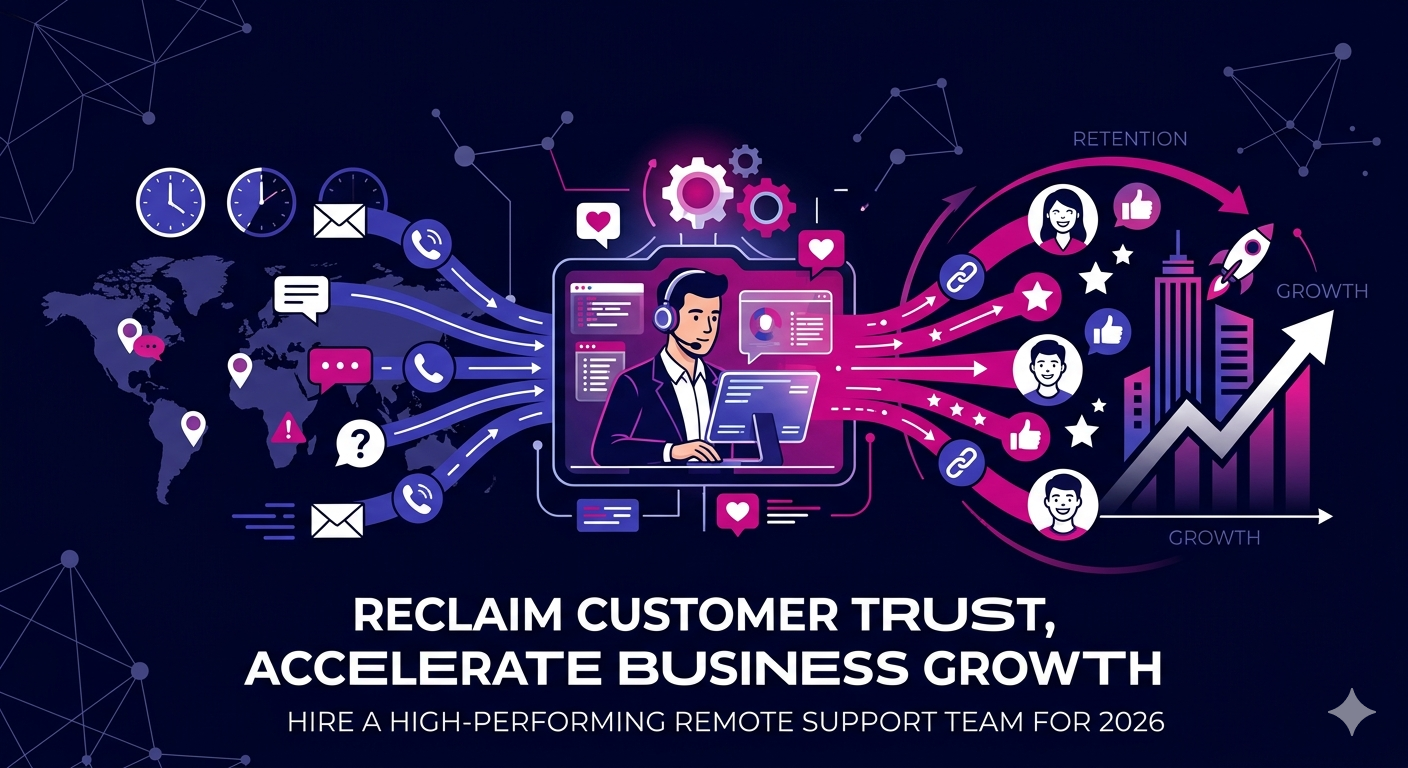
Customer experience is the single most powerful driver of retention, referrals, and long-term revenue growth. In 2026, the businesses winning on customer experience are not necessarily the ones with the largest support budgets. They are the ones that made the smart decision to hire a skilled remote customer support agent and build a support function that is responsive, empathetic, and available when customers need it most. Whether you are fielding your first wave of customer inquiries or scaling a growing support operation, understanding how to hire and manage a high-performing remote customer support agent is one of the most impactful investments you can make in your business right now.
This guide covers everything you need to know: what a remote customer support agent does, what qualities separate great candidates from average ones, how much it costs, and how to build a remote support function that consistently delivers exceptional customer experiences.
What Does a Remote Customer Support Agent Do?
A remote customer support agent handles all customer-facing communications on behalf of your business from a remote location. They use helpdesk software, live chat platforms, email, and phone systems to receive, manage, and resolve customer inquiries, complaints, and requests. Their goal is to ensure that every customer interaction leaves the customer feeling heard, helped, and valued, regardless of the nature of their issue.
The remote model does not limit what a customer support agent can accomplish. It changes where they work from. A skilled remote customer support agent who is properly trained and well-equipped delivers the same quality of customer experience as an in-office agent, often at significantly lower cost and with greater scheduling flexibility for your business.
Core Responsibilities of a Remote Customer Support Agent
- Responding to inbound customer inquiries via email, live chat, phone, and social media channels
- Diagnosing and resolving product or service issues accurately and efficiently
- Escalating complex technical or billing issues to the appropriate internal teams
- Maintaining accurate records of all customer interactions in your helpdesk or CRM system
- Processing refunds, replacements, cancellations, and account changes in line with company policy
- Following up with customers to confirm issue resolution and satisfaction
- Identifying patterns in recurring customer issues and flagging them to product or operations teams
- Maintaining knowledge base articles, FAQs, and internal documentation
- Achieving and sustaining defined response time, resolution rate, and customer satisfaction targets
- Representing your brand with professionalism, patience, and genuine care in every interaction
Why Hiring a Remote Customer Support Agent Makes Strong Business Sense in 2026
The shift to remote customer support has been one of the most widespread and successful transformations in business operations over the past several years. In 2026, the evidence is clear: remote customer support agents deliver excellent results for businesses that hire and manage them well. Here is why the model makes such strong business sense.
Significant Cost Reduction Without Sacrificing Quality
A full-time in-house customer support agent in the United States in 2026 costs between $42,000 and $65,000 per year in base salary, plus an additional 20 to 35 percent in benefits, payroll taxes, equipment, and office overhead. When you hire a remote customer support agent through a specialist offshore staffing partner, you access equivalent or superior talent at 40 to 65 percent lower total cost. For businesses managing high inquiry volumes across multiple channels, those savings allow you to staff more agents, cover more hours, and deliver faster response times without proportionally increasing your support budget.
Extended Coverage Hours and Time Zone Advantages
Customers do not confine their support needs to your local business hours. A remote customer support agent based in a different time zone can extend your coverage window naturally, allowing you to serve customers in the early morning, evening, or overnight periods that would otherwise require expensive shift premiums for local hires. With strategically placed remote agents, many businesses achieve 16 to 24 hours of daily coverage at a cost that is far more sustainable than a traditional around-the-clock in-office model.
Access to a Larger, More Diverse Talent Pool
Customer support excellence requires specific qualities: patience, empathy, clear communication, problem-solving ability, and resilience under pressure. These qualities are not restricted to candidates within commuting distance of your office. When you open your search to remote candidates globally, you access a far wider pool of people with exactly these attributes, often combined with multilingual capabilities that allow you to serve customers in multiple languages without the premium cost of local bilingual hires.
Scalability to Match Demand
Customer inquiry volumes are rarely constant. Seasonal spikes, product launches, marketing campaigns, and unforeseen issues can suddenly triple your inbound support volume. Hiring a remote customer support agent through a staffing partner gives you the ability to scale your support capacity up or down much faster than traditional in-house recruitment allows. You can add agents within weeks during peak periods and right-size the team when demand normalizes.
Reduced Attrition and Continuity of Service
Remote customer support roles, when they offer genuine flexibility, competitive compensation within the candidate’s local market, and a positive work culture, tend to attract professionals who stay longer than their in-office counterparts. A specialist remote staffing partner places candidates who are specifically seeking stable, long-term remote engagements. That stability translates directly into better product knowledge, stronger customer relationships, and more consistent service quality over time.
What to Look for When You Hire a Remote Customer Support Agent
The qualities that define an exceptional remote customer support agent go beyond basic communication skills. Here is what to assess to ensure every hire meets the standard your customers deserve.
Essential Communication Skills
- Clear, professional written English with strong grammar, tone control, and empathy
- Confident verbal communication for phone and live chat interactions
- Ability to adapt tone and language to different customer personalities and emotional states
- Skill in de-escalating frustrated or upset customers without becoming defensive
- Precision in documenting interactions accurately and completely in your helpdesk system
Technical Proficiency and Tool Familiarity
- Experience with helpdesk platforms such as Zendesk, Freshdesk, HubSpot Service Hub, or Intercom
- Familiarity with live chat tools and ticketing queue management systems
- Comfort with CRM platforms for customer account lookup and history review
- Basic troubleshooting ability for common software, e-commerce, or SaaS issues relevant to your product
- Proficiency with collaboration tools such as Slack, Zoom, and Google Workspace
Personal Attributes That Drive Support Excellence
- Genuine patience and empathy with customers in distress or frustration
- Strong problem-solving instincts and the resourcefulness to find solutions independently
- Resilience and emotional stability in high-volume, high-pressure environments
- Meticulous attention to detail to ensure accurate information and complete follow-through
- Accountability and the motivation to hit response time, resolution, and satisfaction targets consistently
- Reliability, punctuality, and professional conduct at all times
Remote Work Readiness
- A stable, high-speed internet connection suitable for live chat and phone interactions
- A quiet, professional home office environment free from background noise during customer calls
- Experience working independently in a remote environment with minimal supervision
- Proactive communication about technical issues, high-volume periods, or escalating customer concerns
How Much Does a Remote Customer Support Agent Cost in 2026?
Cost varies based on experience level, language requirements, and the talent market the candidate is sourced from. The following ranges reflect typical monthly investment levels for dedicated remote customer support agents placed through an offshore staffing specialist in 2026:
- Entry-level remote customer support agent: $800 to $1,600 per month for candidates with foundational support experience handling standard inquiry volumes
- Mid-level remote customer support agent: $1,600 to $2,800 per month for experienced agents with strong helpdesk tool proficiency and a track record of high CSAT scores
- Senior or specialist remote customer support agent: $2,800 to $4,500 per month for agents with technical product knowledge, team lead experience, or specialized industry expertise
At every tier, these rates represent exceptional value relative to the fully loaded cost of equivalent in-office hires in the United States or Western Europe, generating per-agent annual savings of $25,000 to $55,000 or more depending on the role level and local market comparison.
How to Set Up Your Remote Customer Support Agent for Success
Hiring the right remote customer support agent is the first step. The onboarding and management experience you provide determines how quickly they reach their potential and how long they stay. Here is a proven framework for setting your remote support agent up to deliver excellent results from day one.
Week One: Product, Policy, and Tool Immersion
Walk your remote customer support agent through your product or service in detail, your support policies and escalation procedures, the helpdesk and communication tools they will use, and your brand voice guidelines for customer communications. Provide them with a knowledge base, a set of templated responses for common inquiry types, and access to all relevant systems. The more comprehensive this foundation, the faster they will handle real customer interactions confidently and accurately.
Week Two: Supervised Practice and Feedback
Have your remote customer support agent begin handling real customer inquiries under close supervision. Review their responses before they are sent where practical and provide specific, constructive feedback on tone, accuracy, and resolution quality. This supervised practice period is invaluable for identifying knowledge gaps, refining responses, and building the agent’s confidence before they work fully independently.
Week Three and Four: Independent Operation and Metric Tracking
By week three, your remote customer support agent should be handling their full ticket queue independently. Begin tracking formal performance metrics including first response time, average resolution time, first contact resolution rate, and customer satisfaction (CSAT) scores. Hold a weekly one-on-one to review these metrics, recognize strong performance, and address any recurring issues before they become patterns.
Ongoing: Continuous Development and Knowledge Sharing
Great remote customer support agents grow in capability over time when they are given opportunities to deepen their product knowledge, expand their troubleshooting skills, and contribute to knowledge base improvements. Invest in your remote support agents as professionals, not just ticket handlers, and you will build a support function that becomes a genuine competitive advantage for your business.
At The Remote Reps, we specialize in placing pre-vetted remote customer support agents with the communication skills, tool proficiency, and professional discipline that high-quality customer experience demands. If you are also looking to expand your broader remote team, you can explore our full range of remote staffing services including remote virtual assistants and remote executive assistants to support your operations at every level.
Tools Your Remote Customer Support Agent Needs to Perform at Their Best
Equipping your remote customer support agent with the right tools from day one is essential for productivity, quality, and data integrity. At minimum, your remote support agent should have access to:
- A helpdesk or ticketing platform such as Zendesk, Freshdesk, or HubSpot Service Hub
- A live chat tool such as Intercom, Drift, or Tidio for real-time customer conversations
- Your CRM system for customer account history, purchase records, and previous interaction logs
- A business phone or VoIP system such as RingCentral or Aircall for phone support channels
- A knowledge base platform where policies, product information, and standard responses are documented
- A team communication platform such as Slack for internal escalation, collaboration, and daily check-ins
- A video conferencing tool such as Zoom or Google Meet for team meetings and supervisor check-ins
Confirming tool access and providing clear login instructions before your remote customer support agent’s first day prevents avoidable productivity delays during the critical early weeks of the engagement.
According to Salesforce’s State of Service report on remote customer support agent performance and customer expectations, customers in 2026 rank response speed, issue resolution on first contact, and agent empathy as the top three drivers of satisfaction with support interactions. A well-hired and well-managed remote customer support agent delivers on all three of these priorities consistently.
Complementary Roles to Pair with Your Remote Customer Support Agent
A remote customer support agent focuses on reactive, inbound customer communication. Many businesses find that pairing their support function with complementary remote roles creates a more complete customer experience ecosystem. Consider adding:
- Remote virtual assistants to handle administrative tasks that free your support agents to focus purely on customer interactions
- Remote e-commerce marketing experts to reduce the volume of support inquiries through clearer product listings, better FAQs, and proactive customer communications
- Remote Amazon experts for businesses selling on marketplace platforms where seller support and review management are critical to performance
- Remote lead generation specialists to convert satisfied customers into referral sources and upsell opportunities through proactive outreach
Conclusion: A Remote Customer Support Agent Is One of the Smartest Hires Your Business Can Make in 2026
Customer experience is not a department. It is a business strategy. In 2026, the businesses that win on customer loyalty are the ones that invest in skilled, empathetic, well-supported remote customer support agents who treat every customer interaction as an opportunity to build lasting trust. With the right hire, the right tools, and the right management practices, a remote customer support agent delivers more value per dollar than almost any other role you can add to your team.
The Remote Reps places pre-vetted remote customer support agents for businesses across e-commerce, SaaS, professional services, and beyond. Our candidates are assessed for real communication skills, real tool proficiency, and the remote work discipline that sustained support excellence requires.
Read what our clients say about the customer experience results they have achieved through The Remote Reps, or visit theremotereps.com to start building your remote customer support team today.
FAQ: Remote Customer Support Agent
What is a remote customer support agent and how do they differ from an in-office agent?
A remote customer support agent performs the same core functions as a traditional in-office support agent: handling customer inquiries, resolving issues, processing requests, and maintaining high satisfaction scores. The key difference is that they work from their own location using cloud-based helpdesk software, live chat platforms, and communication tools. In 2026, the remote model is widely recognized as equally effective to in-office support when the agent is properly vetted, equipped, and managed, with the added advantages of lower cost, greater scheduling flexibility, and access to a larger talent pool.
How much does it cost to hire a remote customer support agent in 2026?
The cost of a dedicated remote customer support agent in 2026 ranges from approximately $800 to $4,500 per month depending on experience level and specialization. Entry-level agents handling standard inquiry volumes typically cost $800 to $1,600 per month, while experienced senior agents with strong CSAT track records and technical product knowledge fall in the $2,800 to $4,500 range. These rates represent savings of 40 to 65 percent compared to the fully loaded cost of equivalent in-office agents in the United States, generating per-agent annual savings of $25,000 to $55,000 or more.
Can a remote customer support agent handle phone calls effectively from a different country?
Yes. VoIP technology in 2026 makes phone-based customer support entirely location-independent. A remote customer support agent using a platform such as RingCentral, Aircall, or Dialpad can handle inbound and outbound customer calls with the same audio quality and system functionality as an in-office agent. The key requirements are a stable, high-speed internet connection, a noise-cancelling headset, and a quiet professional home office environment. Many remote customer support agents in offshore markets specifically select their setup to support high-quality voice interactions as a core part of their professional capability.
How do I measure the performance of a remote customer support agent?
The key performance metrics for a remote customer support agent are the same as for in-office agents. The most important metrics to track include first response time (how quickly the agent responds to a new inquiry), average resolution time (how long it takes to fully resolve an issue), first contact resolution rate (the percentage of issues resolved without requiring a follow-up), customer satisfaction score (CSAT) gathered through post-interaction surveys, and ticket volume handled per shift. Modern helpdesk platforms including Zendesk and Freshdesk generate these metrics automatically, giving you full visibility into your remote agent’s performance in real time.
How do I ensure my remote customer support agent accurately represents my brand voice?
Brand voice consistency starts with onboarding. Provide your remote customer support agent with a detailed communication style guide covering your preferred tone, key phrases, language to avoid, and examples of ideal responses across common inquiry types. Include examples of both excellent and poor responses and explain why each falls into its category. Build a library of approved templated responses for your most frequent inquiry types that the agent can personalize and deploy. Review early interactions closely and provide specific feedback on tone and brand alignment. Over time, a well-briefed remote customer support agent will internalize your brand voice and apply it naturally across every customer interaction.
What industries benefit most from hiring a remote customer support agent?
Almost every business with a customer base benefits from hiring a remote customer support agent, but the industries that see the strongest ROI include e-commerce and direct-to-consumer brands with high order and inquiry volumes, SaaS companies managing subscription customer relationships, marketplace sellers on platforms like Amazon and Etsy, financial services and fintech businesses with regulated but high-volume client communications, healthcare and wellness brands with sensitive customer inquiry needs, and professional services firms where client communication quality directly impacts retention. If your business generates customer inquiries at any meaningful volume, a remote customer support agent is a high-value hire.